The Kurdish Digital Library (BNK)
Retour au resultats
Imprimer cette page

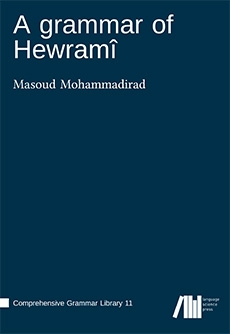
A grammar of Hewramî


Editor : Language Science Press Date & Place : 2026, Berlin
Preface : Pages : 546
Traduction : ISBN : 978-3-96110-543-4 & 978-3-98554-163-8
Language : EnglishFormat : 170x240 mm
FIKP's Code : Liv. Eng. Moh. Gra. N°Theme : Linguistics

A grammar of Hewramî

A grammar of Hewramî

Masoud Mohammadirad

Language Science Press

This book is a comprehensive grammatical description of the Hewramî variety of Tekht, grounded in current linguistic methodsHewramî is one of the most morphologically complex West Iranian languagesIt is spoken by several thousand people in the high mountainous Hewraman region situated between Iranian and Iraqi Kurdistan.
This work is primarily based on a corpus of 46 narratives, collected during several trips to the Hewraman region between 2016 and 2023This corpus was supplemented by elicitation tasks to provide a detailed account of the phonology, morphology, and syntax of HewramîAdditionally, the grammar touches on prosody and information structureThe analysis is grounded in linguistic theory, particularly informed by the functionaltypological approach.


Contents

Acknowledgments / xiii
Abbreviations / xv

1 Introduction / 1
1.1 Hewramî and its varieties / 1
1.2 The place of Hewramî within Iranian dialectology / 4
1.3 Hewraman Tekht / 7
1.4 The affiliation of Tekht Hewramî and its status within Hewramî dialectology / 8
1.5 Earlier research / 10
1.6 Fieldwork behind this study / 11
1.7 Main text corpus / 13
1.8 Folktale corpus / 16

2 Typological overview 19
2.1 Phonology / 19
2.2 Morphology / 21
2.3 Syntax / 27
2.3.1 Word order / 28
2.3.2 Alignment / 29
2.3.3 Grammatical relations / 31
2.3.3.1 Differential A indexing / 31
2.3.3.2 Differential P indexing / 33
2.3.3.3 Differential A flagging / 34
2.3.3.4 Differential P flagging / 36
2.3.3.5 Differential case marking on non-core arguments / 38

3 Phonetics, phonology, and morphophonology / 41
3.1 Phoneme inventory / 41
3.1.1 Vowel phonemes / 41
3.1.1.1 Description of vowels / 41
3.1.1.2 Phonetic realisation of vowels / 43
3.1.1.2.1 -i- / 44
3.1.1.2.2 -e- / 45
3.1.1.2.3 -æ- / 45
3.1.1.2.4 -ɛ- / 47
3.1.1.2.5 -ɑ- / 49
3.1.1.2.6 -o- / 50
3.1.1.2.7 -u- / 51
3.1.1.2.8 -ʊ- / 52
3.1.1.2.9 -ɨ- / 52
3.1.2 Consonant phonemes / 53
3.1.2.1 Description of consonants / l56
3.1.2.1.1 -p- / 56
3.1.2.1.2 -b- / 56
3.1.2.1.3 -t- / 57
3.1.2.1.4 -d- / 57
3.1.2.1.5 -k- / 58
3.1.2.1.6 -g- / 58
3.1.2.1.7 -q- / 59
3.1.2.1.8 -ʔ- / 59
3.1.2.1.9 -t͡ʃ- / 59
3.1.2.1.10 -d͡ʒ- / 59
3.1.2.1.11 -m- / 60
3.1.2.1.12 -n- / 60
3.1.2.1.13 -ŋ- / 61
3.1.2.1.14 –f- / 61
3.1.2.1.15 -s- / 61
3.1.2.1.16 -z- / 62
3.1.2.1.17 -ʃ- / 62
3.1.2.1.18 -ʒ- / 62
3.1.2.1.19 -x- / 63
3.1.2.1.20 -ɣ- / 63
3.1.2.1.21 -ħ- / 63
3.1.2.1.22 -ʕ- / 64
3.1.2.1.23 -h- / 64
3.1.2.1.24 -ɾ- / 64
3.1.2.1.25 -l- / 66
3.1.2.1.26 -ɫ- / 66
3.1.2.1.27 -j- / 66
3.1.2.1.28 -w- / 67
3.1.3 Phoneme-grapheme associations / 67
3.2 Phonotactics / 67
3.2.1 Phoneme distribution / 68
3.2.1.1 Phonotactics of Consonants / 68
3.2.1.2 Phonotactics of vowels / 70
3.2.2 Syllable structure / 71
3.3 Stress position / 72
3.3.1 Nouns / 73
3.3.2 Adjectives / 74
3.3.3 Adverbs / 75
3.3.4 Verbs / 75
3.3.5 Copula / 78
3.4 Major morphophonemic processes / 78
3.4.1 h-initial insertion / 78
3.4.2 Inversion in the voicing of pharyngeals / 79
3.4.3 Glide insertion / 79
3.4.4 Anaptyctic vowel insertion / 79
3.4.5 Metathesis / 80
3.4.6 Vowel hiatus / 81
3.4.7 Assimilation / 82

4 Nouns and nominal morphology / 83
4.1 Nominal inflection / 83
4.1.1 Gender / 87
4.1.1.1 Gender assignment / 87
4.1.1.2 Gender of loanwords / 93
4.1.1.3 Functions of the base-final feminine morphemes / 95
4.1.1.3.1 Expressing the female counterpart of masculine nouns / 95
4.1.1.3.2 Deriving the fruit names / 95
4.1.1.4 Gender agreement / 96
4.1.2 Number / 98
4.1.2.1 Inherently plural nouns / 99
4.1.2.2 Associative plural / 100
4.1.3 Case / 101
4.1.4 Classifiers and measure nouns / 110
4.1.5 Bare nouns / 113
4.1.6 Definiteness / 115
4.1.7 Indefiniteness / 117
4.2 Nominal word formation / 119
4.2.1 Derivation / 119
4.2.1.1 -î / 120
4.2.1.2 -dar / 120
4.2.1.3 -eke/ -ekê / 120
4.2.1.4 -îne / 121
4.2.1.5 -le -ɫe / 121
4.2.1.6 -ga -ge, -gê / 122
4.2.1.7 -gerî / 122
4.2.1.8 -wan / 122
4.2.1.9 -yane / 123
4.2.1.10 -gel / 123
4.2.2 Nominal compounding / 123
4.2.2.1 N-N compounds / 124
4.2.2.2 N-V compounds / 124
4.2.2.3 N-ADJ compounds / 125
4.2.2.4 Echo compounds / 125

5 Noun phrase / 127
5.1 Noun phrase properties / 127
5.2 Modifiers in the noun phrase / 128
5.3 Linkers in the noun phrase structure / 129
5.3.1 Genitive ezafe / 129
5.3.2 Attributive ezafe / 132
5.3.3 Compound ezafe / 134
5.4 Interaction of nominal case marking and ezafe marking / 135
5.5 Word order in the noun phrase / 136
5.6 Agreement in the noun phrase / 140
5.7 Syntax of definiteness / 142
5.8 Syntax of indefiniteness / 146
5.9 Quantifiers / 148
5.9.1 girđ ‘all’ / 148
5.9.2 her ‘each, every’ / 148
5.9.3 çinnê ‘some’ / 150
5.9.4 beʕzê ‘some’ / 151
5.9.5 kuçê ‘a bit, few’ / 151
5.9.6 ter ‘other, another’ / 152

6 Pronouns and demonstratives / 155
6.1 Personal pronouns / 155
6.1.1 Speech act pronouns / 155
6.1.2 Third person pronouns / 159
6.2 Clitic pronouns / 165
6.2.1 Functions / 166
6.2.2 Morphosyntactic behaviour / 171
6.3 Nominal demonstrative pronouns / 177
6.3.1 Independent demonstrative pronouns / 177
6.3.1.1 Exophoric use / 179
6.3.1.2 Anaphoric use / 180
6.3.1.3 Discourse presentative use / 181
6.3.1.4 Empathetic use / 182
6.3.1.5 Predicative use / 182
6.3.2 Demonstrative determiners / 183
6.3.3 Local adverbial demonstratives / 186
6.3.4 Manner adverbial demonstratives / 187
6.4 Reflexive pronouns / 189
6.5 Reciprocal pronouns / 192
6.6 Indefinite pronouns / 192
6.7 Interrogative pronouns / 195
6.7.1 çêş ‘what?’ / 196
6.7.2 kê ‘who?’ / 197
6.7.3 çî ‘why?’ / 198
6.7.4 ko ‘where?’ / 199
6.7.5 çenî ‘how?’ / 200
6.7.6 kam ‘which?’ / 200
6.7.7 çinne ‘how many, how much’ / 201
6.7.8 key ‘when’ / 201

7 Adjectives and numerals / 203
7.1 Adjectives / 203
7.1.1 Adjectival inflection / 205
7.1.1.1 Attributive adjectives / 205
7.1.1.2 Predicative adjectives / 206
7.1.1.3 Substantivised adjectives / 208
7.1.1.4 Adjectives in the NP / 209
7.1.2 Adjectival derivation / 209
7.1.2.1 -î / 209
7.1.2.2 -in / 210
7.1.2.3 -dar / 210
7.1.2.4 -oɫ / 210
7.1.2.5 ne- / 211
7.1.2.6 na- / 211
7.1.2.7 Other derivational affixes / 211
7.1.3 Compound adjectives / 212
7.1.3.1 Noun + adjective compounds / 212
7.1.3.2 Adjective + noun compounds / 212
7.1.3.3 Other types of compounds / 213
7.1.4 Comparison of adjectives / 213
7.1.5 Adverbial function of adjectives / 216
7.2 Numerals / 216
7.2.1 Cardinal numerals / 217
7.2.2 Substantivised numerals / 220
7.2.3 Ordinal numerals / 220

8 Verb system: stems and major derivational processes / 223
8.1 The two verb stems / 223
8.1.1 Stem types / 224
8.1.1.1 Type 1 / 226
8.1.1.2 Type 2 / 227
8.1.1.3 Type 3 / 227
8.1.1.4 Type 4 / 228
8.1.1.5 Type 5 / 228
8.1.1.6 Type 6 / 229
8.1.1.7 Type 7 / 229
8.1.2 Variation in stem ending / 231
8.1.3 Denominal and deadjectival verbs / 232
8.1.4 Imperative stem / 232
8.2 Light verb constructions / 233
8.3 Particle verbs / 236
8.4 Valency changing morphology / 236
8.4.1 Causative voice / 237
8.4.2 Passive / 244
8.5 Derivation of new verb meanings / 246
8.5.1 Preverbal derivation / 246
8.5.2 Postverbal derivation / 247
8.5.2.1 Postverb =re/=ra / 247
8.5.2.2 Completive particle =we/=o / 248
8.6 Infinitive / 251

9 Verbal inflectional morphology and verbal categories 253
9.1 Verbal inflection: tense-aspect-mood and person / 253
9.1.1 Indicative m(i)- / 254
9.1.2 Subjunctive b(i)- / 257
9.1.3 Imperative b- / 259
9.1.4 Negation prefixes with present tense verbs / 260
9.1.5 Summary of TAM and negation forms in verbs with present time reference / 265
9.1.6 TAM and negation forms in verbs with past time reference / 266
9.1.7 Bound person/number markers / 267
9.2 The copula / 271
9.2.1 Negative copula / 272
9.2.2 Past copula / 273
9.2.3 Existential copula / 275
9.2.3.1 Possessive function of existential copula / 276
9.2.3.2 Locational function of the existential copula / 277
9.2.4 Locational copula / 277
9.2.5 b- copula / 278
9.2.5.1 Realis uses of b- copula / 279
9.2.5.2 Irrealis uses of b- copula / 280
9.3 TAM categories built on the present stem / 281
9.3.1 Present indicative / 281
9.3.1.1 Narrative present / 281
9.3.1.2 Performative / 283
9.3.1.3 Future / 283
9.3.2 Present subjunctive / 284
9.3.3 Imperative / 287
9.3.4 Present progressive / 289
9.3.5 Past progressive / 292
9.3.6 Habitual past / 295
9.3.7 Irrealis past / 296
9.3.8 Summary of TAM categories derived from the present stem / 297
9.4 TAM categories derived from past stem / 297
9.4.1 Past perfective-preterite / 297
9.4.2 Past conditional / 301
9.4.3 Perfect / 302
9.4.4 Perfect progressive / 306
9.4.5 Irrealis perfect / 308
9.4.6 Conditional perfect / 310
9.4.7 Past perfect / 311
9.4.8 Perfect pluperfect / 314
9.4.9 Summary of TAM categories derived from the past stem / 316

10 Adpositions and adverbs / 317
10.1 Adpositions / 317
10.1.1 Prepositions / 317
10.1.1.1 Basic prepositions / 318
10.1.1.1.1 be ‘to, by, with, in’ / 319
10.1.1.1.2 pey ‘for, to’ / 321
10.1.1.1.3 çenî ‘with’ / 322
10.1.1.1.4 ce ‘at, from’ / 322
10.1.1.1.5 bê ‘without’ / 323
10.1.1.1.6 ta ‘until’ / 324
10.1.1.1.7 e= ‘in’ / 324
10.1.1.2 Locational nouns / 325
10.1.2 Postpositions / 328
10.1.3 Circumpositions / 330
10.1.4 Absolute adpositions / 332
10.2 Adverbs / 337
10.2.1 Spatial adverbs / 337
10.2.2 Temporal adverbs / 338
10.2.2.1 General deictic adverbs / 338
10.2.2.2 Time-of-day adverbs / 339
10.2.2.3 Calendrical adverbs / 340
10.2.2.4 Calendrical cyclic adverbs / 341
10.2.2.5 Other temporal adverbs / 342
10.2.3 Adverbs of change and continuation / 342
10.2.4 Degree adverbs / 343
10.2.5 Manner adverbs / 344

11 Grammatical relations 347
11.1 Argument indexing / 348
11.1.1 Argument indexing in TAM constructions built on the present stem of the verb / 349
11.1.2 Argument indexing in TAM constructions built on the past stem of the verb / 350
11.1.2.1 Differential A indexing / 354
11.1.2.2 Differential P indexing / 361
11.2 Argument flagging / 366
11.2.1 Differential A flagging / 368
11.2.2 Differential P flagging / 372
11.2.3 Differential flagging of non-core arguments / 379

12 Syntax of the clause / 385
12.1 Verbal clauses / 385
12.1.1 Subject constituent / 385
12.1.2 Word order configurations / 386
12.1.2.1 Order of subject, object and verb 386
12.1.2.2 Subject - Verb / 388
12.1.2.3 Direct object / Verb / 389
12.1.2.4 Goal - Verb / 390
12.1.2.5 Recipient - Verb / 392
12.1.2.6 Addressee - Verb / 392
12.1.2.7 Placement of adverbials / 393
12.2 Copula clauses / 394
12.2.1 Locational copula clauses / 396
12.2.2 Predicate complements of ‘become’ / 397
12.3 Clauses with existential particles / 399
12.3.1 Existential clauses / 399
12.3.2 Predicative possessive constructions / 400
12.4 Light verb constructions / 401
12.5 Reciprocal constructions / 406
12.6 Periphrastic causative constructions / 406
12.7 Passive clauses / 407
12.8 Interrogative clauses / 408
12.8.1 Polar questions / 408
12.8.2 Constituent (Wh-) questions / 408

13 Clause combining / 411
13.1 Coordination / 411
13.1.1 Simple coordinators / 412
13.1.1.1 Conjunction / 412
13.1.1.2 Disjunction / 415
13.1.1.3 Adversative coordination / 416
13.1.2 Bisyndetic coordination / 417
13.2 Additive particle =îç / 418
13.2.1 Scope over a constituent / 419
13.2.1.1 Inclusive focus (‘too’) / 419
13.2.1.2 Scalar additive focus (‘even’) / 419
13.2.1.3 Establishing a new topic / 420
13.2.2 Scope over proposition / 421
13.2.2.1 Thetic clauses / 421
13.2.2.2 Concessive conditionals (‘even if’) 421
13.2.3 Constituent coordination / 422
13.3 Incremental repetition / 422

14 Syntactic subordination of clauses 425
14.1 Relative clauses / 425
14.1.1 Extraposition of relative clauses / 428
14.1.2 Resumptive pronouns in relativisation / 428
14.2 Embedded questions / 429
14.3 Complement clauses / 430
14.3.1 Factive content complement clauses / 431
14.3.2 Non-factive complement clauses / 432
14.3.3 Purpose clauses / 433
14.3.4 Modifier clauses / 434
14.4 Adverbial clauses / 434
14.4.1 Adverbial temporal clauses / 435
14.4.2 Hypothetical manner clauses / 436
14.4.3 Substitutive / 437
14.4.4 Conditional clauses / 437

Appendix A: Hewramî-English glossary / 441
Appendix B: English-Hewramî glossary / 499
Appendix C: Verb list / 515

References / 527

Index / 537

Name index / 537

Language index / 539

Subject index / 541


ACKNOWLEDGMENTS

This book is the product of several rounds of fieldwork in Hewraman between 2016 and 2023It would not have been possible without the support of many individualsIt is my great pleasure to acknowledge their contributions here.

I am deeply grateful to my informants and storytellers in Hewraman Tekht for welcoming me into their community and offering me unique access to their language and cultureI owe special thanks to my primary informant, Amir Qasemi, who patiently answered my many questions about his native language and kindly introduced me to some members of the local community. My friends Kamran Zamani and Heyder Fatemi provided valuable assistance with the logistical aspects of the fieldworkI was warmly received during each visit to Hewraman, and I dedicate this book to its people in recognition of their ongoing effort to preserve their language in a rapidly changing world.

The idea of writing a grammar of Hewramî emerged during my collaboration with Geoffrey Khan on our joint study, Language contact in Sanandaj: A study of the impact of Iranian on Neo-AramaicThrough that collaboration, I came to appreciate the importance of documenting Hewramî as an endangered language. Geoffrey’s support and encouragement have been invaluable over the years.

I am especially indebted to my friend and colleague Shuan Osman Karim, who went above and beyond in assisting with the technical aspects of the grammar, including typesetting in LATEX and developing Python scripts to export the text corpus from FLEx into the required LATEX template for linguistic examples, as well as to extract glossaries from the text corpus.

I am grateful to Martin Haspelmath for accepting this manuscript into the series ‘Comprehensive Grammar Library’, for arranging the review process with multiple reviewers, and for sharing his own constructive comments on several occasionsI am equally grateful to anonymous reviewers whose insightful feedback on earlier versions of the book significantly improved the work. My thanks extend to all the individuals who contributed to proofreading and offered suggestions on the revised versionI thank Sebastian Nordhoff for his consistent assistance and professionalism throughout the publication process.

Finally, I extend my heartfelt thanks to my wife, Slava, for her unflagging support throughout the years.

The research on the book from September 2021 onwards was made possible by funding from the European Research Council (ERC, ALHOME, 101021183), for which I am grateful.

1 Introduction

The mountainous Zagros regions of northwestern Iran and northern Iraq are characterised by rich linguistic diversityVarieties of Kurdish are spoken across much of the area, along with remaining varieties of Gorani and Neo-Aramaic. Over the last two decades, there has been a growing interest in documenting peripheral Gorani varieties, leading to the publication of a few sketch grammars of these endangered languages (see Mahmoudveysi et al.’s 2012 description of the Gewrecû variety, Mahmoudveysi & Bailey’s 2013 description of the Zerde variety) Despite these welcome documentation efforts, the more conservative Hewramî varieties of Gorani have lacked a decent monograph-length description since MacKenzie’s (1966) seminal sketch grammar of the Luhon variety of Hewramî.

This book aims to fill this gap by providing a comprehensive grammar of the Tekht variety of Hewramî, one of the most conservative Hewramî varieties spoken in the high mountainous region of Hewraman Tekht straddling Iranian and Iraqi KurdistanThe grammar is accompanied by a Hewramî-English glossary, an English-Hewramî glossary, and a verb list.

This chapter is structured as follows: §1.1 provides a general description of Hewramî and its varieties§1.2 discusses the place of Hewramî within Iranian languages. Then, I move on to give a brief description of Hewraman Tekht (§1.3), followed by the affiliation of the Tekht variety within Hewramî dialectology (§1.4). In §1.5, I give an overview of the literature on Gorani varieties§1.6 summarises the fieldwork behind producing this grammarThe chapter ends with information about the main corpus of narrative texts (§1.7) behind this study, followed by an additional corpus of folktales used to back up the description of morphosyntactic features (§1.8).

1.1 Hewramî and its varieties

Hewramî is an Iranian language spoken in the remote mountainous region at the heart of the Kurdish-speaking region along the western border of Iran and neighbouring areas in Iraqi KurdistanHewramî is a name used by Hewramî people 1 Introduction to refer to themselves and their languagePublished references to the language appear in the following forms: Awromānie (Christensen & Benedictsen 1921); Auramânî (Mann & Hadank 1930); Hawrāmī (MacKenzie 1966, Mahmoudveysi & Bailey 2018); Hawrami (Holmberg & Odden 2008, Haig 2008, Stilo 2019)The exonyms maço ‘he/she says’ and maço zuwan ‘maço language’ are sometimes used by neighbouring Kurdish-speaking people to refer to the languageIn addition, in some linguistic studies, e.g., Khan & Mohammadirad (2024a, 2024b), the cover term Gorani has been used interchangeably with Hewramî.

.....


Masoud Mohammadirad

A Grammar of Hewramî

Language Science Press

Language Science Press
Comprehensive Grammar Library 11
A grammar of Hewramî
Masoud Mohammadirad

Comprehensive Grammar Library
Editor: Martin Haspelmath
In this series:
1 Jacques, GuillaumeA grammar of Japhug.
2 Grimm, NadineA grammar of Gyeli.
3 Maurer-Cecchini, PhilippeA grammar of Tuatschin: A Sursilvan Romansh dialect.
4 Visser, ElineA grammar of Kalamang.
5 Caballero, GabrielaA grammar of Choguita Rarámuri:
In collaboration with Luz Elena León Ramírez, Sebastián Fuentes Holguín,
Bertha Fuentes Loya and other Choguita Rarámuri language experts.
6 Barlow, RussellA grammar of Ulwa (Papua New Guinea).
7 Terhart, LenaA grammar of Paunaka.
8 Pebley, Carol J& Thomas EPayneA grammar of Kagayanen.
9 Rohleder, JeanA grammar of Vamale.
10 Kasak, RyanA grammar of Mandan.
11Mohammadirad, MasoudA grammar of Hewramî.

ISSN (print): 2748-971X
ISSN (electronic): 2749-7798

Masoud Mohammadirad2026.
A grammar of Hewramî
(Comprehensive Grammar Library 11).
Berlin: Language Science Press.

This title can be downloaded at:
http://langsci-press.org/catalog/book/517
© 2026, Masoud Mohammadirad
Published under the Creative Commons Attribution 4.0 Licence (CC BY 4.0):
http://creativecommons.org/licenses/by/4.0/
ISBN: 978-3-96110-543-4 (Digital)
978-3-98554-163-8 (Hardcover)

ISSN (print): 2748-971X
ISSN (electronic): 2749-7798
DOI: 10.5281/zenodo.17140766
Source code available from www.github.com/langsci/517
Errata: paperhive.org/documents/remote?type=langsci&id=517

Cover and concept of design: Ulrike Harbort
Typesetting: Masoud Mohammadirad
Proofreading: Carlos Fasola, Aidan Winberry, Elliott Pearl, Gracious Temsen,
Jeroen van de Weijer, Lachlan Mackenzie, Mary Ann Walter, Matthew Korte,
Nicoletta Romeo, Patricia Cabredo, Steven Kaye
Fonts: Libertinus, Arimo, DejaVu Sans Mono
Typesetting software: XƎLATEX

Language Science Press
Scharnweberstraße 10
10247 Berlin, Germany
http://langsci-press.org
support@langsci-press.org

Storage and cataloguing done by FU Berlin

PDF
Downloading this document is not permitted.


Foundation-Kurdish Institute of Paris © 2026
LIBRARY
Practical Information
Legal Informations
PROJECT
History & notes
Partenaires
LIST
Themas
Authors
Editors
Languages
Journals