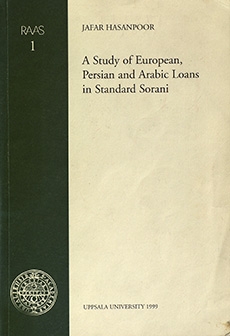
A Study of European, Persian and Arabic Loans in Standard Sorani
Jafar Hasanpoor
Uppsala University
This dissertation examines processes of lexical borrowing in the Sorani standard of the Kurdish language, spoken in Iraq, Iran, and the Kurdish diaspora. Borrowing, a form of language contact, occurs on all levels of language structure. In the pre-standard literary Kurdish (Kirmanci and Sorani) which emerged in the pre-modern period, borrowing from Arabic and Persian was a means of developing a distinct literary and linguistic tradition. By contrast, in standard Sorani and Kirmanci, borrowing from the state languages, Arabic, Persian, and Turkish, is treated as a form of domination, a threat to the language, character, culture, and national distinctness of the Kurdish nation. The response to borrowing is purification through coinage, internal borrowing, and other means of extending the lexical resources of the language. As a subordinate language, Sorani is subjected to varying degrees of linguistic repression, and this has not allowed it to develop freely. Since Sorani speakers have been educated only in Persian (Iran), or predominantly in Arabic, European loans in Sorani are generally indirect borrowings from Persian and Arabic (Iraq). These loans constitute a major source for lexical modernisation. The study provides wordlists of European loanwords used by Hemin and other codifiers of Sorani. Most European loanwords are well established, used in magazines, books, and the spoken language although they are neither standardised in their spelling nor registered in Kurdish dictionaries. Some loan blends, loan shifts, creations, and pure Kurdish words introduced into Sorani are also established. However, under conditions of intensive language contact, borrowing and purification continue to be the main trends of standardisation. Keywords-, borrowing, purification, language contact, standard Sorani Kurdish, Mukri dialect, norm conflict, Silemani dialect, modernisation, standardisation, nationalism. Jafar Hasanpoor, Department of Asian and African Languages, Uppsala University, Box 527, S-751 20 Uppsala, Sweden. Reports on Asian and African Studies (RAAS) 1
Chapter 1 Methods and Aims / 17 1.1. The theoretical framework of the study / 17 1.1.1. Theories of borrowing / 17 1.1.2. Theories of standard languages and lexical modernisation / 19 1.1.3. Language purism and purified Sorani / 21 1.1.4. Theoretical issues in the study of the Kurdish nation and language / 22 1.2. Previous research on loans in Sorani / 23 1.3. Subject and scope of the study / 25 1.4. Purpose and signficance of the study and research questions / 25 1.5. Type of study / 26 1.6. The data / 28
Chapter 2 An Overview of Arabic and Persian Loans in Sorani / 29 2.1. Arabic loans in Sorani / 29 2.2. Persian loans in Sorani / 31 2.2.1. Farhangestan and the development of standard Persian / 32
Chapter 3 The Kurds, Kurdish Nationalism and the Kurdish Standard Dialects / 34 3.1 Ideas about the Kurdish nation and standard Kirmanci / 34 3.1.1. Conceptualizing the ’Kurds’ / 34 3.1.2. Language nationalism and the Kurdish language / 35 3.1.3. Opposition of the central governments to a national standard Kurdish / 39 3.1.4. Marxists and the Kurdish language / 40 3.1.5. Ideas of nationalists about the national Kurdish language in the Kirmanci speaking areas / 42 3.1.6. Emergence of national Kirmanci literature / 45 3.1.7. Summary and conclusions / 46 3.2. Ideas of nationalists about standard Sorani in Iraq and Iran / 47 3.2.1. Iraqi Kurds and the ideas of nationalists about standard Sorani / 47 3.2.2. Kurds of Iran and standardisation of the Mukri dialect / 50 3.2.3. The Kurdish diaspora / 62 3.2.4. Concluding remarks / 63
Chapter 4 Pre-standard and Standard Sorani / 66 4.1. Arabic, Persian and Turkish influences on Kurdish / 66 4.1.1. A short historical background / 66 4.1.2. Arabic and Persian influences on pre-standard Kurdish / 67 4.2: Ideas about purified standard Sorani / 70 4.2.1. Purification and the development of Sorani in Iraqi Kurdistan / 71 4.3. Codifiers of standard Sorani / 72 4.3.1. Plremerd (1863 or 1867-1950) / 74 4.3.2. Hemin (1921-1986) / 75 4.3.3. Hejar (1920-1991) / 76 4.4. Ideas of nationalists about writing standard Sorani texts / 77 4.5. Concluding remarks / 79
Chapter 5 Sources, Wordlists and Analysis of European, Persian and Arabic Loanwords in Sorani / 81 5.1. Preparation of a Sorani text / 81 5.2. Sources of the study / 82 5.2.1. Writings of codifiers of Sorani / 82 5.2.2. Kurdish dictionaries / 83 5.2.3. Kurdish magazines / 87 5.3. Wordlists of loanwords / 91 5.3.1. Wordlist of European, Persian, Arabic, and dialect loanwords / 91 5.3.2. Exotica / 91 5.4. Modernisation and loanwords / 144 5.5. Classification of loans in Sorani according to Haugen’s division of loans / 145 5.5.1. Loanwords in Sorani / 149 5.5.2. Loanblends in Sorani / 149 5.5.3. Loanshifts in Sorani / 153 5.6. Creations in Sorani / 154 5.7. Kurdish purists and loans / 154 5.8. Establishment of loans, morphological adaptations of loans / 155 5.9. Standard spoken Sorani / 156
Chapter 6 Conclusions / 157 Bibliography / 163
ACKNOWLEDGEMENTS
I owe an enormous debt to my main teacher and supervisor Professor Bo Utas for his erudite and endless scholarly guidance and advice throughout the writing and presentation of this dissertation. I am also indebted to Dr. Carina Jahani for her prudent guidance, Amir Hassanpour for his comments, suggestions, and editorial assistance, and Donald MacQueen for his final editing of the dissertation. I also wish to thank Anwar Kader Muhammad, Michael Chyet, Abbas Vali, Omar Sheikhmous, Abdulaziz Y. Lodhi, Leena Huss, Christiane Bulut, Irving Palm, Aziz Zhyan, Rafik Kadir, Hassan Ghazi, Anwar Soltani, Fateh Shaikholeslami, Malmisanij, Rasho Zilan, Jaffer Sheykolislami, Hemin Koyi and Hashem Ahmadzadeh for reading earlier drafts and giving valuable suggestions. I thank my friends Goran Karadaghi and Mahmod Mola Ezat, for helping me with the analysis of Arabic loanwords in Kurdish. I am grateful to Shahrzad Mojab for assisting me in using inclusive language and in recognising and avoiding biased forms of communication. My thanks are also extended to the Kurdish writers, poets, and essayists for their kindness in answering my 1996 questionnaire about their treatment of loans in Sorani.
Kurdish is a repressed language, and it is not easy to contact Kurdish writers who live in countries where they are denied language rights including the freedom of expressing their views on their native tongue. Conducting research based on questionnaires or telephone and taped interviews threatens the safety of the respondents in Turkey, Iran, and Syria. Kurdish libraries do not exist except in Iraq, where they are also under surveillance. Even in Europe where a number of Kurdish libraries have been established since the 1980s, it is almost impossible to borrow from their collections. As a result, collecting material for a dissertation about the written variety of the language is a trial. I would like to express my gratitude once more to Prof. Bo Utas who, as Head of the Iranian Section, Department of Asian and African Languages, arranged for the departmental library’s purchase of numerous publications that I would not have been able to acquire otherwise. I have also had easy access to the private libraries of Prof. Bo Utas, Amir Hassanpour, Hassan Ghazi, Mahmod Mola Ezat, Rasho Zilan, Ferhad Shakely, Elzbieta Swiecicka, Zagros Khosravi, Kerim Danisyar, Jamshid Haydari, Soleiman Kaveh, and I am most grateful to them all. I am indebted to my late friends Jalal Husen for his encouragement, and Macid Ziryan for reading the first drafts and enriching my studies with suggestions. I thank my friends and colleagues Nasser Ghazi, Hemin Koyi, Olof Pedersen and Franz Wennberg who have helped me in working with computers. I wish to thank Goran Engemar and Ingvar Nord for helping me in preparing a camera-ready copy of the dissertation.
I would like to thank the Language Division the Faculty of Arts at Uppsala University for a generous four-year research grant which made the writing of the main part of this dissertation possible, and the Indo-iranska stiftelsen, Uppsala University, for a grant which facilitated the collection of data for my research.
Writing a dissertation is an arduous task, especially for a student like me who suffers from polio. I have been able to rest at the rehabilitation home Malargarden one month annually since 1996. I thank the County Council of Uppsala, which enabled me to reside there. I wish to thank Director Nils Ahlinder, Dr. Bengt Nordgren, and the staff of Malargarden for their kindness in rehabilitating me and other guests. I am grateful to the staff of Uppsala University Library, who ma'de it possible for me to work in a comfortable environment. Finally, I would like to thank my companion Inger Vestergard, my sister Shilan, my brothers Amir and Mohsen and their families, and all my friends for their constant encouragement and support.
Of course, any shortcomings and inconsistencies in this study are my own responsibility.
Introduction
As a native speaker of Kurdish, the study of my own language invokes the memory of violent forms of repression. Throughout much of my life in Kurdistan (Iran), I was not allowed to learn my native tongue in its written form, nor to own a book or write a letter in the language. Those who dared to resist the codes of repression would automatically be charged with the crime of “secessionism.” If Kurdish was ever mentioned in books or on radio, it was called a “local dialect” of the state language, Persian. Numerically, Kurdish is one of the top languages of the world. It is spoken by some 25 million Kurds, who live in Kurdistan, a contiguous territory that was divided in 1918 among Turkey, Iran, Iraq, and Syria. It is difficult to clearly define the boundaries of this geoethnic territory or to provide accurate population figures because these states are reluctant to provide census figures or linguistic maps. There is also a sizeable Kurdish diaspora stretching from Central Asia to North America. Some Kurdish communities were dispersed in the Caucasus between the eighteenth and twentieth centuries. Others were moved, often forcibly, to Central Asia, the Xorasan province in northeast Iran, Pakistan and Lebanon. Since the 1960s, no fewer than half a million Kurds resettled as “guest workers,” refugees, and immigrants in Europe, North America, and Australia. Under these conditions, Kurdish has experienced intensive contact with numerous languages.
As a speaker and writer of Kurdish, I have been under the pressure of making difficult choices in the use of words, and in finding enough lexical resources in order to translate a text from Persian, Swedish, or English. The language, especially its spoken variety, is invaded by borrowings on all levels of structure and use. A disturbing situation is the paucity of Kurdish lexical and terminological resources in specialised forms of knowledge such as the disciplines of social sciences, the humanities or exact sciences. The question “What is the Kurdish word for ...? is often raised in diverse contexts including informal situations. In fact, Kurdish does not match up to Western languages or even the three major languages of the Middle East, Arabic, Turkish, and Persian. The language needs to be modernised lexically.
Although the lexical expansion of Kurdish is a serious challenge, there is a dearth of research on borrowing, purification, and the development of the vocabulary. Aspects of borrowing and purism in standard Sorani have received some research attention (Jamal Jalal Abdulla and Amir Hassanpour), but there is yet no comprehensive study focused on loanwords. One of the goals of my research is, therefore, to conduct an empirical study of lexical borrowing, which is theoretically informed and can address some of the questions raised by language users and reformers. Loanwords are not and cannot be reduced to purely linguistic constructs. They are products of the history of a language, and of the social, economic, political and cultural contexts in which it is used. The life of loanwords in Kurdish is, among others, the story of the tranformation of a pre-modem society, the …
Jafar Hasanpoor
A Study of European, Persian and Arabic Loans in Standard Sorani
Uppsala University
Uppsala University A Study of European, Persian and Arabic Loans in Standard Sorani Jafar Hasanpoor
RAAS 1
Uppsala University 1999
RAAS Reports on Asian and African Studies 1
Jafar Hasanpoor
A Study of European, Persian and Arabic Loans in Standard Sorani
Uppsala 1999
Doctoral dissertation for the Degree of Doctor of Philosophy in Iranian languages presented at Uppsala University 1999.
Abstract
Hasanpoor, J. 1999: A Study of European, Persian and Arabic Loans in Standard Sorani. Reports on Asian and African Studies (RAAS) 1. 176 pp. Uppsala. ISBN 91-506-1353-7
Typesetting: Jafar Hasanpoor Printed in Sweden by Reprocentralen, Ekonomikum, Uppsala University Distributor: Department of Asian and African Languages, Uppsala University, Uppsala, Sweden