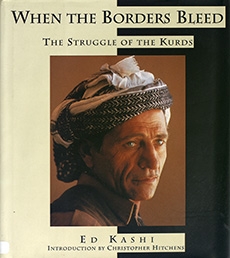
When the Borders Bleed: The Struggle of The Kurds
Ed Kashi
Chatto & Windus
Throughout their history, the Kurdish people have been the victims of geopolitics. Caught in the middle of wars and conflicts in the oil-rich territory where the borders of Iran, Iraq, Syria, and Turkey converge, exploited and betrayed first by colonial nations and then by Cold War superpowers, they have most recently endured genocidal campaigns waged against them by Saddam Hussein.
This stunning visual essay —one hundred photographs taken in locales ranging from Tur-key, Iraq, and Israel to Britain and Germany — brings the Kurdish struggle for survival into sharp, powerfully affecting focus. We see the guerrillas training for war, mothers and chil-dren living in the bombed-out rubble of their homes, victims of chemical warfare, expatriates in Europe preserving their culture in the face of sometimes violent xenophobia. And in a cogent introduction, Christopher Hitchens traces the little-known history of the Kurds —a narrative filled with oppression, exploitation, and be¬trayal-helping us understand the legacy that has given rise to the Kurds’ desperate self- reliance that finds expression in the adage: “The Kurds have no friends—no friends but the mountains.”
Contents
Preface / 9
Acknowledgments / 11
Map of Kurdistan / 12
Introduction by Christopher Hitchens / 13
Chronology by Maya Brisley / 31
When the Borders Bleed / 37
A Select Bibliography / 139
PREFACE
My first encounter with Kurdistan actually took place in Northern Ireland, where, in early 1990, I met a British artist and his Kurdish wife. During the next year I spent many nights in their east London flat discussing the Kurdish people, their ancient culture, and their contemporary fight for survival, as well as the atrocities committed against them, most of which have gone unreported by the Western press. Before ever setting foot in Kurdistan, I became obsessed with the Kurds, their plight, and their futile attempts to secure a homeland.
The Kurds are the largest ethnic group in the world without a nation, numbering over twenty million people with a common language and culture. Kurdish history came to a virtual standstill after World War I, when the region known as Kurdistan was divided between five newly formed nations: Iran, Iraq, Turkey, Syria, and the former Soviet Republic of Armenia. This partitioning by the League of Nations obliterated thousands of years of Kurdish claims to the region and set in motion decades of oppression, culminating in the ruthless chemical warfare waged against them by the Iraqi government, whose troops leveled more than four thousand Iraqi Kurdish towns and villages over the last two decades.
Toward the end of 1990 I started to plan my first trip to Kurdistan, which would begin in the ancient city of Diyarbakir, Turkey. But by then Iraqi troops had occupied Kuwait, and the United States and its allies were poised to erupt into Operation Desert Storm. My project to document the Kurds was in danger of being overshadowed by the Gulf War. Little did I know that the Kurds would dominate front-page headlines in the coming months.
The ground war ended by late February 1991, and Operation Provide Comfort began its effort to rescue nearly a million Iraqi Kurdish refugees stranded in the mountains between Iraq and Turkey. I wrote to Tom Kennedy, the director of photography at National Geographic magazine, suggesting that the Geographic underwrite my efforts to document the life and struggle of the Kurds. We had never worked together, but with a great leap of faith he stood behind me and assigned the widely acclaimed political writer Christopher Hitchens to the story.
By late April 1991 I was off to Diyarbakir, but the scope of the story had expanded way beyond Turkey. I now had the means to cover six countries over a six-month shooting schedule. In addition to the ancient alleyways of Diyarbakir, I scoured the refugee camps in Turkey and Iran, and I witnessed firsthand the landscape of destruction left behind by Iraqi troops. In Lebanon's infamous Bekaa Valley, I visited the training camp for the Kurdistan Workers Party (PKK), an armed Kurdish separatist movement fighting in southeastern Turkey, and I managed to move in and out of Iran under the ever- watchful eyes of the secret police. I froze through a fierce winter with young Kurdish gangs in the streets of Berlin and with courageous refugees living without heat or electricity in the rubble in northern Iraq. On Christmas Day, 1991,1 returned to Washington, D.C., from the last of three trips, having shot more than 1,100 rolls of film.
As 1 write this, the Kurdish situation remains dire at best: in Turkey, the government's denial of past injustices and its continued repression constitute a state of siege in the Kurdish region. This, combined with the armed movement of the PKK, has resulted in more than seven thousand deaths since 1984. In the past two years alone, more than sixteen journalists have been killed in the area.
In Iraq, for the first time in modern history, the Kurds are autonomous, but tens of thousands of Iraqi troops amassed along the border of sovereign Kurdistan threaten this foundling nation's security. In the meantime, the Kurds struggle to endure the food and fuel embargo imposed by Baghdad, and Saddam's agents continue to terrorize UN relief workers and destroy supply vehicles bound for Kurdistan.
Although little is ever heard about the plight of the Kurds in Iran, their oppression continues. In 1993, three of the most powerful Iranian Kurdish leaders were gunned down in a Berlin restaurant during a meeting. In Syria, under the heavy- handed rule of Hafez al-Assad, the Kurds are effectively muted by their small numbers and their inability to organize a strong opposition.
For a brief moment after the Gulf War, the Kurdish story commanded world attention, but it has since been relegated to the back page. In an age of disposable news, the Kurds are in danger of being quickly forgotten, even though their suffering continues with no end in sight. From the genocidal campaign in Iraq to the insidious oppression in Turkey, the Kurds fight daily to maintain their lives, their land, and their language. For anyone who comes in contact with the Kurds, it is impossible to remain silent. This book is a tribute to the strength and dignity of the Kurdish people.
Ed Kashi
San Francisco, 1993
Acknowledgments
This collection of photographs would not have been possible without the cooperation of the Kurdish people. I was continually amazed by the Kurds' spirit, strength, and grace in the face of the most punishing conditions I have ever experienced. I would like to thank so many of them personally, but for their own safety I cannot name names. I am forever indebted to one Kurdish man from Diyarbakir who worked with me as a guide and interpreter through much of the project, traveling with me illegally in Iraq and at great personal risk in Turkey, where he could have disappeared all too easily without a word. I worry for his continued safety in light of the many assassinations of Kurdish journalists in the region. In November of 1992 he was wounded by Turkish security forces.
Thanks to Stuart and Maya Brisley, my friends in London who got me interested in this subject, and to Maya in particular for her insights and for writing the chronology for this book. To Rich Amdur, my dear friend, who helped me write that first letter to the Geographic. To Linda Asher, who stuck through thick and thin with me and my work for nine years, and who helped me put together the proposal for this project. To Jane Palecek for her patience, support, and wisdom during the grueling year I was working on this story.
Thanks to Christopher Hitchens for adding a different dimension to my work and life, - Joan Kristensen for her beautiful work on the map for this book, - Vera Beaudin Saeedpour for her incredible support and devotion to the Kurdish cause, - Estella Schmid for her courage, commitment, and Zealand the Kurdish centers in London, Berlin, and Cologne for their invaluable assistance. Love and thanks to Julie Winokur for donning the editor's cap to refine the words and images for this book.
I also want to thank the people at National Geographic, especially Tom Kennedy, Kent Kobersteen, Susan Welchman, Heidi Ernst, Dave Griffin, Erla Zwingle, Bill Allen, Bob Poole, and Bill Graves.
Finally, I want to thank my Baghdad-born mother and father, who were always on my mind while I was in Iraq.
Introduction
by Christopher Hitchens
A general in the Iraqi army, a veteran of the Gulf War, wakes one morning in Baghdad and decides to take a few trusted men into the northern mountains, resolved never to return.
A waiter in an Armenian restaurant in Aleppo, Syria, upon learning that I visited a certain training camp in Lebanon's Bekaa Valley, puts down his tray and, to the puzzlement of onlookers, raises a fist in the air and says "PKKl"
A woman social worker in the Spandau district of Berlin faces another day of neo-Nazi graffiti at her place of work and lobbies the local school for classes in a strange, ancient language.
In a house in Nicosia, Cyprus, a poet who works for the Palestine Liberation Organization hears of a chemical warfare massacre in a country he has never seen and writes a long verse tribute. The poem is called Mahabadthe name of a city he has never visited, but a name with nearly magical power for the few who understand it.
In an elegant restaurant in Jerusalem, a senior member of the municipal government dines with friends. They talk excitedly, lovingly, of a far-off place their fathers knew and had left, never to return.
In southeastern Turkey, a philosophy student interrupts a discussion of Greek ideas to fiddle with a radio dial. He picks up a station in the former Soviet Caucasus, broadcasting in a tongue which may not be spoken on local airwaves.
In San Diego, California, a computer technician takes time off from his work to help produce a cultural and political magazine named Halabja, for a town gutted of its people in an Iraqi gas attack.
All of these people—General Mufti, Jamal the waiter, Aso Agace the social worker, Salim Barakat the poet, Aharon Sarig the Israeli official, Ibrahim Qalan the philosophy student, and Alan Zangana the computer operator—are Kurds. Along with their arduous and unique history, they all became the unexpected responsibility of the world in early 1991. The Kurds were as startled to be discovered as was the West to discover them. The history of Kurdish life and culture, however, is a litany of sudden shifts, as well as of betrayals and abandonments.
Who are these people, and where do they come from? Anthropology and ethnology tell us that they are Indo-European or Aryan, a finding more intriguing than definitive. It is easier to state what they are not: not Arab, not Persian, not Turkish. Travelers to the region which these people have occupied for more than two thousand years have been reporting for centuries on the blue or green eyes, the fair hair and complexions of the Kurds, but shade and coloring do not a nation make. If we take Winston Churchill's famous remark that "a man is of the race which he passionately believes himself to be," we are on safer ground.
Around 400 B.C., as the Greeks were retreating …
Ed Kashi
When the Borders Bleed
The Struggle of The Kurds
Chatto & Windus
Chatto & Windus
When the Borders Bleed
The Struggle of The Kurds
Photographs by Ed Kashi
Chatto & Windus
London
First published in the United States in 1994
1 3 5 7 9 10 8 6 4 2
Introduction Copyright © Christopher Hitchens 1994
Photographs Copyright © Ed Kashi 1994
All rights reserved. No part of this publication may be reproduced, stored in a retrieval system or transmitted in any form, or by any means, electronic, mechanical, photocopying, recording or otherwise without the prior permission of the publisher.
First published in the United Kingdom in 1994 by Chatto & Windus Limited
Random House, 20 Vauxhall Bridge Road, London SWlV 2SA
Random House Australia (Pty) Limited
20 Alfred Street, Milsons Point, Sydney,
New South Wales 2061, Australia
Random House New Zealand Limited
18 Poland Road, Glenfield
Auckland 10, New Zealand
Random House South Africa (Pty) Limited
PO Box 337, Bergvlei, South Africa
Random House UK Limited Reg. No. 954009
A CIP catalogue record for this book
is available from the British Library
ISBN 0 7011 6275 9
Some photographs were originally published in National Geographic, vol. 182,
no. 2 (August 1992).
Copyright © 1992 by National Geographic Society
Book. Design by Fearn Cutler
Map by Joan Kristensen / Siren Design
Manufactured in the United States of America
Borders are scratched across the hearts of men
By strangers with a calm, judicial pen,
And when the borders bleed we watch with dread
The lines of ink along the map turn red.
—Marya Mannes
A brave man dies once, a timid man dies daily
—Kurdish proverb