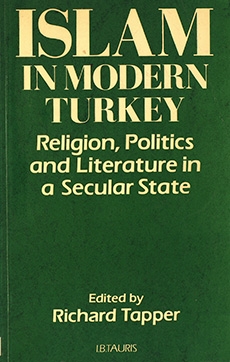
Islam in Modern Turkey Richard Tapper I. B. Tauris
When the Thrkish Republic was founded in 1923, secularism was adopted as one of the key principles of the state, and religious expression was brought under strict government supervision and control. The Caliphate was abolished, the powerful Sufi orders were outlawed, and mystical forms of religious expression were discouraged. Islam in Turkey became limited and compartmentalized while republican ideology and its associated institutions came to dominate much of everyday life. Only after 1950, when the centre-right Democrat Party was elected, did this repressive attitude to religion ease. The subsequent growth of popular religious sentiment became particularly evident from the 1980s onwards with the remarkable proliferation of religious newspapers, periodicals and other literature and, in spring 1994, the extraordinary electoral gains made by the Islamist Welfare Party in the municipal elections. Although Islam as a social and political phenomenon has commanded much attention in recent years, relatively little has been written about this steady resurgence in Turkey. Still less is known of the practice of Islam among the broad mass of the Turkish people, of its meaning and importance in their lives today, or of how the political culture of modern Turkey has shaped and been shaped by Islamic schools, Sufi orders, mosques and pious literatures. The essays collected in this volume, written by scholars from a variety of disciplines, aim to fill this gap by looking at constructions of Islam in some less accessible areas of daily life and through popular and religious literature. They also raise the question of the extent to which Turkey may still be said to be a unique case in the Islamic world.
Richard Tapper is Reader in Anthropology at the University of London and teaches at the School of Oriental and African Studies. He is author of Pasture and Politics (1979), editor of Conflict ofTrihe and State in Iran and Afghanistan (1983) and co-editor, with Sami Zubaida, of Culinary Cultures of the Middle East (1994).
Contents
Editor’s Foreword / v 1. Introduction - Richard Tapper / 1
Part I: Islam and Nationalism as Political Ideologies 2. Religion and Political Culture in Turkey, liter Turan / 31 3. Religion, Education and Continuity in a Provincial Town, Richard Tapper & Nancy Tapper / 56 4. Mosque or Health Centre? A Dispute in a Gecekondu, Akile Gürsoy-Tezcan / 84 5. Ethnic Islam and Nationalism among the Kurds m Turkey, Laie Yalgin-Heckmann / 102 6. The Nak^ibendi Order in Turkish History, Şerif Mardin / 121
Part II: Turkish Muslim Intellectuals and the Production of Islamic Knowledge 7. Islamic Education in Turkey: Medrese Reform in Late Ottoman Times and Imam-Hatip Schools in the Republic, Bahattin Akşit / 145 8. Muslim Identity in Children’s Picture-Books, Ayşe Saktanber / 171 9. The New Muslim Intellectuals in the Republic of Turkey, Michael E. Meeker / 189
Part III: Islamic Literature and Literacy in Contemporary Turkey 10. Traditional Sufi Orders on the Periphery: Kadiri and Nakşibendi Islam in Konya and Trabzon, Sencer Ayata / 223 11. Pluralism Versus Authoritarianism: Political Ideas in Two Islamic Publications, Ayşe Güneş-Ayata / 254 12. Women in the Ideology of Islamic Revivalism in Turkey: Three Islamic Women’s Journals Feride Acar / 280
Notes on Contributors / 304
Index / 308
EDITOR’S FOREWORD
This book derives from a workshop held at the School of Oriental and African Studies (SOAS), University of London, in May 1988 as part of the Modern Turkish Studies Programme of the Centre of Near and Middle Eastern Studies. Apart from the Introduction, all the chapters are revised versions of papers delivered at the workshop; Ahmet Evin and Gencay §aylan also delivered papers, neither of which, unfortunately, were available for publication here.
I would like to thank the Research Committee of SOAS, the Nuffield Foundation and the British Academy, for generous grants which helped bring participants together for the workshop. Thanks are also due to the following for assistance in organizing the workshop: Clement Dodd, Chairman of the Programme, and co-convenor of the workshop; Tony Allan, then Chairman of the Centre Near and Middle Eastern Studies; Martin Daly, Secretary of SOAS Research Committee; and Rita Duah-Sakyi, Bridget Harney and Anne Mackintosh for valuable administrative assistance.
I am most grateful to all the contributors to the book, who have been patient with my suggestions for revision and with the delays in bringing the book to publication; they are not responsible for the way in which I have characterized their chapters and linked them together in the Introduction.
1
Introduction
Richard Tapper
Among the many recent studies of Islam as a social and political phenomenon, few have specifically discussed the Turkish case. Those which have, seeking to explain the apparent revival of Islam in modern - supposedly secular - Turkey, mostly focus on the role of Islam in the political process, especially on the most visible manifestations of ‘Islamic revival’ such as political party activity and events which have attracted foreign media attention. The question most often asked has been whether Islamic revival poses a political ‘threat’ to the survival of the modern Turkish state; the hidden agenda is the age-old Western fear of Islam, now shared by many Turks, and the rarely articulated role of this fear in determining Turkey’s relation to Europe.
Much of this discussion is abstract and speculative; what is usually missing is any detailed knowledge of how religion has been practised by the broad mass of the Turkish people during the decades of the Republic, or of its meaning and importance in their lives today. There are few detailed studies of the way Turkey has shaped and been shaped by such ‘Islamic institutions’ as schools, Sufi orders, intellectual activities, and pious literature.
This book attempts this kind of broad coverage, filling the gap by looking at constructions of Islam in some less accessible areas of daily life and as they appear in popular and religious literature. Turkey has long stood out as a unique case in the Islamic world, and the authors hope that, by exploring the nature of some of the important manifestations of Islam in Turkey today, and their place in the context of other aspects of Turkish society, they can shed light on matters of importance to the general social scientific study of Islam: the conflict between, and possible intersection of, secular and re-traditionalizing appeals; socialization and mobilization through agents of education and popular culture; and the competition of Islamic idioms. The book raises the question of whether Turkey may still be said to be so different from other Muslim societies, the exception that proves the rule.1 How far is the self-designation ‘secular state’ still appropriate, either as a description or as a political principle, to modern Turkey?
In the pages that follow, I make no pretence at a comprehensive survey of the complexities of politics, religion and literature in recent Turkish history; rather, the rest of this Introduction is intended both as a background to the other chapters, and as a means of highlighting their arguments and the way in which they contribute to an improved understanding of Turkish Islam.
Since the republican revolution of 1923, Islam in Turkey has been redefined. Secularism (‘laicism’) emerged as one of the key principles of Ataturk’s new state, and religious expression came under strict government supervision and control. With the abolition of the Caliphate, the outlawing of the powerful Sufi tarikats (orders/brotherhoods) and the discouragement of mystical forms of Islam, Turkish Islam in effect became more standardized, circumscribed and compartmentalized, while republican ideology and associated institutions came to dominate much of everyday life.
The new centre-right Democrat Party government elected in 1950, widely supported by the Anatolian peasantry and small townspeople, whose religious lives had been less affected than those of city-dwellers, brought an easing of the repressive attitude to religion. Over the following decades there was a growth in manifestations of popular religious sentiment, evidenced both in the building of mosques and religious schools and in the semi- clandestine activities of mystical groups, whether the older Sufi tarikats such as the Nakşibendis and Kadiris, or the more recent Nurcu and Siileymanci movements. This resurgence in religious consciousness and activity became particularly evident in the …
Richard Tapper Islam In Modern Turkey Religion, Politics and Literature in a Secular State
I.B. Tauris
I.B. Tauris & Co Ltd Islam In Modern Turkey Religion, Politics and Literature in a Secular State Edited by Richard Tapper
I.B. Tauris & Co Ltd Publishers London - New York
Published in association with The Modern Turkish Studies Programme of the Centre of Near and Middle Eastern Studies, School of Oriental and African Studies (University of London)
First published in 1991; paperback edition published in 1994 by I. B. Tauris & Co Ltd 110 Gloucester Avenue London NW1 8JA
175 Fifth Avenue New York NY 10010
In the United States of America and Canada distributed by St. Martin’s Press 175 Fifth Avenue New York NY 10010
First published in the UK in 1982; reprinted 1984, 1990, 1993.
All rights reserved. Except for brief quotations in a review, this book, or any part thereof, must not be reproduced in any form without permission in writing from the publisher.
A CIP record of this book is available from the British Library.
Library of Congress Catalog card number 90-60627 A full CIP record is available from the Library of Congress
ISBN 1-85043-833-1
Printed and bound in Great Britain by WBC Print Ltd, Bridgend, Mid Glamorgan