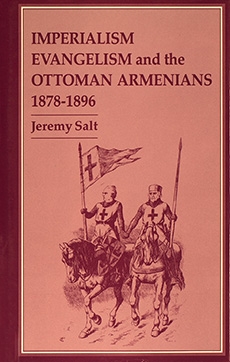
 Imperialism Evangelism and the Ottoman Armenians 1878-1896
Jeremy Salt
Frank Cass
The focus of this work is the unfolding of the Armenian Question from the Congress of Berlin in 1878 to the breakdown of communal relations among Armenians, Turks and Kurds in the eastern provinces of the Ottoman Empire in the mid-1890s. The author takes as his starting point the inherited attitudes towards the Ottoman state, Islam and the Turks which outside observers brought to their understanding of Ottoman affairs. He discusses the role of American missionaries in the Ottoman state as they strove to introduce the Armenians to a 'higher' form of Christianity and proselytised among the Muslims. By the time the European diplomats met at Berlin in 1878, the interests of European governments in the Ottoman state, foreign religious interests in the affairs of Ottoman Christians and the claims of these communities themselves were converging in a single stream.
The result was the attempt - with Britain taking the lead - to establish a 'European' protectorate over the Armenians living in the eastern provinces. Although this attempt failed, the European governments continued their campaign for reforms. The hope that they could be induced to intervene more directly was an element in the calculations of the Armenian revolutionaries, and with uprisings and reprisals spreading across eastern Anatolia in the 1890s the British government led a final attempt to impose 'reforms' on the sultan. This was followed by an unprecedented surge of violence across the east and in Istanbul itself.
In Britain these developments caused an outcry among humanitarians and led to demands for military intervention to 'save' the Armenians. In the United …
Contents
Illustrations / viii
Acknowledgements / ix
Introduction / 1
Part One: The Religious Question
1 Imperialism and the Christian Polemic / 9
2 Christians Under the ‘Ottoman Yoke’ / 22
3 The Missionary Impact / 30
Part Two: The Political Synthesis
4 War, Reform and the Armenians / 43
5 The Chains Must Be Broken’ / 54
Part Three: The Consequences
6 Insurrection in the East / 71
7 The Ambassadors Propose / 81
8 Reform and Chaos / 95
9 The Missionary ‘Meddlers’ / 111
Part Four: The Reaction
10 The Armenian Agitation / 123
11 The Powers Dispose / 136
12 The View from Yildiz: ‘Who Has Conceived Such Wicked Lies?’ / 143
Epilogue / 151
Notes / 158
Select Bibliography / 177
Index / 184
Illustrations
1 The Status Quo (from Punch, 9 September 1876) / 46
2 A Free Hand (from Punch, 18 January 1896) / 125
3 The Old Crusaders (from Punch, 18 May 1895) / 126
Map: The Ottoman Empire, showing the six vilayets covered by the 1895 reform project and the main centres of the com-munal upheaval between 1894 and 1896 / 87
ACKNOWLEDGEMENTS
I would like to thank a number of people who have helped me in various ways at different stages of this project; Emeritus Professor John Bowman, of the Department of Middle Eastern Studies, Melbourne University; Patrick Singleton, formerly of the Baillieu Library at Melbourne University; Professor Ersin Kalaycioglu of Bogazigi University, Istanbul; Professor Metin Heper, chairman of the Department of Politics and Public Administration, Bilkent University, Ankara; and Dr Nur Bilge Criss, of the Department of International Relations, Bilkent University. Material from this manuscript has been used as the basis for three articles. ‘Ottoman Christians and Foreign Missionaries: A Precarious Symbiosis’ appeared in the International Journal of Turkish Studies, Vol. 3, No. 2 (Winter 1985/86). ‘Nineteenth-Century Images of the Turks’ was published in Dr Rahmi Akgelik (ed.), Before and After Gallipoli: A Collection of Australian and Turkish Writings (Melbourne, 1986). ‘Britain, the Armenian Question and the Cause of Ottoman Reform 1894—96’ appeared in Middle Eastern Studies, Vol. 26, No. 3 (July, 1990). I would like to thank Dr Akgelik, together with Professor Kemal Karpat and the late Professor Elie Kedourie, for their permission to make use of this material again. The three cartoons are reproduced by courtesy of Punch, now sadly defunct.
Finally I must record my lasting gratitude to the late Anna Stewart, my wife, for all the support and encouragement she gave me in the early stages of this project.
Jeremy Salt
Ankara, 1992
Introduction
The reader will not get far before discovering that this book is not a general history of the Armenians in the nineteenth or any other century. It is not intended to be. Certainly it is ‘about’ the Armenians but it is also about the diplomats, missionaries and politicians whose interests and involvement helped to create the Armenian question in the last quarter of the nineteenth century. It is also about public opinion, and particularly the religious and racial biases that were usually carried into any discussion of Ottoman affairs. Although I hope the specialist will find some value in this work, I have written it with one eye on a more general audience. I believe that anyone interested in history could not fail to find the subject matter compelling, particularly as so much has been written about the tragic fate of the Armenians during the First World War but very little about this earlier period of ‘their’ history.
Unfortunately, the period I have studied remains extremely contro-versial. As a neophyte I did not realise this when I began, and had I been aware of the ferocity still generated by debate on the Armenian question I might have been tempted to abandon the project altogether. Earlier drafts of the manuscript were submitted to other publishers, none of whom was able to find two readers who could agree on its worth, and their views were usually so divergent as totally to negate each other. Armenian or pro-Armenian readers accused me of glossing over the facts, of supporting Ottoman imperialism, of bandying around half-truths, of racism and even of ‘Turkish linguistic chauvinism’ (had this particular reader known it, my knowledge of Turkish is very slight). From the other side came more constructive criticism and sometimes praise. Although anxious to see the work in print, I could not help feeling some sympathy for publishers expected to make a sound judgement on the basis of such expert but contradictory opinions, but perhaps this is a normal situation in the publishing world. In any case, the reaction should not have been surprising.
Virtually the whole of that area of scholarship known as Modem Middle Eastern studies is a minefield and the Armenian question is no exception.
…..
Jeremy Salt
Imperialism Evangelism and the
Ottoman Armenians 1878-1896
Frank Cass
Frank Cass & Co. Ltd.
Imperialism Evangelism and the
Ottoman Armenians 1878-1896
Jeremy Salt
ISBN 0 7146 3448 4
Jeremy Salt
Bilkent University
First published in 1993 in Great Britain by
Frank Cass & Co. Ltd.
Gainsborough House, Gainsborough Road,
London E11 1RS, England
and in the United States of America by
Frank Cass
c/o International Specialized Book Services, Inc.
5804 N.E. Hassalo Street, Portland, Oregon 97213-3644
Copyright© 1993 Jeremy Salt
British Libraiy Cataloguing in Publication Data
Salt, Jeremy
Imperialism, evangelism and the Ottoman Armenians,
1878-96.
I. Title
956.62
ISBN 0-7146-3448-4
Library ot Congress Cataloging-in-Publication Data
Salt, Jeremy.
Imperialism, evangelism and the Ottoman Armenians,
1878—96 Jeremy Salt
p. cm.
Includes bibliographical references and index.
ISBN 0-7146-3448-4
1. Armenian question. 2. Turkey—History—1878-1909. 3. Europe-
—Relations—Turkey. 4. Turkey—Relations—Europe. 5. Turkey-
—Relations—United States. 6. United States—Relations—Turkey.
I. Title.
DS194.S25 / 1992
956.6'2015—dc20 / 91-18938
CIP
All rights reserved. No part of this publication may be reproduced in
anyform or by any means, electronic, mechanical, photocopying,
recording or otherwise, without the prior permission of Frank Cass
and Company Limited.
Typeset by Regent Typesetting, London
Printed by Bookcraft (Bath) Ltd.

PDF
Downloading this document is not permitted.
|