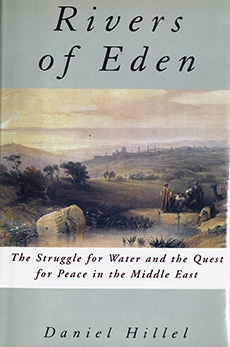
After decades of strife, the Middle East now seems to be moving toward peace. But prospects for a settlement stand on shakier ground than many observers realize, says scientist Daniel Hillel. What they tend to overlook is that the severely wounded environment of the region threatens the future stability of any political accord. Widespread destruction of vegetation and natural habitats, erosion of uplands, desertification of semiarid areas, waterlogging and salinization of valleys, and, most of all, depletion and pollution of precious water resources— no diplomatic formula will ensure lasting peace in the Middle East, argues Hillel, unless it redresses these ills. In Rivers of Eden, Hillel examines this environmental crisis and explores its crucial role in the political and economic future of this particularly sensitive and troubled region. He shows how ecological degradation, exacerbated by an uncontrolled explosion of population and a potential warming and drying of climate, is itself a cause of instability in the area, dislocating and disorienting countless people and fomenting despair and extremism. And yet, he adds, since no country in the region can solve its water problem alone, the very cause of conflict is also an inducement for promoting peace. This hope illuminates Rivers of Eden as it traces the vital issue of water in the Middle East, ranging from its first appearance in antiquity and its manifestations in folklore and religion to the present. …..
Contents
1. An Overview / 3 A transregional journey, and a realization 2. Waters of Life / 20 The planet’s, and the region’s, most precious fluid 3. Ancient Civilizations / 41 The rise and demise of societies in an arid environment 4. Modern States / 74 How the contemporary map of the region was drawn 5. The Twin Rivers / 92 New rivalries over the ancient waters of Babylon 6. The Mighty Nile / 111 The mother river and her many thirsty children 7. The River Jordan / 143 Dividing the earth’s most storied river 8. The Flowing Streams of Lebanon / 177 Disputed waters in a fractious state 9. Fountains of the Deep / 190 Tapping the underground pools, rechargeable or fossil 10. The River of Waste / 210 An unrealized resource: conservation, efficiency, reuse 11. Augmenting Supplies / 232 Inducing rain and runoff, trading waters, desalinization 12. Criteria for Sharing International Waters / 264 Ethical, legal, and pragmatic considerations 13. Water for Peace / 279 Calming turbulent waters
Notes / 299
Bibliography / 319
Glossary / 331
Index / 343
PREFACE
Behold, I extend peace like a river, and the honor of nations like a mighty stream. Isaiah 66:12
They will not hear any vain discourse, but only salutations of peace. Koran XIX:62
If the mythical Eden ever had a real geographical location, it must have been somewhere in the Middle East. Humanity’s first abode, as described in the Book of Genesis, was, literally, a Garden of Delight. In it grew “every tree that is pleasant to the sight and good for food,” all watered by a primordial river and its distributaries. Adam and Eve, whose names meant “earth and life,” were put in the garden for a purpose—“to serve and preserve it.”
Alas, as the biblical story unfolds, the first humans soon abused God’s trust, yielding to temptation and consuming beyond their needs. In so doing, they banished themselves from the garden by despoiling it. They and their descendants were thenceforth condemned to a life of toil: “Cursed is the earth for thy sake… With the swreat of thy brow shaft thou eat bread till thou return to the earth.” One of their sons learned to domesticate animals and became a herder, while the other learned to till the soil and grow crops.
The part of the Middle East where humans settled some 10 millennia ago is known as the Fertile Crescent. It was a hospitable region, blessed with a benign climate and abundant biological resources. Now this same region is a largely degraded landscape in which most of the people are impoverished and insecure.
The problems besetting the Middle East today are multifaceted and exceedingly complex. Ethnic, national, religious, economic, social, and historical conflicts combine to make the present scene particularly contentious. The issues are highly emotive and so do not lend themselves readily to dispassionate analysis and rational solution. Some people in the region do not believe a peaceful solution is possible at all, and thus are driven by desperation and bitterness to acts of violence. The vast majority of the people, however, are weary of conflict and yearn for a just peace and an opportunity to turn their faith and energy toward progress and development.
The good of the region and all its people demands a new approach, cognizant of the past but not bound by it, aware of the deprivations and grievances of the present but not obsessed by them. Needed above all is a forward-looking vision of the region’s potential strengths and positive destiny, attainable in a context of international cooperation.
During the greater part of the twentieth century, the nations of the Middle East have been embroiled in seemingly endless turmoil. Now, in the last decade of this tumultuous century, prospects have arisen for a momentous change. Political leaders have at last begun to respond to the real needs of their people and to pursue peaceful compromises rather than violent confrontations among their nations. However, no mere political formula will heal the region’s maladies unless it redresses their root causes.
The general aim of this book is to reveal an important dimension of the Middle East’s fundamental predicament, one that is still insufficiently understood and therefore typically ignored by politicians and by the observers who too often report only superficially on the scene. That dimension is the severely wounded environment. Its manifestations include widespread destruction of vegetation and natural habitats, erosion of uplands and watersheds, waterlogging and salinization of valleys, desertification of semiarid areas, and—in particular—depletion and pollution of water resources. Combined with an uncontrolled explosion of population, these processes undermine the economic and social welfare of entire societies and cause the dislocation of numerous people. Environmental degradation thus contributes to despair and extremism.
The more specific message of this book is that the acute shortage of water, if left unresolved, is bound to further exacerbate tensions and conflict. No country in the region can resolve its water problem independently without encroaching upon the resources of its neighbors. Hence no comprehensive water development can take place without peace, and—conversely—no peace is possible or sustainable without such development. The very problem that engenders rivalry and threatens to instigate war can and must be turned into an opportunity and a powerful inducement to promote peace.
The book describes the background and nature of the water problem and offers some ideas toward its peaceful resolution. In so doing, it necessarily explores numerous related issues in the context of the region’s history and contemporary circumstances. The ultimate aim is to bring the positive prospects of the Middle East more clearly to the attention of policymakers and opinion makers, who might henceforth act more effectively to rehabilitate the ravaged lands and waters of the region and thereby alleviate the plight of the people dependent on those resources. Only thus can the Middle East be restored to the Eden and center of culture that it once was.
As author, I have striven to present the contentious problems with fairness to all sides, while avoiding inflamed political polemics. Of course, no human being is omniscient or able completely to transcend private perceptions. Yet my conscious intention has been to analyze the sensitive issues as honestly and impartially as I could. The region is now poised on a fateful watershed divide between a dangerous casus belli and a promising casus pads. My fervent wish is that the latter prevail over the former, and that a hopeful future will indeed overcome an unhappy present.
Several colleagues read all or parts of the manuscript and offered constructive comments. Among them were Dr. David Hopper, former Senior Vice President of the World Bank; Dr. Shawki Barghouti, Chief of the Irrigation Division and later of the India Division of the World Bank; Mr. Shaul Arlosoroff, then head of the World Bank-UNDP Water and Sanitation Program; Professors Muhammad Jiyad (Near Eastern Studies), David Alexander (Geography), and Haim Gunner (Environmental Sciences) at the University of Massachusetts; Mr. Hassan Khalilieh of the Near Eastern Studies Program at Princeton University; Mr. Joseph Spieler and Ms. Lisa Ross, my literary agents; Ms. Joyce Berry, Senior Editor, Ms. Susan Hannan, Development Editor, and Ms. Laura Calderone, Assistant Editor, at Oxford University Press; and Dr. Michal Artzy, of Haifa University’s Department of Archaeology, to whom I am particularly grateful for apprising me of historical sources pertaining to water in the ancient Middle East.
During the preparation of the book, I have held discussions with numerous additional colleagues and experts. Among them were Professor Dan Zaslavsky and Mr. Menachem Kantor, each a former Water Commissioner of Israel; Mr. Joshua Schwartz of Tahal, Water Planning Engineers, and Mr. Elisha Rally, formerly of the same group; Professor Hillel Shuval of the Hebrew University; Dr. Munther Haddadin, chief Jordanian water negotiator at the Arab-Israeli peace talks; as well Dr. Maher Abu- Taleb of Amman; Professor Said Assaf of the Arab Institute for Research and Transfer of Technology; Professor Muhammad El-Raey, Vice Dean of Environmental Studies at Alexandria University; Professor Abdallah Bazaraa and Dr. Magdy Saleh of the engineering faculty at Cairo University; Dr. Dia El-Quosy, Director of the Water Distribution and Irrigation System Research Institute of Egypt; Messrs.' John Hayward and Ulrich Kuffner of the World Bank task force on the development of water resources in the Middle East; Dr. David Brooks of the International Development Research Centre of Canada; Professors Yvonne Haddad and Adnan Haydar of the University of Massachusetts; and others too numerous to list. Each of them contributed valuable insights and thus helped to improve the content of this book. None of them, though, is to be held accountable for the book’s shortcomings, for which I alone bear responsibility.
A special acknowledgment is due to the John Simon Guggenheim Foundation for awarding me a Fellowship and lending support to the research that has culminated in this volume.
After many years of studying water in the Middle East, I have come to realize that it is an issue so fluid and pervasive, and so affected by rapidly evolving circumstances, as to defy complete containment or closure. I therefore offer this book to prospective readers in the hope that it might at least whet, if not entirely quench, their thirst for knowledge of the vital subject addressed herein.
Amherst, Mass. / D. H. January 1994
Rivers of Eden
1
An Overview
A river rose out of Eden to water the garden, and from thence it was parted and became four heads. / Genesis 2:10
I begin with a personal testament. The topic of this book has long been of intense interest to me. Born in a man-made oasis in the semidesert of southern California, I was taken at an early age to Palestine, then in the first stages of reclamation from centuries of desolation. I spent part of my childhood in a pioneering settlement in the Jezreel Valley where, in biblical times, Gideon drove off the pastoral nomads who would encroach periodically on the laboriously cultivated fields of settled farmers.
Here, the ancient contest for survival and supremacy between the desert and the sown, between the mutually dependent yet ever competitive descendants of Abel and Cain, has been waged since civilization began. And it was here, at the frontier of life, that I was first captivated by the region’s environment and its contrasting counterpoints of sky and earth, soil and water, rainfall and drought, native and domesticated plants and animals, wilderness and agriculture.
I remember myself as a child of nine, sloshing barefoot in an irrigation furrow, striving with spade in hand to direct the frothy waters as they slaked the harsh dry clods, marveling at the exuberant growth of tender saplings in the tiny orchard that rose up so defiantly in the midst of the wind-blown dry plain. At the end of our working period, my friends and I would immerse ourselves in the ditch and wallow in the squishy ooze like lazy water buffaloes. And on occasional moonlit nights during the long rainless summer, we would sneak away from the grownups to wade into the dark waters of a hilltop reservoir, there to float quietly on our backs and gaze at the luminous sky.
I learned to swim in the Jordan River. Between the ages of twelve and …
Daniel Hillel
Rivers of Eden The Struggle for Water and the Quest for Peace in the Middle East
Oxford University
Oxford University Press Rivers of Eden The Struggle for Water and the Quest for Peace in the Middle East Daniel Hillel
New York / Oxford Oxford University Press 1994
Oxford University Press
Oxford - New York - Toronto Delhi Bombay - Calcutta - Madras - Karachi Kuala Lumpur - Singapore - Hong Kong - Tokyo Nairobi - Dar es Salaam - Cape Town Melbourne - Auckland - Madrid and associated companies in Berlin – Ibadan
Published by Oxford University Press, Inc., 200 Madison Avenue, New York, New York 10016
Oxford is a registered trademark of Oxford University Press
All rights reserved. No part of this publication may be reproduced, stored in a retrieval system, or transmitted, in any form or by any means, electronic, mechanical, photocopying, recording, or otherwise, without the prior permission of Oxford University Press.
Library of Congress Cataloging-in-Publication Data Hillel, Daniel. Rivers of Eden: the struggle for water and the quest for peace in the Middle East / Daniel Hillel. p. cm. Includes bibliographical references and index. ISBN 0-19-508068-8 1. Water resources development—Middle East. 2. Water-supply—Political aspects—Middle East. 3. Riparian rights—Middle East. I. Title. HD1698.M53H55 / 1994 333.91'00956—dc20 94-19092
Illustration Credits U.N. Photo 153777/Jeffrey Foxx, p. 9; U.N. Photo 132536/Gamma, p. 11; U.N. Photo 80769, p. 12; U.N. Photo 103913, p. 116; U.N. Photo 156041, p. 117; U.N. Photo, 107130, p. 179; U.N. Photo 111971, p. 195; U.N. Photo 131336, p. 214; Courtesy Netafim Co., Israel, p. 226; Courtesy Netafim Co, Israel, p. 227
135798642 Printed in the United States of America on acid-free paper