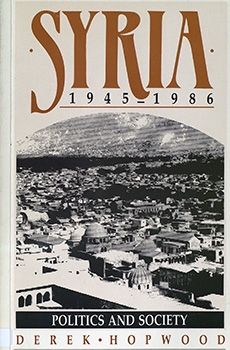
Syria 1945-1986: Politics and Society
Derek Hopwood
Unwin Hyman
Syria has often lacked sympathetic observers. This introductory text tries to interpret the country and its people in terms of how they see their own history and of what they are trying to achieve. More than a political or diplomatic history, it discusses the economy, society, education and culture to help the reader understand and explain contemporary Syria.
A description of the country deals with the physical and other factors which have influenced Syria's development. An historical survey concentrates mainly on the period after the Second World War and explains why a knowledge of Syrian history is important and why Syrians look at their history in the way they do. The achievements, problems and failures of President Asad are fully discussed. Further chapters explain the ideological factors which have been of vital importance in Syrian politics, the development of education, the economy and society. The author looks at examples of contemporary Syrian literature and the way in which writers view the problems of their society and culture.
This is a clear, succinct and readable account of modern Syria which will be essential for all those studying the Middle East, the developing world or international relations.
Derek Hopwood is the author of Egypt: politics and society 1945-1984 (Allen & Unwin, 1985) and is a fellow of St Antony's College, Oxford. He has been teaching Middle Eastern history for twenty years and has travelled extensively in the Middle East.
Contents
List of Maps / viii
Maps / ix
Preface / xiii
1 Syria and the Syrians / 1
2 The Emerging State / 13
3 Independence 1945-1970 / 31
4 Syria under Asad 1971-1986 / 54
5 Politics and Ideologies / 79
6 The Search for Economic Progress / 102
7 The Pursuit of Education / 115
8 The Growth of Culture / 132
9 People and Society / 166
10 Conclusion 183
Chronology of Events / 185
Important Personalities / 187
Bibliography / 188
Index / 191
List of Maps
Map 1 Syria’s neighbours / ix
Map 2 Syria / X
Map 3 Areas occupied by Israel after the 1967 war / xi
Map 4 Population distribution in the 1970s / xii
PREFACE
To many outsiders Syria is an enigma. I have written this book in an attempt to understand the country better myself and to pass on my conclusions for the judgement of others. It is only one person’s view of the country and there is obviously room for opposing or complementary views. My aim has been to try to explain why Syria behaves as it does and the historical reasons for this behaviour. It has not been written as propaganda or to elicit sympathy. Syria is in many ways a difficult country to write about. Its policy and aims are clear, yet the methods adopted to further them are impossible for many people to accept. The Syrians would assert that they do not act to gain world sympathy. They have certain objectives which they pursue unremittingly. Nevertheless, their external image is of concern to them. If a reader reaches the end of this book he may perhaps be in a better position to make his own judgement on a fascinating country.
This book is based on my interpretation of the works of others, on first hand impressions and on innumerable conversations with Syrian colleagues and friends and with scholars studying Syria. Among them I would like to mention Ruth and Kamal Abu Deeb, great friends and commentators on the Arab and Syrian scenes; Abd al-Nabi Staif, a friend and colleague in Oxford for many years; Salma Mardam, George Jabbur, Philip Khoury, Moshe Maoz and Khairiya Qasimiya, a delightful host in Damascus. Their views, written and spoken, are reflected in these pages as are those of the other scholars whose works I have used. They have helped me to form my own views on Syria which are in the end my responsibility and not theirs. This book, like my earlier one on Egypt, was written for those who may have no previous knowledge of the country or the area. If a specialist reads it he will be annoyed by the statement of the obvious. I have included footnotes to the more important sources. The bibliography includes all those studies I found of help in writing this book. It was completed coincidentally at a particularly difficult period in Anglo-Syrian relations. One can only hope that things will improve.
Derek Hopwood
Oxford, July 1987
1 Syria and the Syrians
Our idealism is the optimistic spirit which is
confident in itself, its nation and its future. (M. Aflaq)
The Land
Syria is both a country and a concept. The Arabic name for the region in the eastern Mediterranean between Egypt and Turkey is Sham which the dictionary defines as ‘the northern region, the north, Syria, Damascus’. For the early Arabs looking at the world from their Arabian homeland Sham was a term applied to a largely undefined place across the deserts to their north. They did not use the word Syria which was the Greek and Roman name for the province in that area, a name that probably derives from the Babylonian suri. To the Arabs it was Sham and usually remained so until the twentieth century when there came into being in a part of that region the modern state of Syria - named thus both by its Arab inhabitants and European statesmen. Sham is still used to signify the whole area — greater Syria — and to underline that, despite political frontiers, there still exists the concept of unity. This greater area is today divided into the states of Jordan, Syria, Lebanon, Israel and the West Bank of the Jordan under Israeli occupation.
It can be roughly defined geographically. In the north stretch the Taurus mountains in Turkey; to the west is the Mediterranean coast; to the east and south are deserts in which man-made boundaries have been drawn and which now march with those of Iraq, Saudi Arabia and Egypt. From north to south the region stretches over 800 kilometres and at its widest is 480 kilometres. The state of Syria comprises over half of the total area. It is triangular in shape with a portion taken out in the south-west where Lebanon is formed. The country is divided into a coastal zone, with a narrow double range of mountains and a large eastern area that includes mountains and vast deserts.
On the Mediterranean there are 160 kilometres of coastline which offer only sheltered coves and no large natural harbour.
Behind the narrow coastal plane the Nusairiya mountain range rises to 1500 metres and continues down to the Anti Lebanon mountains where a gap allows access from the coast to the inland city of Homs. The slopes of the mountains facing the sea benefit from moisture-laden winds and are more fertile and heavily populated than those facing the desert which receive only hot dry winds. The mountains are rather rugged with several deep valleys and ravines and steep cliffs which are difficult to traverse. On the tops of some of the hills still stand the imposing ruins of ancient Crusader castles, built to dominate the coastal plain. The Homs gap provides the only easy way to the interior from the coast and for centuries has been a favourite invasion and trade route. Today the railway and road from Tripoli in Lebanon run through it.
Behind the coastal mountains there is a lower and more extensive eastern chain which stretches from the Kurdish uplands in the north to the lofty mount Hermon (2800 metres), one of the most majestic peaks in Syria, on the border with Lebanon, known in Arabic as Jabal al-Shaikh - the grey-haired mountain. It drops southward into the plateaux of the Hauran and the Jaulan Heights.1 The Hauran, treeless with few springs but abundant wheat and pasture, rises again in the east to become the Druze mountain, a high volcanic region.
Between the two long ranges of mountains lies a rift valley. Through it runs one of Syria’s few rivers, the meandering Orontes, which rises in Lebanon and reaches the sea near Antioch in Turkey after a journey of 270 kilometres. On its way it waters the fertile Ghab region to the north of the Homs gap. Damascus itself is watered by the Barada river, rising in Lebanon and expiring in the desert. It has created the Ghuta oasis south of the city which was the basis of Damascus’ prosperity.
Fertile Crescent
The Fertile Crescent is the name given to a large area of cultivable land stretching from the northern Arabian desert round to the Gulf. The western section lies in Syria and includes the fringes of the desert at the foot of the eastern mountain chain, the Hauran, Damascus oasis, the plains of Homs, Hama and Aleppo, and the area known as the Jazira (the ‘island’), a fertile area in north-eastern Syria lying between the two rivers, the Tigris and the …
Derek Hopwood
Syria 1945-1986
Unwin Hyman
Unwin Hyman Ltd
Syria 1945-1986
Politics and Society
Derek Hopwood
Derek Hopwood
St Antony’s College, Oxford
London
Unwin Hyman
Boston Sydney Wellington
© Derek Hopwood, 1988
This book is copyright under the Berne Convention.
No reproduction without permission. All rights reserved.
Published by the Academic Division of
Unwin Hyman Ltd
15/17 Broadwick Street, London W1V1FP
Allen & Unwin Inc.,
8 Winchester Place, Winchester, Mass. 01890, USA
Allen & Unwin (Australia) Ltd,
8 Napier Street, North Sydney, NSW 2060, Australia
Allen & Unwin (New Zealand) Ltd
in association with the Port Nicholson Press Ltd,
60 Cambridge Terrace, Wellington, New Zealand
First published in 1988
British Library Cataloguing in Publication Data
Hopwood, Derek
Syria 1945-1986: politics and society.
1. Syria History 20th century
I. Title
956.9T042 / DS98.2
ISBN 0-04-445039-7
ISBN 0-04-445046-X Pbk
Library of Congress Cataloging in Publication Data
Hopwood, Derek.
Syria 1945-1986: politics and society I Derek Hopwood.
p. cm.
Bibliography: p.
Includes index.
ISBN 0-04-445039-7. ISBN 0-04-445046-X (pbk.)
1. Syria—Politics and government. 2. Syria—Social conditions.
I. Title.
JQ1825.S8H66 1988
956.91'042—dcl9
Typeset in 10 on 12 point Times by Nene Phototypesetters Ltd
and printed in Great Britain by Billing and Sons, London and Worcester