INTRODUCTION
When Iraq declared Kuwait its nineteenth lima (province) on 8 August 1990, it argued that the present-day frontiers of the Gulf states had been drawn by the colonial powers - in particular Britain - and that one of these frontiers was simply being correctly, if brutally, redrawn. In order to understand the course of events which this book follows, it is necessary to look back to the powerful impact on the Gulf region which the West made in the nineteenth century, to understand the West’s relationship with both the Ottoman Empire and the Iranian monarchy and to recognize the extent to which Western support for the state of Israel has undermined self-esteem in the Arab world.
This book covers major events between the end of the Second World War and the present day in three large states: Iran, Iraq and Saudi Arabia and six smaller ones: Kuwait, Qatar, Bahrain, the United Arab Emirates (UAE), Oman and the Republic of Yemen (former North and South). The period spreads itself through four extremely eventful decades. The late 1940s saw the emergence of Israel and the 1950s and the 1960s saw the total independence from the West of most of the Gulf states. The 1970s saw a boom era financed by escalating oil prices while the 1980s were dominated by the influence of the Islamic revolution in Iran. The 1990s have been flung into chaos by Iraq’s invasion of Kuwait and the international war that followed it in January 1991.
British domination: Iran’s humiliation
Between 1800 and the Second World War, most of the Gulf region came under various forms of European control, although until 1916 a great part of the region outside of Iran remained technically part of the Ottoman Empire ruled from Istanbul (formerly Constantinople). Iran remained independent in name, although in the mid-nineteenth century there was widespread resentment against the readiness of its monarch, Nadir al-Din Shah, to sell economic concessions to foreigners. This resentment led to a protest movement organized by the ulema (clergy) against a tobacco monopoly granted to a British subject in 1890.
The success of this movement brought about the alignment of the ulema, the bazaaris (or merchants) and the intelligentsia to limit the power of the Qajar shahs (or kings) and create a government that answered to a Western-style, elected assembly. Unfortunately, the achievements of the so-called constitutional revolution which came to a head in 1907 were never to be enjoyed, and the Qajars continued to rule autocratically. Following the end of the First World War, the British encouraged a Persian Cossack officer, Reza Khan (the father of the late shah), to seize power in 1921 and found a new autocratic dynasty, the Pahlavis, whose very name stressed Iran’s imperial, pre-Islamic past. On 12 December 1925 Reza Khan crowned himself shah. The Pahlavis’ continued autocracy and their attempts to bypass Islam fuelled widespread resentment and were to be the crucial factors leading to the Islamic revolution of February 1979 inspired by Ayatollah Khomeini.
The Arabian awakening
Although the intellectual awakening of the Arab world had its roots in Egypt and the Fertile Crescent (Syria, Lebanon, Palestine and Iraq), it has been argued that the first Arab movement with nationalist implications had emerged in what is now Saudi Arabia.
In 1744 Muhammad ibn Saud, the chieftain of Dir’iyyah, a town north of the present Saudi capital of Riyadh, became the patron of a religious revivalist preacher, Shaikh Muhammad ibn Abd al-Wahhab. Abd al-Wahhab sought to cleanse Muslim society of the corrupt and mystical practices which had become widespread since the time of the Prophet Muhammad in the seventh and eighth centuries AD. Muhammad ibn Saud and Abd al-Wahhab were to lead a puritan reformation and campaign of territorial expansion that swept Arabia.
However, Saudi power was checked first by Egypt’s semi-independent ruler, Muham¬mad Ali, and then by the Rashid clan who were based in the northern Saudi town of Hail. The Al-Saud (the Family of Saud) were eventually forced into exile in Kuwait. However, in 1902, after a dare-devil raid on Riyadh’s Musmak Fort, the future King Abd al-Aziz (popularly known as Ibn Saud) managed to drive Ottoman forces out of eastern Arabia and establish his authority over the central region of Najd. All of the Saudi kings since Ibn Saud (Saud, Faisal, IGialed and the present King Fahd) have been his sons.
Ibn Saud galvanized his ikhwan (literally brothers), puritan soldiery, to spearhead his conquests. He seized Hasa, now the Eastern Province, from the Ottomans, but under British pressure and persuasion desisted from taking the western, Hejaz region containing the holy cities of Mecca and Medina, until the end of the First World War. However, after the Turkish leader, Mustafa Kemal (Ataturk), had abolished the caliphate (the spiritual leadership of Islam) in 1924 the Sharif Husayn of Mecca had what Ibn Saud considered the gross impertinence of claiming it, thus giving Ibn Saud his casus belli for invading the Hejaz. In 1926 Ibn Saud’s armies took the Hejazi port of Jeddah and then the holy cities of Mecca and Medina. Having annexed the southern province of Asir in 1934, he was ruler of present-day Saudi Arabia.
Britain protects the shaikhs
The Arabian peninsula’s eastern seaboard has had strong links with Britain since the eighteenth century. In 1776, during the Persian occupation of Basra, Britain s East India Company moved the southern terminal of its overland mail route to Aleppo, from Basra to Kuwait. As long as Istanbul recognized Britain’s trade routes through the Gulf to India, Britain recognized nominal Ottoman control of the peninsula. The shaikh of Kuwait himself at times recognized Ottoman sovereignty (by paying tribute to the sultan), and Shaikh Abdullah ibn Sabah al-Jaber (1866-92) accepted the Ottoman title of qa’imaqam (district governor) in 1871. In 1899 his successor Shaikh Mubarak the Great, fearing an Ottoman invasion of Kuwait, signed a treaty agreement with Britain according to which Britain would defend Kuwait from external aggression.
The ‘Pirate Coast’ to the south (essentially the region of the present-day UAE) was to challenge Britain from its headquarters in Ras al-Khaimah. To secure its trade route to India, Britain signed truces with the tribal shaikhs in 1820, 1835 and 1853 when a treaty of maritime peace in perpetuity’ established a ‘perpetual maritime truce’ on what now became known as the Trucial Coast or Trucial Oman. In 1838 and 1847 the shaikhs also agreed to abandon their customary slave-trading. A truce in 1892 further consolidated British authority at a time when Russia and France were showing increasing interest in the region. When Britain eventually terminated all its agreements on 1 December 1971, six of the Trucial States became the UAE, the seventh, Ras al-Khaimah, joining a year later.
Just as Iraq had claimed Kuwait in the 1930s, in 1962 and in 1990 on the basis of Kuwait’s historic ties with Ottoman Basra, so Iran had long claimed the largely Shi i islands of Bahrain. In 1861,1880 and 1892 Bahrain’s amir (ruler) secured his independence from Iran by signing treaties with Britain similar to those that Kuwait and the Trucial States had signed. The amir bound himself not to enter into any relationship with a foreign government without British consent. In 1913 the British and Ottoman governments signed a convention recognizing Bahrain’s independence, although the islands remained under British administration. In 1923 the ruler was deposed and Britain’s powerful Sir Charles Belgrave was appointed adviser to the new ruler, becoming the power behind the throne. In 1916 during the First World War Britain signed a similar treaty with Qatar whose ruler, Abdullah ibn-Qasim, had decided to support Britain against the Ottoman Empire which was allied to Germany. According to the agreement, Abdullah undertook not to cede, sell, lease or mortgage any of its territory without British consent, to have no relations with any foreign power without British consent, to accept the stationing in the Qatari capital, Doha, of a British political agent and to desist from piracy, the slave trade and arms traffic.
Iraq becomes a nation-state
After the Mongols destroyed the great Abbasid Empire and sacked Baghdad in AD 1258, Iraq had become a mere frontier province of the Mongol Khans of Persia. Various regimes followed but when the Safavid Ismail made himself the Shah of Persia and imposed Sh’ism (see Glossary) on his majority Sunni (see Glosssary) subjects, the Sunni Ottoman sultan saw this as a challenge and in the course of a campaign with Persia (as Iran was called until 1935) conquered Baghdad in 1535. Iraq was to remain, at least nominally, part of the Ottoman Empire (apart from a short period of further Persian rule) until the First World War and was divided approximately into the three liivas of Basra, Baghdad and Mosul. By 1800 there was a British Resident (Britain’s senior political post in the region) at Basra and in 1802 a British consulate at Baghdad but until the reforms initiated in 1869 by Midhat Pasha, Iraq was little exposed to the West. It was with the emergence in 1908 of the reformist Young Turks that Arab nationalist sentiment began to flourish in cities such as Basra.
Arab hopes are disappointed
The First World War represented a period of dramatic changes for the region. In August 1914, shortly before war broke out, the Young Turks, who had come to power in Istanbul in 1908, made a secret treaty with Germany. They declared war on Britain, France and Russia in November. This meant that the allies were now at war with Istanbul throughout Arabia and the Near East. British forces landed at Iraq’s peninsular town of Fao in November, taking the vital Shatt al-Arab waterway dividing Iraq from Iran. In the famous Arab S'-'.oit ofjune 1916, the British officer, T.E. Lawrence (‘Lawrence of Arabia’), gave his support to Faisal, the son of the Sharif Husayn of Mecca, to lead a Bedouin army against the Ottoman Turks at Aqaba and from there to march on Damascus which was taken in October 1918. On 11 March 1917 the British had occupied Baghdad.
In 1917 a secret agreement reached the previous year (the Sykes-Picot agreement) was revealed to the world by the victorious Bolsheviks in Moscow who wanted to embarrass the imperial nations. It was a result of correspondence between the french and the British, and provided for the division of the Ottoman Empire if the allies won the war. Palestine would be internationalized, control of Mesopotamia (Iraq) and the ports of Haifa and Acre would go to Britain, and Syria and Lebanon would go to France. Yet, at the same time the Britis were promising the Sharif Husayn an independent Arab state in return for his support of the revolt. Even more significantly, in terms of the West’s ‘Great deception of the Arabs, was the Balfour Declaration of 2 November 1917 in which the British government favoured ‘the establishment in Palestine of a National Home for the Jewish people’. This was to become the basis on which the state of Israel was created in Palestine in 1948 and it has been a source of profound bitterness to the Arabs ever since.
Britain and France divide the spoils
The war ended, and the January 1919 peace conference in Paris rearranged the frontiers of Europe. In 1924 Ibn Saud was to defeat the Sharif, the British doing nothing to protect their erstwhile ally. In March 1920 the Syrian National Congress proclaimed the Sharif s son, Faisal, king of Syria (including Palestine) but at the San Remo conference in April, the League of Nations parcelled out Syria, Lebanon, Palestine, Iraq and the newly-created emirate of Transjordan (later to become Jordan) as ‘mandates’, virtual protectorates, in approximate accordance with the now-notorious Sykes-Picot agreement. Iraq went to Britain and this led to a major uprising in Iraq which was not put down by the British until 1921. In March 1921 Faisal, whom the French had forced out of Syria as they took over their mandatory responsibilities, became king of Iraq. He was crowned on 23 August. His brother, Abdullah, was made amir of Transjordan on 1 April 1921.
The Second World War saw dramatic changes in the region once again as well as constant European interference. In July 1937, incidentally, Iraq had signed an important treaty with Iran providing for agreement on their mutual borders. Meanwhile, Iraq’s relations with Britain began to deteriorate because of Britain’s role in allowing the increasing settlement in Palestine of Jews fleeing Nazi persecution in Europe. German influence increased in Iraq and was to have a particular impact on an Iraqi army group later to be known as the Golden Square. In April-June 1941 an Iraqi lawyer and politician called Rashid Ali al-Gailani came to power and demonstrated pro-German sympathies, provoking the British occupation of Baghdad and Basra. Meanwhile, the Allies took Syria and Lebanon from the Vichy French, and in August Anglo-Soviet troops moved into Iran. On 16 September 1941 Reza Shah was forced to abdicate because of his apparently pro-German sympathies and was replaced by his son, Muhammad Reza.
The exodus of the Palestinians
After the war, the politics of the region were dominated by the influx into Palestine of hundreds of thousands of Jews from Europe, the creation of the state of Israel in 1948 and the first Arab-Israeli war which immediately followed it. The flight of up to one million Palestinians to neighbouring countries contributed to the dangerous political climate of the period. The humiliating defeat of the Arabs was a factor in provoking the Egyptian revolution in 1952 of young army officers. They were led by the charismatic Colonel Gamal abd al-Nasser who replaced the monarchy of King Faruk. Nasser’s philosophies of pan-Arabism, Arab socialism and uncompromising hostility to Israel were to make him a hero with the Arab masses. His nationalization of the Suez Canal in 1956 and the subsequent humiliation of Britain and France made him a kind of Arab ‘superman’.
Nasser: the super-star of Arab nationalism
In 1958 Egypt’s union with Syria as the United Arab Republic (UAR) on 1 February 1958 appeared to be the first step in his dream of pan Arab unity. In July General Abd al-Karim Qasim led a revolution against the Iraqi monarchy in which the young King Faisal II, the regent, Abdulilah, and the prime minister, Nuri al-Said, were slaughtered. Iraq was to experience a period of violent conflict between the Communists and the Arab nationalist Ba’th Party and several reigns of terror. Today both Syria and Iraq are ruled, at least in principle, by mutually hostile groups of Ba’thists.
Nationalism and the search for cultural roots after longperiods ofWestem domination lie at the heart of this period of Arab history. Nasser’s success in championing independence was mirrored briefly by Muhammad Musaddiq in Iran who attempted to nationalize the British-owned oil company which was based in Iran. But the forces against Musaddiq were too strong and the combined efforts of the West and Central Intelligence Agency (CIA) money eventually toppled him and brought the young Shah Muhammad Reza back to his Republicanism, exemplified by Nasser, and monarchism, exemplified by the no-less idealistic King Faisal of Saudi Arabia, were to confront each other in the long civil war in Yemen. No sooner had that come to an end than the Arab-Israeli war of 1967 saw Egypt’s Sinai, Palestine’s West Bank and Gaza Strip and Syria’s Golan Heights absorbed by a conquering Israel. In the humiliation of that war lies many of the problems of the Arab world today.
When Nasser died in 1970 he was replaced by Anwar Sadat who was to make tn dramatic peace mission to Israel in 1977 which led to the Camp David peace agreements two years later. Although most Arab states broke ties with Egypt over what they considered its treachery to the Palestinian cause, their fear of the spread of Islamic militancy after_the 1979 Islamic revolution in Iran and the eight-year Iran-Iraq war which Parted in l^SU, soon saw Egypt courted by its neighbours again. Iraq, in particular, found itself dependent on Egypt throughout the war. By the time of Iraq’s invasion of Kuwait in August 199U, Egypt had once again become the pivot of the Arab world, this time leading a coalition o Arab states against Iraq.
The Islamic revolution
No event in modern Middle East history has been more momentous than the Islamic revolution in Iran of February 1979. The replacement of a Western-supported monarchy by a populist revolution with its roots in Islam was to inspire Islamic militants throughout the world and alarm Arab regimes. With the taking of the shah’s palace in Tehran on 9 February, control of Iran was finally in the hands of revolutionaries inspired by Ayatollah Khomeini The revolution had been the culmination of a year in which sometimes as many as three million unarmed people had defied imperial troops, at first every forty days (the Shi’i period of mourning), then almost daily, to demand the replacement of the shah’s regime by an Islamic republic.
The seeds of the revolution were sown during the economic boom of the 19/Us. Atte the Arab-Israeli war of 1973 and the quadrupling of oil prices which followed it, the shah believed himself able to fulfil his dream of turning Iran into a military and economic giant. The result was massive spending, raging inflation and severe shortages of foo and consumer goods. Accelerating rural drift crippled agriculture while Westerners who poured into the country took the best jobs and brought with them cultural values that disturbed the country’s Islamic identity.
The subsequent reduction of oil revenues forced cutbacks in the economy while severe power cuts in Tehran in the summer of 1977 affected every family and belied the myth that the nation was on the point of becoming a second Japan. Many Iranians saw their Muslim traditions increasingly eroded; the mosque benefited from this cultural backlash with women adopting the hijab (head covering) and chador (body-wrap) and students seeking security in Islam.
The election to the US presidency of the liberal Jimmy Carter in 1976 had encouraged the dissidents from the Mosque, the universities and the bazaar to meet for the first time in large, illegal gatherings. The mysterious death of Khomeini’s son later in the year triggered suspicion that the shah’s secret police, SAVAK, was responsible. When theology students demonstrated on 9Januaty 1978 against an article critical of Khomeini, die police killed six of the demonstrators. The Mosque promptly declared a traditional Shi 140-day mourning period which automatically associated the martyrs in people’s minds with those of the early days of Islam such as Husayn and Hasan (the sons of the Prophet Muhammad’s cousin and son-in-law, Ali) and the shah and his regime with their persecutor, Yazid. The demonstrations became bigger, the reprisals more brutal and the mourning periods almost constant. The shah responded with liberal measures but remained unwilling to reduce his own powers. The result of this indecision was disastrous: the pressure valves of dissidence being lifted while the security forces felt emasculated and panicked. Two traumatic events in 1978, the Abadan cinema burning on 19 August and the Jaleh Square massacre of 8 September had left the regime without any real remaining options. The burning of the cinema with 477 people locked inside was widely blamed on SAVAK while the Jaleh Square massacre in which up to 1,000 demonstrators were shot made any concordat between the regime and conservative religious leaders impossible. A day of anarchy in Tehran on 5 November was the prelude to the shah’s final departure on 16 January. On 1 February Khomeini returned from France to a tumultuous welcome and within 11 days he was effectively the ruler of the country.
The siege by Islamic militants of the Great Mosque of Mecca in November 1979 was to serve as a warning against corruption and decadence among the ruling elites of the Arab states. The Iran-Iraq war which followed was to help the Iranian clergy keep the Islamic struggle alive and their own power-base secure. However the West, by supporting Saddam Husayn’s Iraq, effectively created a new regional power that had become a potential threat to its Arab neighbours once the war had ended without advantage to either Iraq or Iran.
Saddam Husayn threatens the Arab dream
Arab moderates were horrified by Iraq’s invasion of Kuwait because it seemed to expose as hollow the whole concept of Arab unity. Nevertheless, Saddam Husayn did not hesitate in claiming to be the very exemplar of Arab unity and nationalism. Kuwait, he maintained, had merely returned to its mother, Iraq. By linking any withdrawal from Kuwait with an Israeli withdrawal from the West Bank and Gaza, he managed to endear himself to the despairing Palestinians and draw the world’s attention to the very heart of the grievance of the Arab world. He was also playing on the envy and disgust that many poor Arabs felt for the rich oil shaikhs of the Gulf. However bad Saddam Husayn’s human rights record in Iraq might have been, his invasion of Kuwait seemed to win genuine support from the Arab masses, not only from Iraqis but also from Palestinians, Jordanians and Syrians. At the time of writing, whatever the outcome of the war raging in Iraq, the Middle East will never be the same again.
Note on transliteration
I have chosen as practical a transliteration system as possible. For names, I have used the classical Qasim rather than the anglicized Kassem, Abd al-Aziz rather than Abdul Aziz and Husayn in Arabic and Hussein in Persian. I have avoided elisions, writing Al-Sabah rather than As-Sabah.
Note on chronology
Where two unrelated events have occurred on the same date, I have repeated the date to introduce the second entry. On rare occasions where the exact date is unknown, I have simply inserted the month.
Organizations - e.g. the Revolutionary Command Council - are written in full for the first time in each year. Thereafter, the acronym - RCC - is used. Common Arabic and Persian words as well as acronyms are listed in the Glossary.
1945
January In Saudi Arabia the California Arabian Standard Oil Company, owned jointly by the Standard Oil Company of California and the Texas Company, is re-formed as the Arabian American Oil Company (ARAMCO). In the same month work began on ARAMCO’s Trans-Arabian pipeline (Tapline), running between the oilfields m Saudi Arabia’s Eastern Province and the port of Sidon on the Mediterranean. Then the world s largest privately financed construction project, the pipeline was delayed while US Congress was being persuaded to approve the oil companies’ plans.
A stumbling block was, and was to continue to be, Saudi anxiety about the Rowing political tension in Palestine caused by mass Jewish immigration. Indeed, ARAMCO briefly withdrew its backing for the pipeline while the US secretary of defence declared that unless the US had access to Middle East oil ‘American motorcar companies would have to design a four-cylinder motorcar sometime within the next five years’. The Arab League reached a tentative agreement that pipeline rights would be refused to US companies so long as the US gave the Zionists unquestioned support. Nevertheless, work on the pipeline eventually began in January under the supervision of the US company, Bechtel, although it was not to be completed until September 1950. It was delayed by the first Arab-Israeli war which followed the ending of the British mandate in Palestine and the declaration of the new Israeli state in Palestine on 14 May 1948.
14 February King Abd al-Aziz (popularly known to foreigners as Ibn Saud) of Saudi Arabia meets US President Roosevelt on board USS Quinty in die Suez Canal s Great Bitter Lake The meeting was extremely friendly and characterized by mutual respect. Roosevelt wanted to enlist the king’s help over the question of Palestine. However, there was no real meeting point, the king arguing that the Jews should be given a part of Germany as reparation for the Nazi atrocities committed against them in the concentration camps m Germany, Poland and elsewhere during the Second World War.
17 February Ibn Saud meets the British prime minister, Winston Churchill, in the Grand Hotel du Lac on the shores of Egypt’s Fayyoum Oasis. In contrast with the Roosevelt meeting, the Churchill meeting was strained, to say the least. As an indication of the shifting balance of power, prior to the Churchill meeting Ibn Saud had even asked Roosevelt if there was any US objection to it. For his part, Churchill treated the king with contempt, making a point of drinking alcohol - forbidden to Muslims and loathsome to the fundamentalist Ibn Saud - and smoking huge cigars in his Saudi Arabia had declared war on Germany just in time to be eligible for admission to the new UN, and the US had by now almost completely replaced Britain as a world power. However, Roosevelt’s successor, Harry Truman, was to take a far more pragmatic and, in Arab eyes, far less flexible line on the question of Palestine, making the famous remark to State Department officials in November: ‘I’m sorry, gentlemen, but I have to answer to hundreds of thousands who are anxious for the success of Zionism, I do not have hundreds of thousands of Arabs among my constituents.’ When the British Labour prime minister, Clement Attlee, succeeded Winston Churchill earlier in the year, Truman urged the immediate admission of 100,000 Jews to Palestine. Clement Attlee, keen to cultivate friendly relations with oil-rich Saudi Arabia, was loathe to upset Ibn Saud by allowing further Jewish immigration.
…..
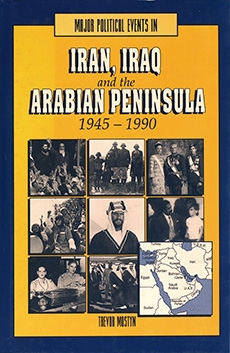
Trevor Mostyn
Major Political Events in
Iran, Iraq. and the Arabian Peninsula
1945-1990
Facts on File
Facts on File Limited
Major Political Events in
Iran, Iraq. and the Arabian Peninsula
1945-1990
Trevor Mostyn
facts On File
New York - Oxford
Major Political Events in Iran,
Iraq. And the Arabian Peninsula
Series editor: Thomas S. Arms
Copyright © 1991 by Trevor Mostyn
All rights reserved. No part of this book may be reproduced
or utilized in any form or by any means, electronic or
mechanical, including photocopying, recording,
or by any information strorage or retrieval systems,
without permission in writing from the publisher.
For information contact:
Facts on File Limited
Collins Street
Oxford 0X4 1XJ
UK
or
Facts on File, Inc.
460 Park Avenue South
New York NY10016
USA
A British CIP catalogue record for this book is available from
the British Library
Library of Congress Cataloging-in-Publication Data
Mostyn, Trevor.
Major political events in Iran, Iraq and the Arabian Peninsula, 1945-1990 / Trevor Mostyn.
p. cm. — (Major Political events series)
Includes bibliographical references and index.
ISBN 0-8160-2189-9
1. Persian Gulf Region—Politics and government. I. Title. II. Series
DS326.M64 1991
950—dc20 / 90-22491
CIP
ISBN 0-8160-2189-9
Facts on File books are available at special discounts
when purchased in bulk quantities for businesses,
associations, institutions or sales promotions.
Please contact the Special Sales Department of our Oxford office on
0865 728399 or our New York office on 212/683-2244
(dial 800/322-8755 except in NY, AK or HI).
Jacket design by Richard Garratt
Typeset by Selectmove Ltd, London
Printed and bound in Great Britain by
Biddles Ltd, Guildford and King’s Lynn
10 9 8 7 6 5 4 3 2 1
This book is printed on acid-free paper.