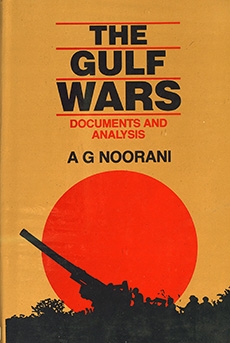
The Gulf Wars: Documents and Analysis
Abdul Ghafoor Noorani
Konark Publishers
The war in the Gulf in January- February 1991 marks a watershed in the transition from a multi-polar to a uni-polar world. Whether it remains uni-polar for long remains to be seen, but the genesis of the war and its after-math are of utmost importance. This collection of documents will assist all those who wish to study the Gulf War in detail. The editor has taken care to include documents representing all viewpoints, making the selection comprehensive and impartial. Comment is confined to a stimulating Introduction.
The views expressed here are refreshingly different from the stereotypes bred by ideological predilections. A.G. Noorani denounces both Iraq and the United States as aggressors.. The impact of the war on the United Nations is also discussed along with the fallout of the ruinous decade-old war between Iraq and Iran. The editor has provided notes on the territorial disputes between Iraq on the one hand and Iran and Kuwait on the other to highlight the pointlessness of the conflicts brought about by the megalomania of a dictator.
A.G. Noorani practises as an Advocate in the Supreme Court and the Bombay High Court, writes a regular column for Indian Express and contri¬butes to Indian and foreign periodicals. He is the author of The Kashmir Question-, Dr. Zakir Hussain, Ministers’ Misconduct-, Badruddin Tyabji-, India, the Super Power and the Neighbours and some other books.
Mr Noorani has written on constitu-tional and political affairs for nearly three decades. In 1990 two volumes containing selections from his articles on constitutional and political issues were published by Konark.
Contents
Introduction / xvii
Iran-Iraq Territorial Disputes / xxxi
Iraq-Kuwait Territorial Disputes / xvii
1. Letter from the Prime Minister of
Iraq and the Ruler of Kuwait
reaffirming the Kuwait-Iraq Boundary / 1
2. Agreed minutes between the State of
Kuwait and the Republic of Iraq
regarding the restoration of friendly
relations / 2
3. Treaty of friendship and co-operation /
between the USSR and the Republic
of Iraq / 4
4. The Algiers accord / 7
5. Treaty concerning the frontier and
neighbourly relations between Iran
and Iraq / 9
6. Protocol concerning the delimitation
to the river frontier between Iran
and Iraq / 13
7. UN Council resolutions on Iraq-Iran
War / 17
8. UN General Assembly resolution on
Iraq-Iran armed conflict / 19
9. UN Security Council resolution / 21
10. UN Security Council resolution / 22
11. UN Security Council resolution / 23
12. UN Security Council resolution / 24
13. Iraq’s reply to Security Council resolution / 26
14. Iran’s reply to Security Council resolution / 29
15. President Khamenei’s letter to UN Secretary General, Perez de Cuellar / 33
16. Agreement on non-interference in internal affairs and non-use of force
between Iraq and Saudi Arabia / 34
17. President Saddam Hussein’s letter to Iranian leaders / 35
18. President Saddam Hussein’s letter to Iranian Islamic Revolution leader
Ali Khamenei and Iranian President Ali Akbar Hashemi-Rafsanjani / 37
19. President Saddam Hussein’s cable to Iranian President Ali
Akbar Hashemi-Rafsanjani / 42
20. Assistant Secretary of State, John Kelly’s remarks to the House
Foreign Affairs Committee / 46
21. President Bush’s remarks / 47
22. Soviet statement on Iraq-Kuwait conflict / 49
23. UN Security Council resolution / 50
24. Statement by official spokesman of India / 50
25. The Arab League’s resolution / 51
26. Gulf Co-operation Council: Ministerial council statement / 52
27. Mr. Tariq Aziz’s letter to Arab League’s Secretary General Chedli Klibi / 53
28. OIC statement / 54
29. Joint statement issued by Soviet Foreign Minister Eduard
Shevardnadze and US Secretary of State James Baker at Moscow / 55
30. UN Security Council resolution / 57
31. News conference by President Husni Mubarak / 60
32. Letter from Iranian President Ali Akbar Hashemi-Rafsanjani to
President Saddam Hussein / 71
33. President Bush’s announcement of despatch of US military units to Saudi Arabia / 75
34. The USSR Foreign Ministry statement / 79
35. Resolution issued by Emergency Arab Summit in Cairo / 80
36. Mr. Martin Fitzwater’s statement / 82
37. President Saddam Hussein’s proposal / 83
38. Commentary by Ze’ve Schiff on President Saddam’s proposal / 85
39. President Saddam Hussein’s letter to Iranian President Ali Akbar
Hashemi-Rafsanjani / 86
40. President Bush’s remarks / 88
41. President Gorbachev on full scale war in Gulf / 89
42. UN Security Council resolution / 91
43. Open letter from President Saddam
Hussein to the families of foreigners in Iraq / 92
44. Statement issued by the PLO leadership / 96
45. Open letter from President Saddam Hussein to US President George Bush / 99
46. Statement issued by I.K. Gujral, Minister of External Affairs on his
visit to Moscow, Washington, Amman, Baghdad and Kuwait / 102
47. US Secretary of State Baker’s prepared testimony to House
Foreign Affairs Committee / 109
48. Final communique of GCC Foreign Ministers’ meeting / 117
49. Peace Plans / 120
50 Peace Plans / 124
51. Statement issued by I.K. Gujral, Minister of External Affairs in Parliament / 125
52. Joint statement by President Gorbachev and President Bush in Helsinki / 127
53. President Bush’s address to the US Congress / 128
54. US refrained from warning off President Saddam Hussein / 136
55. UN Security Council resolution / 139
56. UN Security Council resolution / 140
57. UN Security Council resolution / 142
58. Extracts from the statement by President Francois
Mitterrand of the French Republic to the UN General Assembly / 142
59. Extracts from the speech of Soviet Foreign Minister Eduard
Shevardnadze in the UN General Assembly / 147
60 UN Security Council resolution / 155
61. New Yemeni initiative to solve Gulf crisis / 138
62. President Saddam Hussein’s views on President Francois
Mitterrand’s address in UN General Assembly / 158
63. President Bush’s remarks in the UN General Assembly / 160
64. Extracts from the speech of Tariq Aziz, Deputy Prime Minister and
Foreign Minister of Iraq in UN General Assembly / 166
65. Extracts from the speech of the British Secretary of State for
Foreign and Commonwealth Affairs Mr Douglas Hurd in UN General Assembly / 171
66. UN Security Council resolution / 171
67. UN Security Council resolution / 174
68. US has no right to war: Cuellar / 175
69. UN Security Council resolution / 176
70. UN Security Council resolution / 177
71. UN Security Council resolution / 177
72. President Bush’s statement on Gulf crisis / 178
73. Doha Declaration’ issued by the GCC leaders / 182
74. The French seven-point plan presented in Luxembourg / 192
75. Excerpts from President Bush’s news conference / 193
76. Mr. Tariq Aziz’s news conference in Geneva / 194
77. President Bush’s letter to President Saddam Hussejn / 205
78. Meeting held between President Saddam Hussein and Perez de
Cuellar, UN Secretary General / 207
79. UN Secretary General’s Press meet on his arrival from Iraq / 224
80. Statement by the UN Secretary General to the Security Council / 225
81. UN Secretary General Javier Perez de Cuellar’s statement / 228
82. French launch 11th hour bid for Gulf crisis / 230
83. President George Bush’s news conference / 230
84. Letter from President Saddam Hussein to Soviet President Mikhail
Gorbachev in reply to his letter / 235
85. President Chadli Bendjedid’s speech to the National People s Assembly / 237
86. It is not UN war says Perez de Cuellar / 239
87. Extracts from the State of the Union address by President Bush / 240
88. Joint Soviet-US statement / 245
89. UN Secretary General’s letter to the Foreign Minister Tariq Aziz / 246
90. UN has no control over war says Perez de Cuellar / 248
91. The US Secretary of State, James Baker’s statement before the US
House of Representatives’ Committee of Foreign Affairs / 249
92. President Gorbachev’s statement / 269
93. Iraq’s apprehensions on NAM / 271
94. Ramsey Clark’s report on US bombing of Iraq / 271
95. Indian proposal for Non-Aligned Peace Initiative / 280
96. UN Security Council to hold closed formal session / 283
97. Council must send firm message to Iraq says US / 286
98. China’s statement in UN Security Council / 292
99. Summary of UN Security Council’s debate / 293
100. Excerpts from statement by former Nicaraguan
President Daniel Ortega from Amman / 298
101. Statement by the Iraqi Revolution Command Council / 302
102. The Foreign Ministers of Egypt, Syria and the GCC’s statement / 305
103. AMU Foreign Ministers’statement / 310
104. Statement issued by the Foreign Ministers of Islamic Summit Conference / 312
105. Press Secretary Marlin Fitzwater’s briefing / 316
106. President Bush’s statement / 318
107. Moscow Peace Plan / 319
108. Latest Soviet Peace Plan / 320
109. Press Secretary Marlin Fitzwater’s briefing / 321
110. Vitaliy Ignatenko, Chief of the Press Service of Soviet President’s brief / 323
111. Statement by Iraqi Foreign Minister Tariq Aziz in
Moscow accepting the Soviet Peace Plan / 324
112. News conference in Moscow by Vitaliy Ignatenko, spokesman for
Soviet President Gorbachev / 325
113. Press Secretary Marlin Fitzwater’s statement / 329
114. Statement by President Bush / 330
115. Soviet Government statement / 331
116. Iraqi President’s broadcast on withdrawal / 332
117. Press Secretary Marlin Fitzwater’s statement / 335
118. President Bush’s address to nation / 337
119. Marlin Fitzwater’s briefing / 338
120. Letter from Iraqi Foreign Minister to UN Secretary General / 339
121. President Bush announces suspension of war with Iraq / 340
122. Letter from Iraqi Foreign Minister to the UN Security Council / 342
123. UN Security Council resolution / 343
124. UN Security Council resolution / 344
125. US Commander of Operation Desert Storm, General Norman
Schwarzkopf’s briefing / 346
126. Statement of the President of the Security Council / 348
127. Letter of Iraq to the UN / 349
128. Letter from Mr Tariq Aziz to UN Security Council / 350
129. Revolution Command Council's decision / 351
130.Speech by President Bush to US Congress / 352
131. The Damascus declaration on co-ordination and co-operation
among Arab countries / 358
132. Soviet views on post-crisis set-up in Gulf area / 363
133. Report to the Secretary General on humanitarian needs in Kuwait and
Iraq in the immediate post-crisis environment by a mission to the area led by
Mr Martti Ahtisaari, Under Secretary General for Administration and Management / 366
134. Letter from Nasser Al-Kidwa to President, UN Security Council / 380
135. Letter from Abdul Amir Al-Anbari to President, UN Security Council / 381
136. Security Council adopts Gulf Cease-Fire Resolution / 382
137. UN Security Council resolution / 392
138. Letter by the President of the Security Council addressed to the
permanent representative of Iraq / 393
139. Exchange of letters between the Secretary-General and the
President of the Security Council concerning the composition of UNIKOM / 394
140. UN Security Council resolution / 395
Index / 397
ACKNOWLEDGEMENTS
The author is greatly indebted for the unstinted cooperation and gener-ous assistance he has received from Air Commodore Jasjit Singh, AVSM, VC, VM, Director, Institute for Strategic Studies & Analyses, New Delhi; Dr. Bhaichand Patel, Director, United Nations Information Centre, New Delhi; the Directors of the United States Information Service, Delhi and Bombay; the Information Department, Embassy of the USSR, New Delhi, the Press section of the Embassy of Iraq, New Delhi and the Press Section of the Embassy of France, New Delhi.
—A.G. Noorani
Introduction
As the euphoria in the United States and in the coalition partners who followed its leadership evaporates with the passage of time, questions are sure to be raised as to the soundness of President George Bush’s decision to prefer a quick, devastating war on Iraq to the slower processes of diplomacy backed by economic sanctions. All available evidence, which is confirmed by Bob Woodward’s book The Com-manders, suggests that the decision was his alone and, both, Secretary of State James Baker and the Chairman of the Joint Chiefs of Staff, General Colin L. Powell, had serious reservations. Victory stills doubts but only in the minds of victors. Dissent within the United States is unlikely to abandon its quest for the truth. The world outside should pursue it in its own way.
This collection of documents is a modest effort in that quest. The documents have been selected with every care to ensure that they represent the record faithfully and tell the story by themselves. Comment is confined to this Introduction. No attempt is made to conceal the view that the United States’ recourse to war was worse than unwise and contrary to the Charter of the United Nations. It was immoral and ruinous.
When Baker said on January 26,1991, in the presence of the Soviet Foreign Minister Alexander A. Bessmerthnyhk, “It is not, of course, the purpose or goal of the multinational coalition to destroy Iraq”, none believed him. Every one knew what Secretary of Defence Dick Cheney admitted, rather boasted, the next day. “In effect, what we’re doing with our air campaign is very aggressively going after his (Saddam Hussein’s) production facilities for chemical and biological weapons, his storage facilities, those places, for example, where he loads chemical weapons into warheads. We’re going after the means by which he would deliver them, his artillery, his rocket launcher battalions, his aircraft capabilities.”
Bush claimed, on January 28 “it is a just war... Our cause could not be more noble… we do not seek the destruction of Iraq… But a just war must also be declared by legitimate authority… it is our gravest obligation to conduct a war in proportion to the threat. And that is why we must act reasonably humanely, and make every effort possible to keep casualties to a minimum. And we’ve done so”. Every one of these five claims was false.
After a visit to Iraq, the Under-Secretary-General of the United Nations, Martti Ahtissaari, said in his Report (S/22366) on March 21: “I and the members of my mission were fully conversant with media reports regarding the situation in Iraq and, of course, with the recent WHO/UNICEF report on water, sanitary and health conditions in the Greater Baghdad area. It should, however, be said at once that nothing that we had seen or read had quite prepared us for the particular form of devastation which has now befallen the country. The recent conflict has wrought near-apocalyptic results upon the economic infrastructure of what had been, until January 1991, a rather highly urbanised and mechanised society. Now, most means of modem life support have been destroyed or rendered tenuous. Iraq has, for some time to come, been relegated to a pre-industrial age, but with all the disabilities of post-industrial dependency on an intensive use of energy and technology.
“My mandate was limited to assessing the need for urgent humani-tarian assistance. It did not extend to the huge task of assessing the requirements for reconstructing Iraq’s destroyed infrastructure, much less, to developmental matters. Accordingly, my report to you, in its several technical sections, seeks with as much exactitude as possible to convey the extent of needs in the primary areas of humanitarian concern: for safe water and sanitation, basic health and medical support; for food; for shelter; and for the logistical means to make such support actually available. Underlying each analysis is the inexorable reality that, as a result of war, virtually all previously viable sources of fuel and power (apart from a limited number of mobile generators) and modem means of communication are now, essentially, defunct. The far-reaching implications of this energy and communications’ vacuum as regards urgent humanitarian support are of crucial significance for the nature and effectiveness of the international response.”
Such a result cannot ensue from a war for the liberation of Kuwait, a war under a mandate of the United Nations. It can be—as, indeed, it was—the inescapable consequence only of a war that was aimed intentionally, primarily at the destruction of Iraq’s military capability but which could not have failed to destroy Iraq itself. This was the foreseeable and foreseen consequence of Bush’s decision.
This explains the attempts to conceal the enormity of the destruction that was wrought. Patrick E. Tyler of New York Times reported that three months after the Gulf war had ended, “A comprehensive assess-ment of the damage from the intense 43-day allied bombardment remains classified and the administration has been reluctant to divulge details”, so much for the consequences of a “just war”. (International Herald Tribune, June 4, 1991)
Tyler added: “The assessment indicates that Iraq’s electrical power industry may have been damaged well beyond the intentions of allied war planners, who developed a still-secret weapon that dropped thou-sands of metallic filaments onto the electrical network at key points to create huge short-circuits and blackouts on the night of Jan. 17, when the war began. This was followed by raids on power plants. Even now, 80 per cent of the nation’s power grid is out of service. Electricity shortages are aggravating a health care crisis…
“Overall, the American analysts say, the Iraqis are struggling precariously under a patchwork of short-term fixes and remedies that will probably deteriorate in the months ahead if the Bush administration maintains trade sanctions in an effort to force President Saddam Hussein from power.
“The Bush administration’s internal findings parallel those reported by a special United Nations mission to Iraq in March....” Predictably, the Ahtissaari Report was criticised by the United States when it was published. The former U.S. President Jimmy Carter said, on May 2, that negotiations would have brought a better result. He thought that the decision to use military force was reached by Bush “quite early in the process”. Robert E. Hunter, Vice-President of the Centre for Strategic and International Studies in Washington, D.C., who is no dove, had no hesitation in saying that it was “nonsense” to claim that the US’ “Central goal” in the war was an Iraqi withdrawal from Kuwait. (Washington Post; February 3). “In retrospect, it is clear that this was also true before the war. If George Bush only wanted to get Iraq out of Kuwait, he did little to help bring it about.”
When, on August 2, 1990 Iraq marched into a defenceless Kuwait in an unprovoked act of brazen aggression, the United States’ initial response was reflected in the Security Council’s Resolution 660 adopted that day. The aggression was condemned and Iraq’s withdrawal was demanded peremptorily and rightly so. But Para 3 called upon “Iraq and Kuwait to begin immediately intensive negotiations …
A. G. Noorani
The Gulf Wars
Documents and Analysis
Konark Publishers
Konark Publishers Pvt. Ltd.
The Gulf Wars
Documents and Analysis
A. G. Noorani
Konark Publishers Pvt Ltd
A-149, Main Vikas Marg, Delhi 110 092
Copyright ©A.G. Noorani, 1991
Typeset at Excel Computer Services, New Delhi and printed at
Shiba Offset Printing Press, Delhi
Cover design:
Dushyant Parasher
ISBN 81-220-0250-1