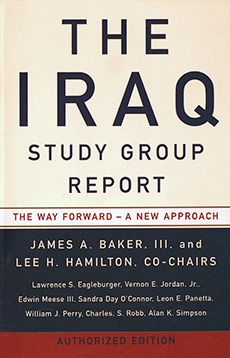
The Iraq Study Group Report James A. Baker, Lee H. Hamilton Vintage Books
On March 15, 2006, members from both parties in Congress supported the creation of the bipartisan Iraq Study Group to review the situation on the ground and propose strategies for the way forward. For more than eight months, the Study Group met with military officers, regional experts, academics, journalists, and high-level government officials from America and abroad. Participants included George W. Bush and members of his cabinet: Bill Clinton: Jalal Talabani: Nouri Kamal al-Maliki: Generals John Abizaid, George Casey, and Anthony Zinni; Colin Powell: Thomas Friedman: George Packer: and many others. This official edition contains the Group's findings and proposals for improving security, strengthening the new government, rebuilding the economy and infrastructure, and maintaining stability in the region. It is a highly anticipated and essential step forward for Iraq, America, and the world. A portion of the proceeds from the purchase of this book will be donated to the national military family association. Which supports families of all ranks and services. Including those of the deployed. Wounded. And fallen.
Contents
Letter from, the Co-Chairs / ix Executive Summary / xiii
I. Assessment
A. Assessment of the Current Situation in Iraq / 3 1. Security / 3 2. Politics / 12 3. Economics / 22 4. International Support / 27 5. Conclusions / 32
B. Consequences of Continued Decline in Iraq / 33
C. Some Alternative Courses in Iraq / 37 1. Precipitate Withdrawal / 37 2. Staying the Course / 38 3. More Troops for Iraq / 38 4. Devolution to Three Regions / 39
D. Achieving Our Goals / 40
II. The Way Forward—A New Approach
A. The External Approach: Building an International Consensus / 43 1. The New Diplomatic Offensive / 44 2. The Iraq International Support Group / 46 3. Dealing with Iran and Syria / 50 4. The Wider Regional Context / 54
B. The Internal Approach: Helping Iraqis Help Themselves / 59 1. Performance on Milestones / 59 2. National Reconciliation / 64 3. Security and Military Forces / 70 4. Police and Criminal Justice / 78 5. The Oil Sector / 83 6. U.S. Economic and Reconstruction Assistance / 86 7. Budget Preparation, Presentation, and Review / 90 8. U.S. Personnel / 92 9. Intelligence / 93
Appendices
Overview Map of the Region / 99 Overview Map of Iraq / 100 Administrative Divisions / 101 Distribution of Religious Groups / 102 Letter from the Sponsoring Organizations / 103 Iraq Study Group Plenary Sessions / 106 Iraq Study Group Consultations / 107 Expert Working Groups and Military Senior Advisor Panel / 117 The Iraq Study Group / 124 Iraq Study Group Support / 142
LETTER FROM, THE CO-CHAIRS
There is no magic formula to solve the problems of Iraq. However, there are actions that can be taken to improve the situation and protect American interests.
Many Americans are dissatisfied, not just with the situation in Iraq but with the state of our political debate regarding Iraq. Our political leaders must build a bipartisan approach to bring a responsible conclusion to what is now a lengthy and costly war. Our country deserves a debate that prizes substance over rhetoric, and a policy that is adequately funded and sustainable. The President and Congress must work together. Our leaders must be candid and forthright with the American people in order to win their support.
No one can guarantee that any course of action in Iraq at this point will stop sectarian warfare, growing violence, or a slide toward chaos. If current trends continue, the potential consequences are severe. Because of the role and responsibility of the United States in Iraq, and the commitments our government has made, the United States has special obligations. Our country must address as best it can Iraq’s many problems. The United States has long-term relationships and interests at stake in the Middle East, and needs to stay engaged.
In this consensus report, the ten members of the Iraq Study Group present a new approach because we believe there is a better way forward. All options have not been exhausted. We believe it is still possible to pursue different policies that can give Iraq an opportunity for a better future, combat terrorism, stabilize a critical region of the world, and protect Americas credibility, interests, and values. Our report makes it clear that the Iraqi government and the Iraqi people also must act to achieve a stable and hopeful future.
What we recommend in this report demands a tremendous amount of political will and cooperation by the executive and legislative branches of the U.S. government. It demands skillful implementation. It demands unity of effort by government agencies. And its success depends on the unity of the American people in a time of political polarization. Americans can and must enjoy the right of robust debate within a democracy. Yet U.S. foreign policy is doomed to failure—as is any course of action in Iraq—if it is not supported by a broad, sustained consensus. The aim of our report is to move our country toward such a consensus.
We want to thank all those we have interviewed and those who have contributed information and assisted the Study Group, both inside and outside the U.S. government, in Iraq, and around the world. We thank the members of the expert working groups, and staff from the sponsoring organizations. We especially thank our colleagues on the Study Group, who have worked with us on these difficult issues in a spirit of generosity and bipartisanship.
In presenting our report to the President, Congress, and the American people, we dedicate it to the men and women— military and civilian—who have served and are serving in Iraq, and to their families back home. They have demonstrated extraordinary courage and made difficult sacrifices. Every American is indebted to them.
We also honor the many Iraqis who have sacrificed on behalf of their country, and the members of the Coalition Forces who have stood with us and with the people of Iraq.
James A. Baker, III Lee H. Hamilton
Executive Summary
The situation in Iraq is grave and deteriorating. There is no path that can guarantee success, but the prospects can be improved.
In this report, we make a number of recommendations for actions to be taken in Iraq, the United States, and the region. Our most important recommendations call for new and enhanced diplomatic and political efforts in Iraq and the region, and a change in the primary mission of U.S. forces in Iraq that will enable the United States to begin to move its combat forces out of Iraq responsibly. We believe that these two recommendations are equally important and reinforce one another. If they are effectively implemented, and if the Iraqi government moves forward with national reconciliation, Iraqis will have an opportunity for a better future, terrorism will be dealt a blow, stability will be enhanced in an important part of the world, and Americas credibility, interests, and values will be protected.
The challenges in Iraq are complex. Violence is increasing in scope and lethality. It is fed by a Sunni Arab insurgency, Shiite militias and death squads, al Qaeda, and widespread criminality. Sectarian conflict is the principal challenge to stability. The Iraqi people have a democratically elected government, yet it is not adequately advancing national reconciliation, providing basic security, or delivering essential services. Pessimism is pervasive.
If the situation continues to deteriorate, the consequences could be severe. A slide toward chaos could trigger the collapse of Iraq’s government and a humanitarian catastrophe. Neighboring countries could intervene. Sunni-Shia clashes could spread. Al Qaeda could win a propaganda victory and expand its base of operations. The global standing of the United States could be diminished. Americans could become more polarized.
During the past nine months we have considered a full range of approaches for moving forward. All have flaws. Our recommended course has shortcomings, but we firmly believe that it includes the best strategies and tactics to positively influence the outcome in Iraq and the region.
External Approach
The policies and actions of Iraq’s neighbors greatly affect its stability and prosperity. No country in the region will benefit in the long term from a chaotic Iraq. Yet Iraq’s neighbors are not doing enough to help Iraq achieve stability. Some are undercutting stability.
The United States should immediately launch a new diplomatic offensive to build an international consensus for stability in Iraq and the region. This diplomatic effort should include every country that has an interest in avoiding a chaotic Iraq, including all of Iraq’s neighbors. Iraq’s neighbors and key states in and outside the region should form a support group to reinforce security and national reconciliation within Iraq, neither of which Iraq can achieve on its own.
…..
James A. Baker Lee H. Hamilton
The Iraq Study Group Report
Vintage Books
Vintage Books The Iraq Study Group Report The Way Forward - A New Approach James A. Baker. III. and Lee H. Hamilton. Co-Chairs
Lawrence S. Eagleburger. Vernon E. Jordan. Jr., Edwin Meese III. Sandra Day O'Connor. Leon E. Panetta. William J. Perry. Charles. S. Robb. Alan K. Simpson
Vintage Books A Division of Random House, Inc. New York
First Vintage Books Edition: December 2006 All rights reserved.
The Authorized Edition of The Iraq Study Group Report is published in the United States by Vintage Books, a division of Random House, Inc., New York, and in Canada by Random House of Canada Limited, Toronto.
Vintage and colophon are registered trademarks of Random House, Inc.
ISBN: 0-307-38656-2 ISBN-13: 978-0-307-38656-4
www.vintagebooks.com
A portion of the proceeds from the purchase of this book will be donated to the National Military Family Association, the only nonprofit organization that represents the families of the Army, Navy, Air Force, Marine Corps, Coast Guard, and the Commissioned Corps of the Public Health Service and the National Oceanic and Atmospheric Administration, prepares spouses, children, and parents to better deal with the unique challenges of military life. The Association protects benefits vital to all families, including those of the deployed, wounded, and fallen. For more than 35 years, its staff and volunteers, comprised mostly of military family members, have built a reputation as the leading experts on military family issues. For more information, visit www.nmfa.org.
Printed in the United States of America 10 9 8 7 6 5 4 3 2 1