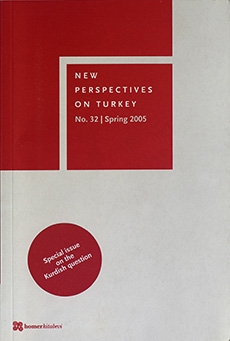
 New Perspectives on Turkey N°32
Special issue on the Kurdish question
Kurdish question
Biray Kolluoglu Kırlı
Zafer Yenal
Homer Kitabevi
Internal displacement has replaced the flows of border-crossing refugees as the major form of forced migration across the world in the past two decades. International organizations seek to have a central role in providing assistance to internally displaced persons (IDPs) although this phenomenon comes under the traditional realm of state sovereignty, in contrast to the refugee regime, which is part of international law. The evolving international IDP regime has triggered policy and scholarly debates about various aspects of state responsibility and international assistance. On one hand, when states fail to provide protection to the displaced, the decision to take international action is often selective and depends to a large extent on the balance of geopolitical interests of powerful donor states. On the other hand, extant international humanitarian assistance practices also face criticism for having created new modes of power over displaced groups.
.....
Contents
Articles
5 / A Belated Awakening: National
and International Responses to the
Internal Displacement of Kurds in Turkey
Bilgin Ayata - Deniz Yükseker
43 / The Conflictual
(Trans)formation of the Public
Sphere in Urban Space: The Case of
Diyarbakir
Zeynep Gambetti
73 / Defensive- vs. Liberal-
Nationalist Perspectives on
Diversity and the Kurdish Conflict:
Europeanization, the Internal
Debate, and Turkiyelilik
Murat Somer
93 / “Social Development” as a
Governmental Strategy in the
Southeastern Anatolia Project
Nilay Ozok-CUndogan
113 / Poverty Alleviation, Conflict
and Power in Poor Displaced
Households: A Study of the Views
of Women in Diyarbakir
Leyla Şen
137 / “I Miss My Village!”: Forced
Kurdish Migrants in Istanbul and
Their Representation in Associations
Ayşe Betül Çelik
165 / Land Inequality in Rural
Southeastern Turkey: Rethinking
Agricultural Development Ban; Karapinar
Review Articles
199 / Approaches to Poverty and
Poverty Alleviation: A Turkish
Perspective
Fikret Senses
217 / The Elusive Solution to
Turkey’s Kurdish Question
Deniz Gökalp
Book Review
227 / Hakan Ozoglu. Kurdish
Notables and the Ottoman State:
Evolving Identities, Competing
Loyalties, and Shifting Boundaries.
Albany: SUNY Press, 2004.
Yonca Köksal
Editors' note: We would like to thank Zeynep Gambetti and Şemsa Ozar and the AGON Working Group in the preparation of this volume. This special issue would have been very difficult to compile without their contributions.
I
A belated awakening:
National and international
responses to the internal
displacement of Kurds in
Turkey
Bilgin Ayata
Department of Political Science,
Johns Hopkins University
Deniz Yükseker
Department of Sociology,
Koç University
Internal displacement has replaced the flows of border-crossing refugees as the major form of forced migration across the world in the past two decades. International organizations seek to have a central role in providing assistance to internally displaced persons (IDPs) although this phenomenon comes under the traditional realm of state sovereignty, in contrast to the refugee regime, which is part of international law. The evolving international IDP regime has triggered policy and scholarly debates about various aspects of state responsibility and international assistance. On one hand, when states fail to provide protection to the displaced, the decision to take international action is often selective and depends to a large extent on the balance of geopolitical interests of powerful donor states. On the other hand, extant international humanitarian assistance practices also face criticism for having created new modes of power over displaced groups.
The displacement of several hundred thousand people in the Kurdish populated southeastern region of Turkey during the 1990s and recent deliberations about how to protect and assist them constitute a very important case which demonstrates the nexus between the workings of the interstate system, state sovereignty and the regulation and control of target populations. After years of neglecting the plight of people evicted from their homes in the course of the armed conflict with Kurdish guerillas, Turkish authorities have agreed to tackle this problem under international pressure within the context of Turkey’s bid to join the European Union. The official perspective has shifted in recent years from denying this phenomenon and ignoring its consequences to an ambiguous policy of regulation.
In this essay,1 we argue that this regulation takes place within the framework of a depoliticized policy discourse centered on “regional development” which is taking shape in the course of the interactions between the Turkish government, the EU and the UN. We say that this discourse is depoliticized since it disentangles the phenomenon of internal displacement from the Kurdish issue2 as a political problem and instead links it to a “technical” agenda of development. In this process, issues of accountability, justice and reconciliation are tacitly circumvented not only by the government, but by the EU and the UN as well.
In order to situate displacement in Turkey within a broader context, we first discuss the global IDP crisis and international responses to it. We raise two sets of issues in this context: first, the tensions between international action and sovereignty in the context of the emerging international IDP regime, and second, the pitfalls of humanitarian assistance programs in opening the way for the construction of new forms of power relations regarding displaced groups. Then, a retrospective account of displacement in southeastern Turkey during the 1990s is given. Official nonacknowledgement and hence the lack of programs of assistance to displaced villagers have carried internal displacement to the plane of urban poverty and destitution. In the wake of the military victory over the PKK in 1998, the government formally allowed displaced people to return to their villages, albeit with restrictions. However, we maintain that it was Turkey’s candidacy to the EU, granted in 1999 at the Helsinki Summit, which …
…
Biray Kolluoglu Kırlı
Zafer Yenal
New Perspectives on Turkey No. 32
Special issue on the Kurdish question
Homer Kitabevi
Homer Kitabevi ve Yayıncılık Ltd. şti.
New Perspectives on Turkey
No. 32 | Spring 2005
Special issue on the Kurdish question
Biray Kolluoglu Kırlı
Zafer Yenal
Editors
Biray Kolluoglu Kirli, Bogaziji University
Zafer Yenal, Bogaziçi University
Book Review Editors
Reşat Kasaba, University of Washington
Deniz Yukseker, Koç University
Editorial Board
Ayfer Bartu Candan, Bogaziçi University
Çagiar Keyder, Binghamton University
Cengiz Kırlı, Bogaziçi University
Ayşe Oncü, Sabanci University
Nadir Ozbek, Bogaziq University
Şevket Pamuk, Bogaziçi University
Asuman Suner, Bilkent University
Fikret Jenses, Middle East Technical University
Faruk Tabak, Georgetown University
Editorial Assistant
Mehmet Evren Dinçer
New Perspectives on Turkey is a series of research
papers published biannually by Homer, Academic
Publishing House Yeni çarşı Caddesi, No: 28/A,
Galatasaray, Beyoglu, 34433, Istanbul / Turkey
Correspondence relating to subscriptions and back
issues should be sent to npt@homerbooks.com
Homer Kitabevi ve Yayıncılık Ltd. şti.
Yeni Çarşı Caddesi, No: 28/A, Galatasaray, Beyoglu,
34433, istanbul / Turkey
www.npt.boun.edu.tr New Perspectives on Turkey is indexed and
abstracted by: Sociological Abstracts, Historical
Abstracts, Worldwide Political Science Abstracts,
Social Services Abstracts
Book Design: Emre Qkinoglu, BEK
Printed in Istanbul
ISBN 975-8293-83-4

PDF
Téléchargement de document non-autorisé.
|