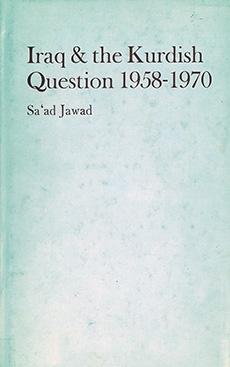
Iraq & the Kurdish Question 1958-1970
Sa‘ad Jawad
Ithaca Press
The Kurdish problem is an important feature of modern Iraqi politics. Already apparent under the monarchy, it developed more acutely after the Revolution of July 1958. The crux of the problem lay in the Kurds’ demand for a distinct status within Iraq, in the face of Arab nationalist fears that its fulfilment would ultimately lead to a call for separation.
This study of the development of the Kurdish national movement in Iraq from 1958 until the conclusion of the March Manifesto in 1970 examines the effects of Iraqi politics on the Kurdish national movement and vice versa. Thus the Kurdish question is seen in its Iraqi context rather than as a separate issue. The views and policies of neighbouring and other countries, and the course of the political struggle within the Kurdish national movement itself, have also been analysed.
Sa‘ad Jawad was born in Baghdad in 1948. He graduated from Baghdad University with a BA in Political Science in 1970, and gained a PhD from the University College of Wales at Aberystwyth in 1977. He was a research assistant at the Polytechnic of Central London between 1976 and 1978, and now teaches Politics at the University of Baghdad.
Contents
A note on transliteration
Preface
Chapter One: Introduction: a History of Iraqi Kurdistan until 1958 / 1
Chapter Two the Iraqi Revolution and its Aftermath, 1958-59 / 36
Chapter Three: Qasim and the Kurds: Cold War and Open Hostility 1960-1963 / 63
Capter Four: The Fall of Qasim and the Second Republic 1962-1963 / 107
Capter Five: Attempts to solve the Kurdish problem / 130
Capter Six: The regime of 'Abd al-Salam 'Arif and the Kurdish question / 153
Chapter Seven: The Kurds under the regime of 'Abd al-Rahman 'Arif:
April 1966 to July 1968 / 191
Chapter Eight: The Ba'th Party and the Kurdish Dilemma / 222
Chapter Nine: The international community and the Kurdish national movement / 277
Chapter Ten: Conclusion / 321
Appendix / 338
Interviews & Bibliography / 350
Index / 371
ACKNOWLEDGEMENTS
This book has grown out of a thesis of the same title, presented for a Ph.D. at the University College of Wales at Aberystwyth in 1977. I should like to thank a number of people for their assistance over the past few years, at Aberystwyth and elsewhere. First, I am indebted to the late Professor T E Evans for his encouragement and guidance during my first two years as a postgraduate I am deeply grateful to Dr Brian Porter, who supervised the final stages of my work, for his invaluable comments, criticisms and patience. I should like to thank Mr C J Edmonds, Mr Salim Fakhri and Dr 'Abbas Kelidar, who read through parts of the first draft and offered a number of constructive suggestions. In Baghdad I must thank Mr H F al-Jaff of the Kurdish Cultural Academy who kindly allowed me to consult his library, and all those who were good enough to spare me their time for interviews. Mrs C Chadwick and Mr D Jones of the University College of Wales Library at Aberystwyth were generous with their time and assistance.
In the preparation of the manuscript for publication I am grateful to Dr Peter Sluglett for his editorial and bibliographical revisions, and to Mrs Rita Hart for her meticulous care in producing the final typed version. Finally, my deepest gratitude goes to my family for their help through all the stages of my education, and to my friends in Aberystwyth and elsewhere for their constant encouragement.
Baghdad, May 1981
Sa'ad N Jawad
PREFACE
The problem of national minorities can prove crucial for new states, particularly in the immediately post independence period. Very often the dominant nationality, having achieved its primary anticolonialist objectives, tends to concentrate on the more pressing task of national reconstruction, while ignoring or dismissing the claims of minority populations for autonomy, self-government, or religious and linguistic freedom. Here we may cite such examples as the southern Sudan and Biafra, or even the situation of the Arabs themselves after the Young Turk revolution of 1908-09. In Iraq, one of the most pressing issues facing the new Republic after 1958 was the Kurdish question, which was rendered more acute by the continuing failure of successive governments to provide a satisfactory solution. Apart from acting as a brake on the economic and social development of the country, the constant fighting in Northern Iraq facilitated the military domination of the various regimes in Baghdad, as well as resulting in ever widening divisions between the Arabs and the Kurdish national movement.
Despite its evident importance, the Kurdish question in Iraq has received relatively little scholarly attention, and although some useful original research has been undertaken,1 most writers have tended to see it largely in Kurdish, rather than Iraqi, terms. Furthermore, the historical rather than the contemporary aspects of the problems have been stressed. Two recent works, one by the French journalist Kutschera and the other a collective volume edited by Gerard Chaliand, deserve mention.
Both books are concerned with the Kurds in general; Chaliand's collection contains a long essay on 'Kurdistan in Iraq' by I C Vanly, but also contains articles on Syria, Iran and Turkey which have been particularly useful for the revision of Chapter 9. Kutschera's work is especially valuable for its documentation of inter-Kurdish rivalries during the 1960s which are crucial for an understanding of that period. Although neither work considers the question in the overall context of Iraqi politics, both have provided important new insights into the Kurdish movement in general.
No study of Iraqi politics can now be undertaken without reference to Batatu's major work. The Old Social Classes and Revolutionary Movements of Iraq… published in 1977. Its breadth, scope and humanity combine to make much earlier writing superfluous, and it is essential reading for a proper understand-ing of modern Iraqi history. Much other writing on the period is demonstrably partisan; two of the principal Kurdish leaders, Ibrahim Ahmad and Jalal Talabani have both written accounts of the movement from the Kurdish points of view, while the Arab nationalist case is presented by al-Durra, al-Feel and al-Ghamrawi.
The primary source material for the present work consists of interviews, and the official publications of the Iraq government and the various political parties. The actual collection of the materials was facilitated by the kindness of many of those involved in the various series of negotiations. As many of the documents consulted were distributed and published secretly, I am particularly conscious of my debt to those concerned. Although another round of fighting broke out in 1974-75, and the present situation is still uncertain this study has taken the March Manifesto of 1970 as its conclusion. Regardless of the differences which have led to the resumption of hostilities, both sides have continued to express their willingness to adhere to the March Manifesto. This fact supports one of my main conclusions, that what is needed is greater cooperation and mutual trust rather than a new agreement.
Notes
1 See the theses listed on pp 356-357.
2 The works of Vanly, Qazzaz and Jwaideh end with the Kurdish revolt of 1961.
Chapter One
Introduction: a History of Iraqi Kurdistan until 1958
Most scholars consider the Kurds to he Aryans, but it is difficult to obtain a unanimous view of their origin.1 As long ago as 400 BC Xenophon, in the Anabasis, mentions Khardukhi or Kardukai, a mountain 2 people who harassed his march towards the sea. The Kurdish language belongs to the Indo-European family, is related to Persian, and has two main dialects.
Kurmanji is spoken by the majority of those in Turkey and the northern part of Iraqi Kurdistan. Although spoken by a smaller number, Sorani or Mokrian is in fact more important, for it is the one which is mostly 3 used in literature. The area in which this dialect is spoken extends from Sulaimaniya into Iranian Kurdistan. As Sulaimaniya and Mahabad (Sauj-Bulag) are the principal centres of Kurdish nationalism, the political importance of this dialect is obvious. A third dialect, Zoza, is used in very limited areas. Kurdish has no script of its own; Arabic script is used in Iraq, Iran and Syria, Roman in Turkey and Russian in the USSR. According to a 1958 estimate Iran, with 95%, had the highest percentage of illiteracy among the Kurds: Turkey has 90%, Iraq 85% and Syria 80%.4 However, it is almost certain that the …
Sa‘ad Jawad
Iraq & the Kurdish Question 1958-1970
Ithaca Press
Ithaca Press Ltd
Iraq & the Kurdish Question 1958-1970
Sa‘ad Jawad
Iraq & the Kurdish Question
by Sa‘ ad Jawad
Iraq & the Kurdish Question 1958-1970
by Sa‘ad Jawad
Ithaca Press London
Copyright © 1981 Sa'ad Jawad
First published in 1981 by
Ithaca Press 13 Southwark Street London SE 1
ISBN 0 903729 77 6
Printed in England by
Anchor Press Ltd and bound by
Wm Brendon and Sons Ltd
both of Tiptree Essex