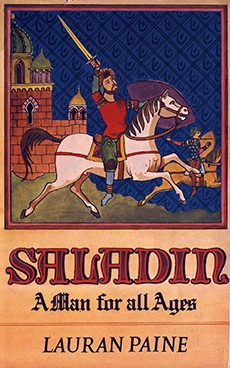
Saladin: a man for all ages
Lauran Paine
Robert Hale
In the Christian West they called him Christ's arch-enemy, the scourge of the cruciati, a vicious, fanatical torturer and beheader of Christians. He was pointed out by the Popes and prelates of Christendom as the outstanding example of Islam's perfidy and cruelty.
Yet this man never once violated a treaty, broke his word, refused clemency when he considered it warranted, nor betrayed his beliefs. He was more gallant, more chivalrous and sincerer than the Western kings and barons who rode against him in the Second and Third Crusades. He was also a better warrior. During his lifetime there was no man, East or West, to equal him in the breadth, scope, and depth of his honour and vision.
Content
Preface / 9
I An Echo of Trumpets / 11
2 Islam’s Camp / 22
3 The Coming of the Kings—the Second Crusade / 30
4 The Departure of the Kings—the Second Crusade / 38
S Impressions from Damascus / 47
6 A Taste of Carnage / 56
7 Salah ed-Din / 65
8 A Man for All Ages / 74
9 From Viceroy to Sultan / 83
10 Saladin, Sword of Islam / 92
11 The Enduring Antagonists / 101
12 Syria, a Crucible of Events / 110
13 Tth July 1187 / 119
14 Fall of the Frankish Kingdom / 128
IS The Fall of Jerusalem / 137
16 Confirming the Conquest / 146
17 An Echo of Events / 156
18 Acre / 166
19 Richard Coeur de Lion / 176
20 The Third Crusade / 186
21 Richard the Unpredictable / 196
22 Almighty God, Look upon this Soul ... / 206
Bibliography / 217
Index / 206
Illustrations
between pages 48 and 49
Sultan Saladin as the nineteenth century saw him
Tyre from the mainland
Damascus from the hills
between pages 64 and 65
King Richard I of England
The death of Frederick Barbarossa
Saladin besieging Jerusalem
Almaric at the siege of Caesarea Philippi
between pages 120 and 121
‘Treacherous attack by Saracens’
A Knight Templar
A scene at the siege of Acre
Alberic Clement storming the tower at Acre
The walls of St Jean d’Acre circa 1835
Crusaders attack a city with siege engines
All the above illustrations are
from the Radio Times Hulton
Picture Library.
PREFACE
Almost one hundred years ago a Doctor of Literature, John Lord, prefaced his chronology of the Crusades in a way that properly summarized, in the light of current Western thought and knowledge, those vast, colourful, and confusing events which occurred between the years A.D. 1095 and 1272.
His mistake was to impute to history a motivation, a continuum, all its own. Rome did not conquer a world, the Caesars of Rome did that. Ancient Britain did not yield to events, William of Normandy came and conquered. France did not bestride Europe, that was Napoleon. History can be nothing but a passage of time, and its heart, soul, and substance, is biography.
Otherwise, Doctor Lord’s analysis deserves quoting:
The great external event of the Middle Ages was the Crusades— indeed, they were the only common enterprise in which Europe ever engaged. Such an event ought to be very interesting, since it has reference to conflicting passions and interests. Unfortunately, in a literary point of view, there is no central figure in the great drama which the princes of Europe played for two hundred years, and hence the Crusades have but little dramatic interest. No one man represents that mighty movement. It was a great wave of inundation, flooding Asia with the unemployed forces of Europe, animated by passions which excite our admiration, our pity, and our reprobation.*
It is indeed true that in the light of Western thought and knowledge there was no one man representative of the Crusading epoch. There could not have been if Doctor Lord wrote in the context of a two-century effort, or from the exclusive viewpoint of a Western chronologist. But had his history reached across to the camp of Islam, had it been tolerant of an alien ethos, had it been willing to breathe biographical life into an enemy of the West who was more representative of feudalism and chivalry than was any European Crusader of those two centuries, then Doctor Lord would have found that one man did, in fact, represent the Crusading epoch and further, that at the apex of that “great inundation”, the Third Crusade, one man was most certainly representative of the best and the worst of both worlds.
He was the Kurdish Syrian Sultan Joseph, who has, somehow, come down through history commemorated by one segment of a title: Saladin. He had a host of titles, including el-Melik en-Nasir al Sultan Salah-ed-Din, Yusuf ibn Ayyub, which could be interpreted: the conquering king, the bountifully religious Sultan, Joseph, son of Job.
‘Saladin’ may be a misnomer, but as Saladin, not Yusuf, has this lord of the Middle Ages survived. As Saladin he has been commemorated by the Arabs who revere his memory as well as by those of the Western World who recognize in this ruler of nearly 800 years ago a man capable of bridging an abyss no other man of his time could even see across. A poet of Islam said at his passing: “Think not that you alone have lost him; the whole world died with him.”
It was true. Saladin was indeed a man of all worlds. He was also a man of all seasons and of all times and when he died a great impetus died with him.
* Italics added.
1
An echo of trumpets
A history of wars, except perhaps in the Teutonic idiom, tends to be unsatisfactory if not downright tiresome unless the ideas, passions and interests of which they appear to be a culmination are vested with a sympathetic identification.
The Crusades were a semi-military, semi-religious outpouring. Every reason that could motivate people was present. Every depth of anguish, triumph and tragedy, every degree of heroism and treachery, every variety of fanaticism, barbarity and stupidity, was present from first to last.
There were seven Crusades and like the diminishing echo of trumpets they progressed from a thunderous rush of uncon-trollable hordes roaring Dieu le vult! Dieu le vult! (God wills it! God wills it!), to a whisper of tramping feet growing fainter as objectives faded, as resolutions got turned aside, as leaders and lords very practically sought immediate accommodation rather than future salvation. The Sixth Crusade ended outside Damietta in Egypt, where Louis IX of France was overwhelmed by Moslem arms, and the Seventh Crusade, also organized by Louis IX, ended just as ignominiously at Tunis where he again turned aside to seek a conquest—which he failed to accomplish—rather than liberation of the Holy City, his objective.
Afterwards, the designations ‘crusade’ and ‘crusader’ were applied freely to almost any contest of arms where heresy allegedly prevailed, such as the activity of the Teutonic knights against the Prussian heathens, the savage suppression of the …
Lauran Paine
Saladin: a man for all ages
Robert Hale
Robert Hale & Company
Saladin: a man for all ages
Lauran Paine
London
Robert Hale & Company
© Lauran Paine 1974
First published in Great Britain 1974
ISBN 0 7091 4363 x
Robert Hale & Company
63 Old Brompton Road
London SW 7
Printed in Great Britain by Clarke.
Doblb K Brendon Ltd.
Plymouth
ISBN 0 7091 4363 X
Printed in Great Britain