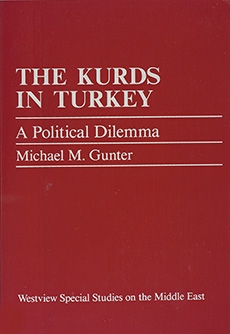
The Kurds in Turkey: a Political Dilemma
Michael M. Gunter
Westview Press
The Kurds constitute one of the largest ethnic groups in the world that does not possess its own independent state. Although useful studies of the Kurds exist, this is the first to deal specifically with those living in Turkey—approximately half of the world’s Kurdish population.
In recent years, the long-standing disaffection and conflict between some of the Kurds and the Turkish state has developed into a small but sustained guerrilla war in the southeastern section of Turkey. Dr Gunter presents the point of view of the Turkish authorities and their supporters as well as the perspective of disaffected Kurds in Turkey and abroad.
The lucid and objective analysis focuses specifically on the historical background of the problem, the political instability and terrorism rampant in Turkey during the late 1970s, and the legal suppression of the Kurds. The emergence of numerous Kurdish political parties is charted, with special attention given to the history and current activities of the PKK (Kurdish Workers’ Party)—the most noteworthy of the parties active in Turkey. Looking at the far-flung Kurdish expatriate communities, Dr. Gunter also evaluates transnational influences on the; Turkish conflict and discusses its geopolitical ramifications.
Michael M. Gunter is professor of political science at Tennessee. Technological University.
Contents
Acknowledgments vii
Introduction / 1
1 Background / 5
2 Prelude to Conflict / 11
3 Political Instability and-Terrorism in the 1970 s / 23
4 Suppression / 43
5 Birth of the PKK and Other Kurdish Parties / 57
6 Revival of the PKK / 71
7 Transnational Influences / 97
8 Conclusion / 123
Selected Bibliography / 129
Index / 141
ACKNOWLEDGMENTS
I would like to thank the Non-Instructional Faculty Assignment Committee at Tennessee Technological University for giving me a semester of released time during which I was able to write much of this book. Angelo Volpe, the President of Tennessee Tech, encouraged and supported me, for which I am very grateful. Robert Bode, Steve Khleif, and Paul Stephenson gave me a considerable amount of help in the mechanics of word processing, while Sanford Silverburg and Steve Tabachnick have been sources of academic encouragement for many years. In writing this book I also have had the benefit of advice from Michael Turner, Heath Lowry, Vera Beaudin Saeedpour, Siyamend Othman, Jennifer Noyon, Paul Henze, and Mehmet Ali Birand, as well as others who have preferred to remain anonymous.
My year spent as a Senior Fulbright Lecturer in International Relations at the Middle East Technical University in Ankara, Turkey, first sensitized me to the issues I have analyzed here. The Fulbright Program was a marvelous broadening experience for me. I hope such academic exchanges will always be supported, for they pay such rich dividends in international understanding and peace.
I thank The Middle East Journal and Conflict Quarterly for giving me permission to use material that appeared in earlier articles I published in them. Special thanks go to Michael S. Miller for permission to use the excellent map he drew of the Kurdish minority in Turkey. Finally, I would like to mention that I omitted the diacritical marks in foreign words to simplify the text; the meanings of the words have not been affected.
Michael M. Gunter
Introduction
The Kurds are a Sunni Muslim, Indo-European-speaking people whose traditional homeland is concentrated in the rugged, mountainous area of the Middle East where Turkey, Iraq, and Iran converge. Much smaller numbers also inhabit Syria and the Soviet Union, while a diaspora has now spread to several other Mideastern states as well as western Europe and North America. Although they constitute the fourth largest ethnic group in the Middle East, the Kurds lack their own independent state. As such, they are one of the largest ethnic groups in the world thus situated.
A number of useful studies of the Kurds exist.1 Very few, however, deal specifically with those living in Turkey.2 This dearth of analysis is ironic since approximately half of the Kurds in the world live in Turkey. What is more, in the past few years a long-festering disaffection for the Turkish state on the part of some of them has developed into a small, but sustained guerrilla war in southeastern Anatolia. Commenting on what it termed the "persistence of Kurdish separatism" in eastern Turkey, an assessment by the United States Central Intelligence Agency (CIA) stated:
The Kurds’ sense of separate identity has not been significantly reduced by the [Turkish] government’s attempts to co-opt or suppress them. The Kurdish language has flourished, and clandestinely published Kurdish literature is surreptitiously obtainable in Kurdish areas.... In the past several years, several overt cultural associations" and covert liberation groups have formed to promote the idea of Kurdish autonomy and independence.3
In an editorial entitled "Something’s going on in east Turkey," the chairman and founder of the Turkish Daily News, Ilhan Cevik, added:
There is no doubt left now that the situation in the region is extremely serious. The Turkish armed forces units there are in a state of permanent alert and security operations are going on round the clock. According to official statements bands of separatist terrorists are being harbored and trained in some neighboring countries. The insurgents are involved in all manner of activities in the region and despite the extensive security measures they are still very active. ... As a matter of fact they regularly raid military patrols, gendarmerie stations and even prisons.4
The purpose of this study is to analyze the current Kurdish problem in Turkey from the point of view of the Turkish authorities and their supporters, as well as from the perspective of disaffected Kurds living in that state and abroad. Analyzed specifically will be the historical background to this situation, the political instability and terrorism rampant in Turkey during the late 1970s, the legal suppression of the Kurds, the emergence of numerous Kurdish political parties in the 1970s of which the Partia Karkaren Kurdistan (PKK) or Kurdish Workers Party has been the most noteworthy, the current activities of the PKK, and transnational influences on the situation. Finally, some tentative conclusions will be offered. My hope is to throw some objective light on a troubling problem that has been poorly understood.
Notes
1. For two excellent examples, see Thomas Bois and Vladimir Minorsky, "Kurds, Kurdistan," The Encyclopedia of Islam (new edition), V, 1981, 438-486; and M. M. van Bruinessen, Agha, Shaikh and State: On the Social and Political Organization of Kurdistan (Utrecht, The Netherlands: University of Utrecht, 1978). In addition, see such recent studies as David McDowall, The Kurds, Report No. 23 (London: Minority Rights Group Ltd., 1985); Anthony Hyman, Elusive Kurdistan: The Struggle for Recognition, No. 214 (London: The Centre for Security and Conflict Studies, 1988); and Charles G. MacDonald, "The Kurdish Question in the 1980s," in Ethnicity, Pluralism, and the State in the Middle East, ed. by Milton J. Esman and Itamar Rabinovich (Ithaca: Cornell University Press, 1988), pp. 233-252.
2. I am aware of two excellent exceptions in English to this general statement. See Kendal [Nezan], "Kurdistan in Turkey," in People without a Country: The Kurds and Kurdistan, ed. by Gerard Chaliand (London: Zed Press, 1980), pp. 47-106; and Martin van Bruinessen, "The Kurds in Turkey," MERIP Reports, No. 121 (Feb. 1984), pp. 6-12.
3. National Foreign Assessment Center (U.S. Central Intelligence Agency), The Kurdish Problem in Perspective (Aug. 1979). The research for this study was done by analysts from the Office of Political Analysis and the Office of Geographic and Cartographic Research, and coordinated within the CIA. Although it was stamped "secret," it was seized during the occupation of the U.S. Embassy in Tehran during 1979. In citing from it, I am simply conveying information that is now in the public domain. In no way, do I condone the method by which it became thus available. Throughout my ensuing text, I refer to this analysis as the "CIA Report."
4. Ilhan Cevik, "Something’s going on in east Turkey," Turkish Daily News, Nov. 11, 1985,
1
Background
Origins
The origin of the Kurds is uncertain, although many scholars believe them to be the descendants of various Indo-European tribes which settled in the area as many as 4000 years ago. The Kurds themselves claim to be the descendants of the Medes who overthrew Nineveh in 612 B.C., and also recite interesting myths about their origins involving King Solomon, jinni, and other magical agents. Many believe that the Kardouchoi, who gave Xenophon and his 10,000 such a mauling as they retreated from Persia in 400 B.C., were the ancestors of the Kurds.
In the seventh century A.D., the conquering Arabs applied the name "Kurds" to the mountainous people they Islamicized in the region, and history records that the famous Saladin, who fought against Richard the Lionheart and the Christian Crusaders so successfully in the twelfth century, was a Kurd.
Divisions
Whatever their exact origin, it is clear that racially the Kurds today constitute a mixture of various groupings, the result of earlier invasions and migrations.2 What is more, it should be noted that, although the Indo-European Kurdish language is an important element of the Kurdish culture, it too is divided into three major dialects (Kurdi, Kurmanji, and Zaza), the first two of which are further split into distinct subdialects. The Turkish Kurds use the …
Michael M. Gunter
The Kurds in Turkey: a Political Dilemma
Westview Press
Westview Press
Westview Special Studies on the Middle East
The Kurds in Turkey a Political Dilemma
Michael M. Gunter
Westview Press
Boulder - San Francisco - Oxford
Westview Special Studies on the Middle East
This Westview softcover edition is printed on acid-free paper and bound in library-quality, coated covers that carry the highest rating of the National Association of State Textbook Administrators, in consultation with the Association of American Publishers and the Book Manufacturers’ Institute.
All rights reserved. No part of this publication may be reproduced or transmitted in any form or by any means, electronic or mechanical, including photocopy, recording, or any information storage and retrieval system, without permission in writing from the publisher.
Copyright © 1990 by Westview Press, Inc.
Published in 1990 in the United States of America by Westview Press, Inc., 5500 Central Avenue, Boulder, Colorado 80301, and in the United Kingdom by Westview Press, 36 Lonsdale Road, Summertown, Oxford OX2 7EW
Library of Congress Cataloging-in-Publication Data
Gunter, Michael M.
The Kurds in Turkey: a political dilemma / Michael M.
Gunter
p. cm. — (Westview special studies on the Middle East)
Includes bibliographical references and index.
ISBN 0-8133-8120-7
1. Kurds—Turkey, Eastern—Politics and government. 2. Kurds—
Civil rights—Turkey, Eastern. 3. Turkey—Politics and
government—1960-1980. 4. Turkey—Politics and government—1980—
5. Turkey, Eastern—Ethnic relations. I. Title. II. Series.
DS51.E27G86 1990
323.1'191590561 — dc20 / 90-42499
CIP
Printed and bound in the United States of America
© The paper used in this publication meets the requirements
of the American National Standard for Permanence of Paper
for Printed Library Materials Z39.48-1984.
10 9 8 7 6 5 4 3 2 1