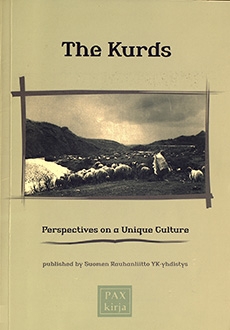
The Kurds: Perspectives on a Unique Culture
Jason O'Neill.
Printed at Yliopistopaino
The Kurds have struggled to ohtain political rights in the countries they inhahit for many years. Many Kurds have also dreamt of a unified and independent nation. This publication, however, is not about that dream or any other political dream. This is a work about cultural identity and all it entails. Each of the six contributing authors offer different yet compelling perspectives on Kurdish culture and identity.
Contents
Preface / 1
Omar Sheikhmous: Features of Kurdish History / 3
Loghman Pireh Eabi: Kurdish Ethnicity,
Kurdism and the Spectre of Kurdism / 9
Leif Hockerstedt: Language, Culture and Identity / 15
Tove Skutnabb-Kangas and Robert Philiipson:
Linguistic Genocide and Human Rights - Kurdish considerations / 25
Goran von Bonsdorff:
Is Mediation possible with regard to the Kurdish Problem? / 51
Olof G. Tandberg: Nordic Solidarity Work 1966-1970 and the
Cultural Experiences of Kurdish Women / 55
PREFACE
In September 1998 The Peace Union in Finland and The Peacefor Kurds Forum in Finland organized a Nordic Kurdish Cultural conference in Helsinki. The conference gathered around sixty participants from the Nordic countries, half of which were of Kurdish origin. The purpose of the conference was to ponder and gain insight into central matters concerning cultural rights, rather than discuss possible solutions to the political problems facing the Kurds and the countries they inhabit. Cultural rights are not only important for the Kurds in their native countries but also for Kurdish immigrants throughout the world. Another important aim of the conference was to establish a network for those interested in supporting Kurdish culture in the Nordic countries.
The essays in this publication explore further the issue of cultural rights and identity.
Omar Sheikhmous is a Syrian Kurd who works at the Center for Research in International Migration and Ethnic Relations at the University of Stockholm. He has presented several scientific papers and given courses on the Kurdish issue. Loghman Pireh Babi received his doctoral degree on the subject of Kurdish nationalism at the University of Helsinki this spring. Leif Hockerstedt is Senior Master in Swedish at the Department of Nordic Languages and Literature at the University of Helsinki. He has written about Kurdish language and culture in relation to Nordic language and culture. Dr. Phil.Tove Skutnabb-Kangas and Dr. Phil Robert Phillipson from the Department of Languages and Culture at the University of Roskilde have, separately and together, written numerous books and papers on linguistic minorities, language policy and other related issues. Goran von Bonsdorff is Professor Emeritus in Political Science and Honorary Chairman of the Peace Union in Finland. He is a veteran peace activist and in recent years he has written several newspaper columns on the Kurdish issue. Olof G. Tandberg, now retired, supervised a number of international assignments within the UN and other organizations. He is the author of numerous books, including a book on Iraqi Kurdistan published as early as 1967.
Features of Kurdish History
By Omar Sheikhmous
To begin with, when speaking of the Kurds and their destiny one cannot help but be startled by the irony of history and wonder why one of the largest ethnic groups in the World, that lives in a common geographical area, has been denied or has failed to establish its own state in the age of nationalism and the nation-state after the French Revolution of 1789. A Kurdish nation-state remains unestablished despite a common language, culture, destiny, shared historical experiences and visions, and a very strong identity as a people with clear ambitions towards preserving their independence in their mountainous terrain.
The Kurds also, seem to have drawn the shorter straw during the period of historical empires notwithstanding the Median and the Ayyubid multi-ethnic states that were established by Kurds but for the benefit of others, i.e. the Persian empire and the Islamic Khalifate.
No doubt, there are a number of very important factors and histo-rical features that have led to this state of affairs. Among others, the following ones:
1. The harsh mountainous terrain of their homeland which has helped save the Kurds from extinction during earlier historical periods, has simultaneously hindered the development of a common identity while strengthening locally and regionally based clan identities akin to that of the Scottish Highlanders.
2. The traditional location of Kurdistan as a buffer zone between large empires has led to a situation in which the battles between these empires have been fought on Kurdish land which has resulted in the most dire consequences for the Kurdish people throughout History.
3. The Undermining of the development of the newly independent Kurdish city states and principalities during the eighth and ninth centuries up until the 15th century by successive waves of foreign invasions by Arab Islamic armies, Mongols, Turkmen, Tatars,
Seljuks and Ottomans.
4. The aggressive drives of the Ottomans and Safavid Persia toward centralisation, that were prompted by their confrontation with a dynamic and expansive Europe. These developments led to the …
Jason O'Neill
The Kurds
Perspectives on a Unique Culture
Printed at Yliopistopaino
Printed at Yliopistopaino
The Kurds
Perspectives on a Unique Culture
Jason O'Neill
The Kurds
Perspectives on a Unique Culture
Published hy Suomen Rauhanllitto YK-yhdistys
Printed at Yliopistopaino, Helsinki 1999
Proof reading and translation:
Jason O'Neill (except Loghman Pireh Babi)
Photographs: Jouni Pirila
Captions: Salar Sofy
Layout and Graphic design: Peter Lofgren
Editor: Petra Sundqvist
ISBN 951 - 9193 - 47—2