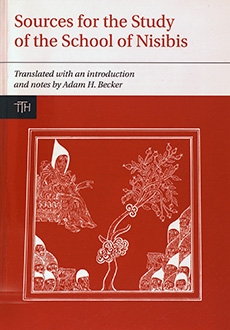
Sources for the Study of the School of Nisibis Adam H. Becker Liverpool University
The Aramaic-speaking Christian community of late antique and early Islamic period Mesopotamia developed a school culture that persisted for several centuries. Not unlike the Rabbinic academies, the East-Syrian schools were innovative as centres of learning where study was formally institutionalized, in contrast to the informal study circles of the past. This school culture played an important role in the early translation of Greek philosophical texts into Arabic in the ’Abbasid period. The most influential and prominent of these schools was the School of Nisibis. and this volume provides an annotated translation of the major sources for the School. A polemical document composed by Simeon of Bet Arsham. a theological enemy of the School, describes the foundation of the School as a significant step in the supposed spread of 'Nestorianism’ throughout the Sasanian Empire. The more extensive East-Syrian Cause of the Foundation of the Schools offers a history of learning from God's creation of the world to the time of the text’s composition at the School of Nisibis in the late sixth century CE. recasting patriarchal. Israelite, ‘pagan’ and Christian history as a long series of schools. The last two chapters of the Ecclesiastical History describe the lives of the two most important head exegetes at the School. These sources have never been translated into English and this is the first time that any of them has received close historical, linguistic and thematic analysis.
Adam H. Becker is Assistant Professor of Classics and Religious Studies, and Director of the Religious Studies Program, at New York University. His previous publications include Fear of God and the Beginning of Wisdom: The School of Nisibis and the Development of Christian Scholastic Culture in Late Antique Mesopotamia (University of Pennsylvania Press, 2006).
Contents
Acknowledgements / vii Abbreviations / ix
Introduction / 1 The School of Nisibis / 1 Identifying Barhadbeshabba / 11 On the Manuscripts, Translation, Notes and Terms / 16 The Transliteration of the Syriac Alphabet in this Volume / 18
Texts Simeon of Bet Arsham, 'Letter’on the ‘Nestorianization’ of Persia / 21 Introduction / 21 Translation and Notes / 25
Barhadbeshabba, Ecclesiastical History / 40 Introduction / 40 Translation and Notes / 47 Chapter Thirty-One: ‘The Life of Narsai’ / 47 Chapter Thirty-Two: ‘The Life of Abraham of Bet Rabban’ / 73
Barhadbeshabba, The Cause of the Foundation of the Schools / 86 Introduction / 86 Translation and Notes / 94 Mingana Fragment of the Cause / 161 Translation and Notes / 161 Portion of the Memra on the Holy Fathers by Rabban Surin / 163 Translation and Notes / 163
Appendix I: On the Manuscript Tradition of the Cause of the Foundation of the Schools / 165 Appendix II: The Tree of Porphyry in the Cause of the Foundation of the Schools / 172 Appendix III: The Literary Dependence of the Cause of the Foundation of the Schools on the Ecclesiastical History / 181
Brief Glossary of Selected Terms / 192 Maps / 194 Bibliography / 196 Index of Biblical References / 203 Index of Proper Names / 206 Subject Index / 211
ACKNOWLEDGEMENTS
This volume offers annotated translations of several of the most important sources for the study of the history of the School of Nisibis, the most promi-nent centre of learning in the Church of the East (the ‘Nestorian’ church of the Sasanian Empire) in the sixth century and an institution that played a key role in the creation of Christian intellectual culture in Mesopotamia in Late Antiquity and the early Islamic period. I hope that it will help to encourage other scholars to continue in the study of the School of Nisibis and East-Syrian intellectual culture in general (I use the term ‘East-Syrian’ throughout this volume for those Syriac-speaking Christians commonly known as ‘Nestorians’). A number of works remain unexamined, such as several examples of the East-Syrian ‘cause’ genre, an aetiological genre typical of East-Syrian scholastic culture, while the role of Syriac Christians in the intellectual history of Mesopotamia, as well as the important compar-ative evidence Syriac Christianity offers for the study of the other contem-poraneous religious communities, has still not been fully appreciated.
This project derives from translation work I began while writing my dissertation in the Religion Department of Princeton University and at the Oriental Institute, Oxford University. The dissertation, which was an intel-lectual and institutional history of the School of Nisibis and the broader East-Syrian scholastic culture, has since been heavily revised and published with University of Pennsylvania’s Divinations series as Fear of God and the Beginning of Wisdom: The School of Nisibis and the Development of Christian Scholastic Culture in Late Antique Mesopotamia (2006). Because of the similar nature of the material it was inevitable that there would be a number of overlaps between the former volume and the present one. I hope these redundancies are not too tedious for those who notice them. Some material from chapter 7 of the Fear of God has been placed verbatim in the notes to the more philosophical portion of the Cause of the Foundation of the Schools. I would like to thank Sebastian P. Brock for, aside from encouraging my studies over the past several years, first suggesting that I submit these texts to be published in Translated Texts for Historians and for his numerous editorial comments and suggestions. Mary Whitby, as General Editor for the series, provided numerous useful suggestions and criticisms. I would like to thank Michael Peachin for several helpful references and Ilaria Ramelli for sharing with me her annotated Italian translation of the Cause of the Foundation of the Schools when it was still in manuscript form. A number of people have helped me with obscure references and bibliographical queries on the Hugoye Syriac Studies electronic list. I appreciate their help. I re-read a large chunk of the Cause of the Foundation of the Schools with my Syriac havruta buddies, Jeffrey Rubenstein and P. V. Meylekh Viswanath. I thank them for their feedback on this text as well as their companionship (along with Mike Pregill) in reading Syriac texts. I thank Ley la B. Aker for listening to me drone on about obscure things during much of the work on this volume. Special thanks to Bridget M. Purcell for her encouragement during its completion. The brevity of this work is inverse to the immensity of love I feel for my two sisters, Danielle Speckhart and Rachel Petev, to whom this small volume is dedicated.
Introduction
The Christianization of the ancient Mediterranean and Near Eastern world led to radical innovations both in the content and the locus of learning in Late Antiquity.1 The Christian study circle and eventually the monastery created a new literary culture, which would be maintained and transmitted for centuries to come in both eastern and western monasteries. However, traditional Greco-Roman institutions of learning persisted deep into the Middle Ages and this new Christian culture of learning continued to be influenced by the ancient classroom until the end of antiquity. For example, Neoplatonism, the final floruit of ancient philosophical learning, especially in the later schools of Athens and Alexandria, left a deep imprint upon the Christian learning of the Middle Ages.2 In varying degrees the diverse Chris-tian cultures of Late Antiquity brought with them into the Middle Ages a combination of late antique monastic spirituality, patristic exegesis, and Greek philosophical and rhetorical learning.
The School of Nisibis
One such innovative combination of the late antique intellectual heritage is attested in the East-Syrian ‘schools’, a series of institutions which began to spread through much of Sasanian Mesopotamia in the sixth century. These institutions could range from gatherings in local churches for the elementary study of scripture to informal study circles which met in specific locations …
1 / A recent study of one example of this new kind of learning is Richard A. Layton’s Didymus the Blind and His Circle in Late-Antique Alexandria: Virtue and Narrative in Biblical Schol¬arship (Urbana and Chicago: University of Illinois Press, 2004). For a general discussion of classical learning, late antique developments, and the Syriac context, see Becker, Fear of God, 6—12. For a more recent discussion, see Paolo Bettiolo, ‘Scuole e ambienti intellettuali nelle chiese di Siria’, in Storia della filosofia nell’Islam medievale, Vol. I, ed. Cristina D’Ancona (Torino: Giulio Einaudi, 2006), 48-100.
2 / For the most recent cultural analysis of the later Neoplatonic schools, see Edward Watts, City and School in Late Antique Athens and Alexandria (Berkeley: University of California Press, 2006).
Adam H. Becker
Sources for the Study of the School of Nisibis
Liverpool University
Liverpool University Press Sources for the Study of the School of Nisibis Translated with an introduction and notes by Adam H. Becker
Translated Texts for Historians Volume 50
First published 2008 Liverpool University Press 4 Cambridge Street Liverpool, L69 7ZU
The right of Adam H. Becker to be identified as the author of this work has been asserted by them in accordance with the Copyright, Designs and Patents Act, 1988
All rights reserved. No part of this book may be reproduced stored in a retrieval system, or transmitted, in any form or by any means, electronic, mechanical, photocopying, recording, or otherwise, without the prior written permission of the publisher.
British Library Cataloguing-in-Publication Data A British Library CIP Record is available.
ISBN 978-1-84631-161-1 limp
Set in Times by Koinonia, Manchester Printed in the European Union by Bell and Bain Ltd, Glasgow
Liverpool University Press
www.liverpool-unipress.co.uk
Cover illustration: Archbishop Esayi Ntchetsi (c. 1255-1338), abbot of the University of Gladzor, teaching. From the Commentary on Isaiah by Gevork’ vardapet, Skevra monastery Cilicia, 1299 (St James’s Monastery, Jerusalem MS 365, f 2r). Drawn by Roger Tomlin. Design by Emily Wilkinson