Azerbaijan: Seven Years of Conflict in Nagorno-Karabakh Human Rights Watch Compte d’auteur
Human Rights Watch conducts regular, systematic investigations of human rights abuses in some seventy countries around the world. It addresses the human rights practices of governments of all political stripes, of all geopolitical alignments, and of all ethnic and religious persuasions. In internal wars it documents violations by both governments and rebel groups. Human Rights Watch defends freedom of thought and expression, due process and equal protection of the law; it documents and denounces murders, disappearances, torture, arbitrary imprisonment, exile, censorship and other abuses of internationally recognized human rights. Human Rights Watch began in 1978 with the founding of its Helsinki division. Today, it includes five divisions covering Africa, the Americas, Asia, the Middle East, as well as the signatories of the Helsinki accords. It also includes five collaborative projects on aims transfers, children's rights, free expression, prison conditions, and women's rights. It maintains offices in New York, Washington, Los Angeles, London, Brussels, Moscow, Belgrade, Zagreb, Dushanbe, and Hong Kong. Human Rights Watch is an independent, nongovernmental organization, supported by contributions from private individuals and foundations worldwide. It accepts no government funds, directly or indirectly. The staff includes Kenneth Roth, executive director; Cynthia Brown, program director; Holly J. Burkhalter, advocacy director; Ann Johnson, development director; Gara LaMarche, associate director; Juan Mendez, general counsel; Susan Osnos, communications director; and Derrick Wong, finance and administration director. The regional directors of Human Rights Watch are Abdullahi An-Na'im, Africa; Jose Miguel Vivanco, Americas; Sidney Jones, Asia; Jeri Laber, Helsinki; and Christopher E. George, Middle East. The project directors are Joost R. Hiltermann, Arms Project; Lois Whitman, Children's Rights Project; Gara LaMarche, Free Expression Project; and Dorothy Q. Thomas, Women's Rights Project. The members of the board of directors are Robert L. Bernstein, chair; Adrian W. DeWind, vice chair; Roland Algrant, Lisa Anderson, Peter D. Bell, Alice L. Brown, William Carmichael, Dorothy Cullman, Irene Diamond, Edith Everett, Jonathan Fanton, Alan Finberg, Jack Greenberg, Alice H. Henkin, Harold Hongju Koh, Stephen L. Kass, Marina Pinto Kaufman, Alexander MacGregor, Josh Mailman, Peter Osnos, Kathleen Peratis, Bruce Rabb, Orville Schell, Gary G. Sick, Malcolm Smith, Nahid Toubia, Maureen White, and Rosalind C. Whitehead.
Table of Contents
Summary / vii
Recommendations / x
Geography-Demographics-History / xiii
I. Immediate Background to The Conflict. February 1988-Marcii 1993 / 1
II. Violations of the Rules of War, April 1993 - February 1994 / 8 The Seizure of Kelbajar by Karabakh Armenian Forces-April 1993 / 8 U.N. Security Council Resolution 822 And U.S.-Russian-Turkish Attempts at Peace / 16 Karabakh Armenians Take Agdam-July 1993 / 18 U.N. Security Council Resolution 853 / 28 Karabakh Armenian Forces Push 3 Owards The Iranian Border-August 1993 / 29 More Displaced Azeris-September 1993 / 35 Diplomatic Responses to The Fighting / 37 Karabakh Armenian Forces Drive to The Iranian Border and Seize Zanglean Province – October 1993 / 39 Azerbaijan's December 1993 Offensive / 45
III. Developments In 1994 / 49
IV Hostages, Prisoners of War, and Other Captives / 51 Official Hostage and Prisoner of War Committees Hostages Held in Armenia / 56 Prisoners of War Held in Armenia / 56
V. Displaced Persons and Refugees / 58
VI. Violations of The Laws of War by Foreign Actors / 63
VII. The Republic of Armenia As A Party to the Conflict / 67
VIII. Seven Years of Contlict In Nagorno-Karabakh
VIII. Blockades and Embargoes / 74
IX. U.S. Policy / 78
X. Peace Negotiations / 81
Osce Minsk Group / 81 Russian Policy and Peace Negotiations / 82
XI. Russian Weaponry, Sources of Arms. And Limits on New Acquisitions / 86
Appendix A: International Law / 90 Customary International Law Applicable to International, Armed Conflicts / 93 Prisoners of War / 93 Mistreatment of Prisoners of War / 94 Civilians in Occupied Territory / 94 Law Applicable in Internal, Conflicts / 94 A Customary International Law Applicable to Both Internal and International Armed Conflicts Protection of the Civilian Population During Conflict / 96 Detainees / 97 Designation of Military Objectives / 97 Civilian Objects / 99 Legitimate Militaiy Targets / 99 Destruction and Pillage of Civilian Objects / 99 Prohibition of Indiscriminate Attacks Affecting Civilians and Civilian Objects', the Principle of Proportionality / 100 Starvation of Civilians as a Method of Warfare / 101 Proof of Intention to Starve Civilians / 103
Appendix B. Points of View / 105 Republic of Azerbaijan / 105 Nagorno-Karabakh Armenians / 108 Republic of Armenia / 110
Appendix C: Letters to-from President Levon Ter-Petrosyan / 113
ACKNOWLEDGMENTS
This report is based on a mission to Azerbaijan, Armenia, and the Nagorno-Karabakh Autonomous Oblast conducted by Human Rights Watch/Helsinki researchers' in March and April, 1994. Christopher Panico, Human Rights Watch/Helsinki researcher, Jemera Rone, Human Rights Watch Counsel, and Fatemah Ziai, Human Rights Watch/Helsinki researcher, visited Azerbaijan from March 23 to April 6, 1994, including the capital Baku, and the cities of Ciobustan, Saatli, Sabirabad, Yevlakh, Barda, and Agjabedi. From April 8 to April 21, 1994, Christopher Panico and Alexander Petrov, Human Rights Watch/Helsinki researcher, visited Yerevan, Armenia, and Nagorno-Karabakh. During their five-day stay in Karabakh, they visited the towns of Stepanakert,2 Askeran, Shusha, Krasnyi Bazar, and traveled to Fizuli in occupied Azerbaijan.
They spoke with refugees, displaced persons, government officials, journalists, human rights activists, foreign embassies, international aid organizations, prisoners of war, and hostages and their families.
Christopher Panico wrote the report; Jemera Rone edited it and also wrote the legal section. Rachel Denber proofread the work. Anne Kuper and Marti Weithman provided invaluable assistance preparing the report for publication. Human Rights Watch/Helsinki would like to thank the Governments of Azerbaijan and Armenia and the authorities of Nagorno-Karabakh for their cooperation. The authors would also like to thank all those who read and commented on the report.
Summary
This Human Rights Watch/Helsinki report on the war over the Nagorno-Karabakh Autonomous Oblast3 of Azerbaijan covers the period from the beginning of 1993 to September 19944 and examines violations of the rules of war by the three main parties to the conflict: the Azerbaijani army and forces under its control, the Nagorno-Karabakh army, and the Republic of Armenia army.
The war — the longest-running conflict in the former Soviet Union — is nearing the end of its seventh year. A shaky cease-fire achieved in May 1994 has left two large, well-equipped armies facing each other over a deserted landscape of empty villages and collective farms in the Azeri lowlands around Karabakh. An estimated 25.000 have been killed and over one million displaced and made refugees on both sides. In December 1994, the Conference on Security and Cooperation in Europe (CSCE') agreed to send a 3,000-strong multinational peacekeeping force to the conflict, but the details still must be worked out and the shaky ceasefire formalized into a truce.5
What began in early 1988 with demonstrations calling for the unification of the Republic of Armenia with Nagorno-Karabakh had become a full-scale war by 1992. In 1993, the war outgrew Karabakh itself, with almost all the fighting spilling over into Azerbaijan proper as Karabakh Armenian forces*’ conducted large-scale operations that resulted in the seizure of all the Azeri-populated provinces surrounding Karabakh on the south, west, and east and in the forcible displacement of the Azeri civilian population, some 450,000-500,000 individuals.' Karabakh Armenian forces occupy twenty- to twenty-five percent of Azerbaijan.
Fighting in Karabakh took on new dimensions in 1994. Tractors and herds of sheep have given way to T-72 tanks, Grad missiles, heavy artillery, and SU-25 ground attack fighter planes. Casualties are counted in the tens of thousands. Fifty — even one hundred — men may be killed in just a few days to retake a single village or strategic height.
Because 1993 witnessed unrelenting Karabakh Aimenian offensives against the Azerbai jani provinces surrounding Nagorno-Karabakh,8 the vast majority of the violations during this period were the direct result of these offensive actions.9 The Azeri civilian population was expelled from all areas captured by Karabakh Aimenian forces, Azeri civilians caught by advancing Karabakh Aimenian forces during their offensives of 1993 were taken hostage, and many Azeris were killed bv indiscriminate tire as they attempted to escape. Wide-scale looting and destruction of civilian propeily accompanied these actions. Some instances of looting and pillaging, such as in Agdam, an Azeri city ot some 50,000 that fell to Karabakh Aimenian forces in July 1993, were organized and planned by the authorities of Nagorno-Karabakh. Since late 1993, the conflict has also clearly become internationalized: in addition to Azerbaijani and Karabakh Aimenian forces, troops from the Republic of Armenia participate on the Karabakh side in fighting inside Azerbaijan and in …
1 Fonnerly Helsinki Watch, Human Rights Watch/Helsinki has been monitoring the conflict connected with Nagorno-Karabakh since December 1990 and has issued two reports dealing directly with the fighting there: Bloodshed in the Caucasus: Escalation of the Armed Conflict in Cagonio-Karahakh.QAcw YorkHuman Rights Watch/Helsinki. September 1992), hereafter Escalation of the Armed Conflict in Nagorno-Karabakh: and "Bloodshed in the Caucasus: Indiscriminate Bombing and Shelling by Azerbaijani Forces in Nagorno-Karabakh," (New York: Human Rights Watch/Helsinki. Volume 5. Issue lOJuly 1993). hereafter "Indiscriminate Bombing". This report only covers military operations carried out in direct connection with fighting over Nagorno-Karabakh. Consequently, it does not deal with cross-border fighting and shelling between the Republics of Azerbaijan and Armenia. These topics, however, may serve as the subject of future reports. In November 1991, the Azerbaijani Parliament annulled the autonomous status of Nagorno-Karabakh. The map in this text depicts the present provincial deliniations, with the border of Nagorno-Karabakh highlighted over drat. Human Rights WatchzHelsinki takes no position on the ultimate status of Nagorno-Karabakh.
2 The Azerbaijan government has renamed Stepanakert "Khankendi." For the sake of clarity, the report uses Stepanakert.
3 Although theNagomo-Karabakh Autonomous Oblast of Azerbaijan declared independence in January 1992 as the Republic of Nagorno-Karabakh, no county recognizes this independence, and under international law the area remains part ot Azerbaijan. In this report. "Nagorno-Karabakh" refers to the Nagorno-Karabakh Autonomous Oblast. In the Soviet Union, an autonomous oblast was the second smallest administrative unit, subordinate either to an autonomous republic (e.g.. North Ossetia) or to one ot the fifteen union republic that constituted the U.S.S.R.
4 There are some minor updates, including information on the Conference on Security and Cooperation in Europe's [CSCE] December 1994 decision to send to Karabakh a 3.000-strong multinational peacekeeping force.
5 At its December 1994 summit, the CSCE renamed itself the OSCE, the Organization on Security and Cooperation in Europe.
6 The war in Nagorno-Karabakh presents an interesting ease for the use ot ethnic identifiers. "Karabakh Annenians" is used to signify forces connected with the self-proclaimed, breakaway "Republic of Nagorno-Karabakh." "Karabakh Armenian" forces, however, may include citizens of the Republic of Armenia, mercenaries, and members of the armed forces of the Republic of Armenia. Only where it can be determined that soldiers in an action are overwhelmingly from the armed forces of the Republic of Armenia will the term "Armenian forces" or "Armenian soldiers" be used.
7 Throughout, "Azeri" will refer to those who are ethnically Azeri, such as an "Azeri women" or an "Azeri-populated village." "Azerbaijani" will refer to organizations connected with the Republic ot Azerbaijan, such as the "Azerbaijani army." This division is arbitrary and limited to this paper. According to Prot. Tadeusz Swietochowski. "Azerbaijani" was coined in the 1930s to refer to the inhabitants of the Soviet republic Azerbai jan. "Azeri" became the preferred term ot use during the "perestroika" era and Popular Front period. There is no received, standardized usage.
8 In 1993. Karabakh Armenian forces captured the following provinces of Azerbaijan: the remainder of Lachin province and all of Kelbajar, Agdam, Qubatli, Jebrayil. Fizuli, Zangelan, and part of Agjabedi and Terter provinces. While Azeri forces launched a massive offensive in the latter part of December 1993, the majority' ot fighting took place in Azerbaijan proper and over areas already emptied of their civilian populations.
9 Whichever side is on the offensive forces out the civilian population and loots and destroys homes and other civilian objects. Azerbaijani forces exhibited similar behavior during their June 1992 offensive against Mardakert province. Nagorno-Karabakh.
Human Rights Watch
Azerbaijan: Seven Years of Conflict in Nagorno-Karabakh Human Rights Watch / Helsinki
Compte d’auteur
Compte d’auteur Azerbaijan: Seven Years of Conflict in Nagorno-Karabakh Human Rights Watch
Human Rights Watch / Helsinki
Human Rights Watch New York - Washington - Los Angeles - London - Brussels
Library of Congress Catalog Card Number: 94-79484 ISBN 1-56432-142-8
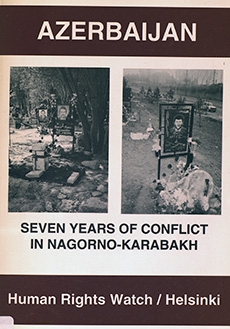
Cover photographs: Un the right: Azeri dead from fighting in Karabakh buried in "Martyr's Cemeteiy," Baku. Located high above the Caspian on a bluff, it used to be Kirov Park, Baku's loveliest, named in honor of the Bolshevik revolutionary. Un the left: Karabakh Armenian dead buried in main cemeterv, Stepanakert. Nagorno-Karabakh.
Human Rights lfratch/Helsinki (formerly Helsinki Watch) Human Rights Watch/Helsinki was established in 1978 to monitor and promote domestic and international compliance with the human rights provisions of the 1975 Helsinki Accords. It is affiliated with the International Helsinki Federation for Human Riglits, which is based in Vienna, Austria. Jeri Laber is the executive director: Holly Cartnei, deputy director; Erika Dailey, Rachel Denber, Ivana Nizich and Christopher Panico are research associates; Anne Kuper, Ivan Lupis and Alexander Petrov are associates; Zeljka Markic and Vlatka Mihelic are consultants. Jonathan Fanton is the chair of the advisorv committee and Alice Henkin is vice chair.
Addresses for Human Rights Watch 485 Fifth Avenue, New York, NY 10017-6104 Tel; (212) 972-8400, Fax: (212) 972-0905, E-mail: hrwnyc@hrw.org
1522 K Street, N.W., #910, Washington, DC 20005-1202 Tel: (202) 371-6592, Fax: (202) 371-0124, E-mail: hrwdc@hrw.org
10951 West Pico Blvd., #203, Los Angeles, CA 90064-2126 Tel: (310) 475-3070, Fax: (310) 475-5613, E-mail: hrwatchla@igc.apc.org
33 Islington High Street, N1 9LH London, UK Tel: (71) 713-1995, Fax: (71) 713-1800, E-mail: hrwatchuk@gn.apc.org
15 Rue Van Campenhout, 1040 Brussels, Belgium Tel: (2) 732-2009, Fax: (2) 732-0471, E-mail: hrwatcheu@gn.apc.org