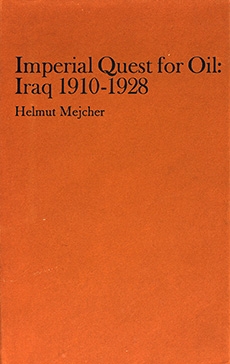
Imperial Quest for Oil: Iraq 1910-1928
Helmut Mejcher
Ithaca Press
This book charts the way in which Britain attempted to extend its control over the major oil-fields of the Middle East at the end of the First World War. Dr Mejcher’s major thesis is that the concept of the Mandate system was deliberately promoted by the British as a cover for the pursuit of their own national interest. In particular the award of the League of Nations Mandate for Iraq was central to Britain’s success¬ful efforts to secure control over the oil near Mosul and Kirkuk. But the author also shows how Britain’s major rival, America, was able to use other internationalist arguments, such as the ‘Open Door’ principle, to wrest the Saudi Arabian fields from the British sphere of influ¬ence.
Before scholars were given access to the British government documents, the story of the use of the Mandate system in the struggle for oil could hardly have been told. Hitherto most historians have agreed with Lord Curzon that economic interests had little to do with Britain’s decision to stay in Iraq. Dr Mejcher’s own examination of these documents shows that for many of Curzon’s contemporaries, oil and Iraq were synonymous. In so doing he adds a vital extra dimension to the study of British imperial expan¬sion into Arab lands.
Contents
Preface
Introduction
I. The start of British interest in Mesopotamian Oil 1910-1914 / 1
1. The Problem in perspective
2. First steps towards control over Middle Eastern oil
3. Germany and the Baghdad railway interlude
4. The agreement on oil that was too late
II. The impact of oil and other economic interests on Britain's / 21
Mesopotamian policy 1914-1918
1. The strategic and political dimensions of the campaign
2. Mesopotamian oil as a strategic and economic factor in
the formation of British war aims
III. The politics of acquisition - conception of the Mandate / 49
and its execution in Iraq
1. The genesis of the Mandate compromise
2. The consolidation of British power in Iraq in the post war years
a. The search for cheap rule
b. The nursing of the contracting power
IV. The American challenge repulsed 1918-1923 / 105
1. The oil-issue and the political response at the end
of the war
2. Another round of claims and expedients
3. Whitehall's partial climb-down on the eve of the
Lausanne Conference
V. The role of oil at the Lausanne Conference 1922-23 / 131
VI. Mosul oil and the settlement of Iraq's northern boundary 1923-1926 / 149
1. The concession of the Turkish Petroleum Company in deliberations of the International Boundary Commission
2. The subjection of the Iraqi Government
VII. Agreement at last 1926-1928 / 159
1. Conflicting claims: C S Gulbenkian, the French and their rivals
2. British mediation and the Red-Line Agreement
3. Conclusions
Epilogue
Appendices
Bibliography
Index
Note on the spelling of Arabic, Turkish and Persian proper nouns.
Arabic, Turkish and Persian names have been given in their familiar, romaised form wherever possible. The spelling of unfamiliar place-names is taken from the Oxford Atlas. The names of unfamiliar persons have been transliterated according to a simplified version of the system to be found in C Brockelmann's Geschichte der Arabischen Literatur, supplementary Vol I (Leiden 1937).
FOREWORD
by Elizabeth Monroe
Plenty of books tell the story of oil once commercial quantities are discovered. Few record the diplomatic and commercial contests that took place in the days when its existence was only suspected. In Mesopotamia, discovery in volume took place only in 1927, but for fifteen years before that, the supposed 'oil of Mosul' was amassing file on file in British government departments.
The story of British tenacity in seeking and securing first, the mandate for Iraq and secondly, the inclusion of Mosul vilayet within that mandate gets into full swing in the last months of the first World War. Then, Admiral Sir Edmond Slade, who was the Admiralty's oil expert, launched two memoranda that quickened attention. In them, he assessed the likely post-war race physically to control oil resources. His reasoning prompted Sir Maurice Hankey, the balanced and unemotional Secretary to the Cabinet, to propound and amplify his idea. It was at least partly responsible for the British army's push on to Mosul after the signing of the armistice with the Turks on the battleship Agamemnon at Mudros on October 30, 1918. Thereafter, it runs through all British diplomacy, like the thread through a banknote, until Curzon emerges from the Lausanne Conference in 1924 with Mosul vilayet in his pocket to be referred to the
League of Nations which in 1925 awarded it to Iraq.
Professor Mejcher, in the course of this story, shows that many other reasons for holding Mosul - some true, some mere excuses - found their way into British arguments. Iraq's northern mountains could prove a barrier to Turco-German expansion towards India; their Christian inhabitants needed protection; they could be turned into splendid levies; Iraq needed a mountain frontier if it was to be safe against invasion; the neighbouring plains might become a granary for the world. He includes descriptions of the way in which the mandate idea unfolded, of the installation of Feisal as King in the hope that he would do British bidding, and of American attempts, to establish within it the principle of the Open Door. His account of the subtlety with which Curzon overcame all contestants at Lausanne is coloured by his now-famous lie: "Oil had not the remotest connection with my attitude over Mosul."
Students who use this book should cap it with two others that have come out since Professor Mejcher wrote. One is Marian Kent’s Oil and Empire (London 1976). (She appears under her maiden name, Marian Jackin Professor Mejcher's bibliography.) It supplements his tale with a detailed account - some think too detailed - of the foundation of the Turkish Petroleum Company just before the first World War; it also gives some useful information about the British acquisition, after the armistice, a big interest in an oil company till then thought untrustworthy - Royal Dutch Shell. The other book is Briton Cooper Busch's Mudros to Lausanne; 1918-1923 (State University of New York Press 1976) which describes the muddle in Southern Russia, Persia and the Caucasus which renders it surprising that successive Cabinets engaged in peacemaking with Turkey had time to remember Mesopotamian oil, - that necessity of Empire in the eyes of Admiral Slade, now thanks to Britain in the possession of Iraq.
Elizabeth Monroe
Acknowledgments
Much kindness and help came my way during the preparation of this study. In particular, I should like to thank Miss Elizabeth Monroe, Dr Roger Owen and Mr Albert Hourani. They gave me much of their hard pressed time to clarify my thought and findings on the British imperial mind and on the Middle East at large.
This thesis was originally submitted, in 1970, under the title: The Birth of the Mandate Idea and its Fulfilment in Iraq up to 1926, and it has meanwhile been quoted as such in literature. In its present shape, size and scope have been varied greatly - always too late to catch up with a rapidly decreasing commercial market for studies of this kind. Therefore, not all curtailments and changes necessarily imply revisions of interpretations and judgements made earlier. On the other hand, Dr Owen and also Dr Hopwood afforded me last valuable comments, which go to the credit of the narrative. Notwithstanding, any shortcomings in factual presentation as well as all views and judgements expressed are my sole responsibility.
Tübingen, November 1976
Preface
In the eighteen years from 1910 to 1928 Iraq could scarcely have been called an oil-producer. In 1929 the annual production figure of 800, 000 barrels compared badly with the 42.1 million barrels produced in neighbouring Iran, and likewise with the total world production in the year - 1, 485. 9 million barrels. Nevertheless it was in those 'unproductive' eighteen years in Iraq that the pattern of oil exploitation in the Arab Middle East took shape. Its basic features remained unchanged until the 1950's, and its eclipse has only very recently come about through the admission of indigenous Arab shareholders to the Western oil-oligopolies, and through nationalisation.
Successive Arab officials and governments had struggled to attain this aim. But individual and local struggle proved futile: it could easily be exploited and absorbed by the Western imperial practice of 'divide and rule'. The lack of technical know-how, of management personnel, of investment capital and perhaps even of social stimulus and the spirit of enterprise may have sapped what energy was left after the frustrations of alien political and economic domination. Success required the formation of a common movement, the Organization' of Petroleum Exporting Countries (OPEC), and the unification of all their efforts, before the dominating power of Western business administration could be made to pass away.
In contrast, the ascendancy of the West and the pattern of oil exploitation resulted from internal antagonisms and alliances that were unstable. Unrelenting internecine rivalry between the industrial empires and giant oil companies such as the Royal Dutch Shell Group, the Anglo-Persian Oil Company, and the American Standard Oil of New Jersey was the prelude to every major oil-concession. Sober politic¬ians and punctilious administrators became avid for the acquisition of oil. Before the turn of the century, technilogical progress in motor transport prompted metropolitan governments and the admiralties of imperial powers urgently to look abroad for unhampered supplies of the vital strategic commodity. The political methods by which the supply of oil was safeguarded were developed in the shadow of war. Having won a Pyrrhic victory over her rival Germany, Britain reached out to gather the most precious spoils of the tottering Ottoman Empire. The acquisition of Iraq's oil-bearing regions, together with production in Iran, would be enough to ensure an independent supply and help restore the hegemony of Britain in world shipping. Her mercantile supremacy and her function of policing the seas could be expected to offset the rising power of America.
Thus far, this kaleidoscopic view may be familiar from a great many books already written on oil. The new data presented in this book derives from the intimate link between the successful acquisition of the oil-bearing regions on the one hand, and on the other, from the combined effects of Iraqi subjection and submission in the unique circumstances of the country's emergence as a nation-state.
Britain's physical conquest and mandatory commitment in Iraq were like two sides of the same coin. Thorough observation of this almost trivial aspect throws up many relevant questions that have been needlessly excluded from previous books on oil policy. Without being cynical we can dissent from the assertion that the changed standards of international behaviour after World War 1, and in particuar, of the conduct of relations between 'backward' and 'advanced' peoples - to use the imperial phraseology of those days - did not leave room for open and direct imperial expansion. Yet how were the restrictions that hindered British oil policy overcome? An assessment and a complete answer have to take into account the specific British contribution, intellectually and politically, to the birth of the international mandate formula which in the end helped Britain to acquire the oil. We must also examine the main steps of Iraq's constitutional development, prior to the Red-Line Agreement of 1928. This factor may well have been a powerful influence in British hands for maintaining submission.
The setting of this study is therefore very broadly based. The focus is as much on the contemporary conditions of imperialism, internationally and locally, as it is on the early days of oil enterprise.
Knowledge of the two together sheds new light on the nervecentres of the British Empire in a vital region during the first quarter of the twentieth century.
Chapter One
The Start of British interest in Mesopotamian Oil 1910-1914
1. The problem in perspective
Anyone who writes about British oil policy, and concerns himself chiefly with the years succeeding World War 1, is inescapably confronted with the question of its legacy before the war. There are many reasons why this is so. The Turkish Petroleum Company, since 1929 known as the Iraq Petroleum Company, was the principal instrument for developing British oil interests in the Arab Middle East. Its origins, both financial and diplomatic, can be traced to the years when Anglo-German trade rivalry was intensifying. The Baghdad Railway Era before the war had been a hey-day for bankers and con-cessionaires. The people were helped by a happy combination of diplomatic factors which caused their governments to ask them to act as intermediaries, with the result that under cover of diplomacy they could easily benefit trade and finance. Once granted governmental support from home, they could also bully the reluctant or unreliable rulers at Istanbul into promising them concessions and trading estates. Conversely, competitors in the field, by pretending that they had government backing, easily found access to the rival factions at the Porte.
Meanwhile, the Turks, burdened by the huge public debt and the imbroglio in the Balkans, were very ready to play off the concessionaires against each other, or else to use them to draw in foreign diplomatic support for their various political ends. Naturally, the …
Helmut Mejcher
Imperial Quest for Oil: Iraq 1910-1928
Ithaca Press
Ithaca Press London
Imperial Quest for Oil: Iraq 1910-1928
Helmut Mejcher
Monograph No. 6
Imperial Quest for Oil: Iraq 1910-1928
by Helmut Mejcher
Published for
The Middle East Centre St Antony’s
College Oxford
by Ithaca Press London 1976
St Antony’s Middle East Monographs No 6
Copyright © Helmut Mejcher 1976
First published in 1976 by
Ithaca Press 13 Southwark Street London SE1
for the Middle East Centre St Antony’s College Oxford
ISBN 0 903729 22 9
Printed in England by Anchor Press Ltd
and bound by Wm Brendon and Sons Ltd
both of Tiptree Essex