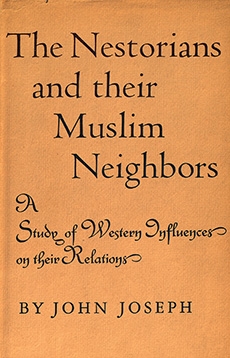
The Nestorians and their Muslim Neighbors
John Joseph
Princeton University Press
Since the Arab conquest in the seventh century, the Nestorians have lived as a Christian minority in a Muslim world. Welcomed and honored at first because of their superior culture and their inde-pendence from Western ecclesiastical authority, the Nestorians gradually declined into a less favored status.
This study is concerned primarily with Western influence on Nestorian-Muslim relations from the early nineteenth century to World War II. In assessing the role of the West, Dr. Joseph weighs the importance of such factors as competing East-West political expansion and the spread of the European and American church missionary movement. His conclusions offer a fresh perspective on the struggle of the Nestorian group to maintain its entity, often in the face of controversy and schism from within, persecution and proselytizing from without.
John Joseph is an assistant professor of history at Franklin and Marshall College.
Contents
Foreword / vii
Preface / ix
Part One
The Nineteenth Century
I. Nestorians, Chaldeans, Syrians, Assyrians / 3
Chaldeans / 5
Syrians / 11
Assyrians / 13
The Middle Eastern Melting Pot / 18
II. The End of an Era / 23
Nestorians the Most Favored / 25
Controversies and Schism / 29
The Ottoman Nestorians / 33
The Persian Nestorians / 37
III. / Missionaries, Kurds, and Christians / 40
The Rise of Missions / 40
Nestorians Rediscovered / 42
Religion and Politics / 46
Kurdistan Agitated / 49
Missionary Encouragement / 51
Nestorians and Missions Suspected / 54
Intrigues / 56
Missionary Competition / 60
The First Kurdish-Nestorian Conflict / 62
Grant’s “Neutrality” / 63
Missionaries before Judgment / 64
IV. Mission to Azerbayjan / 68
Syriac Revived / 71
Religious Revival and Rivalry / 76
Missionaries Exert Influence / 83
Great Britain Concerned / 87
V. The Powers, Kurds, and Christians / 93
British Interest in the Nestorians / 95
British “Containment” Policy / 102
The Nestorians Misguided / 105
The Kurds Feel Threatened / 107
The Kurds Revolt / no
American-Persian Relations / 113
The Powers Shift Interest / 114
Increased Lawlessness / 116
Kurds Neglected and Exploited / 118
VI. The Calm before the Storm / 120
More Missions / 120
Progress at a Price / 123
The Labaree Case / 125
Russians Occupy Azerbayjan / 128
The First World War / 131
Nestorians Flee Hakkari / 134
Russia Withdraws from the War / 137
The Christians Isolated / 138
Christians versus Muslims / 140
The British Arrive / 141
Urmiyah Front Favored / 143
Nestorians Flee Urmiyah / 144
Part Two
The Twentieth Century
VII. The Nestorians in Exile / 147
Minority Problems / 147
The Nestorian Problem / 151
Repatriation / 156
The Missionaries Return to Urmiyah / 164
Recruitment / 165
The Turks Again / 167
The Lausanne Conference / 168
Nestorians and Mosul / 170
The Constantinople Conference / 171
VIII. / The Assyrians as a Political Issue / !75
The Mosul Commission and the Assyrians / 176
The Special Recommendations
The Permanent Mandates Commission and / 180
the Special Recommendations
Great Britain Misinterprets the Special / 183
Recommendations / 185
Misinterpretation Accepted / 187
Kurdish Protests / 189
Special Recommendations Revived / 19°
IX. The Inevitable Clash / 195
The Iraqis Take Over / i95
The Community Alarmed / 200
In Search of a New Home / 201
The Massacre / 203
Iraq Politics, 1933 / 204
Final Settlement / 206
Developments in Iran / 209
X. Conclusion / 214
A New World Order / 214
From Millets to Minorities / 217
The Language Barrier / 218
Religion Still a Dividing Line / 220
Missions, Muslims, and Christians / 221
End of the “Nestorian Mission” / 225
Missions Change Approach / 226
The Church’s Compelling Mission / 228
Evangelism and the Native Christians / 229
Bibliography / 239
Index / 271
Maps: Turko-Iraqi Frontiers, 1920-1924 / 22
Nestorian Homegrounds / 178
FOREWORD
In this atomic and space age, when fleets of jets have brought peoples and cultures within hours, rather than weeks and months, of each other, the history of our intercultural relationships, particularly those of formative periods, acquires paramount importance. To understand each other today we must know the truth about ourselves — about our respective cultures — yesterday and the days before. In the give and take of the generations, adjustments are often so painfully come by that myths and misconceptions, illusions and disillusions, psychic sores and scars, become the heritage that complicates the cultural cooperation of the present, with the latter’s tyranny of haste. To analyze this heritage, to sift the true from the false, and to set these forth in perspective and with clarity, is a much needed service.
This Dr. Joseph has done in connection with one limited, but important, area of relationships in the modern Near East. Throughout the centuries one of civilization’s persistent problems has been the status and rights of minorities — especially of a communal and religious character. In both Christendom and the world of Islam, this problem persists, in the relationships of Jews, Christians, and Muslims, with varying degrees of success and failure. The problem is always compounded when the factors of domestic and international power politics are involved, as inevitably they are; and these factors have not been rendered more amenda-ble to the guidance of reason and wisdom by the forms of zealous and intransigent nationalism which they have assumed in our times. Nor is the problem today simplified by the polarized East-West struggle between the Communist Bloc and the Atlantic Community; certainly not for the Near and Middle East, caught between these foci of power, and conditioned in action by past experience, each with the other.
Foreword
This study of the modern experience of one of the most ancient of Christian minorities set in the heart of the Muslim Near East, exposed to the rivalry of imperialisms that constitutes an important part of the antecedents of the cur-rent East-West struggle, is a historian’s laboratory for investigation of limited and relatively controllable data which should contribute substantial insight into this larger problem of the relationships of a minority to another politically and socially dominant cultural tradition. Moreover, the study should also contribute to more understanding between the West and the Muslim Near East, that each, mending their ways accordingly, may achieve closer understanding and cooperation in the solution of the world’s larger problem of East-West relationships in this perilous age of atomic power.
T. Cuyler Young
June 24, 1961
Preface
A number of Middle Eastern minorities are named after a religious leader with whom they have had either direct or indirect association; there are, for example, the Druzes, Maronites, Alawites, Jacobites, Yezidis, as well as the people who make up the subject of this study. Some of these sects are sometimes known by more than one name. In the case of the Nestorians, they are known also as Assyrians, a name commonly used in reference to them only since the First World War. Although I have used “Assyrian” in sections surveying the community’s postwar history, I have adopted the term Nestorian because of its ancient usage. In spite of its original stigmatic connotation time has made respectable its use as the name of a historic millet.
Both of these names have to a certain extent colored the history of this small but once-flourishing Christian sect. A halo of romance seems to have surrounded the Nestorians who, as respected members of a community that cherished learning, contributed so much to that intellectual flower¬ing for which the medieval Muslims became famous. Much also has been written in praise of the early Nestorian Church and its far flung missionary enterprise. Indeed, the modern history of the Nestorians starts with Western endeavors to set aflame the ashes of their once-zealous church. As “Assyrians,” on the other hand, writers have either ro-manticized them for their gallantry and integrity, or have suspected them as troublesome and rebellious, leaving unexplored important aspects of their history and diverse fac-tors which have gone into its making. In this study I have tried to cover some of these important phases which have been left uninvestigated.
In the task of transliteration, I have tried to be formal and consistent in the footnotes and bibliography but rarely have used diacritical marks in the text. For the transcription of Syriac titles I have adopted a system based on that used for Arabic.
In the preparation of this work I have incurred a great number of obligations to a great number of kind people. Any list of one’s creditors must seem incomplete and per-functory. Nevertheless, I take pleasure in acknowledging my gratitude to all those who have generously assisted me in my task. To the Department of Oriental Studies of Princeton University, which made possible the writing of this book through a grant from the University’s Research Program in Near Eastern Studies, I owe special thanks. To the Chairman of that Department, Professor T. Cuyler Young, I am greatly indebted for his encouragement and support as well as for his writing of the Foreword. I am very grateful to the former Chairman of the Department, and its founder, Professor Philip K. Hitti who in 1956 supervised my doctoral dissertation which has developed into this work. The author is under great obligation to another distinguished member of the Department of Oriental Studies, Professor Louis V. Thomas, for reading and criticizing the final work in manuscript. My thanks are also due to Mr. and Mrs. Roger Older of Princeton who have read the whole manuscript, making useful suggestions from a layman’s point of view.
I should like to put on record my gratitude to the writers of both past and present to whose labors of observation and interpretation most of the pages of this book owe a debt, and to the staffs of a number of archives and libraries in this country and abroad for their cooperation. In the bibliography I have tried to acknowledge these large debts. Here I wish to express my appreciation of a grant from the Ford Foundation which in 1954-56 helped make possible research in the Middle East and England. The Foundation is in no way responsible for any of the statements made or views held in this study.
Finally, I wish to record my heavy debt to those with whom I have worked closely: to Mrs. James Holly Hanford, Editor at Princeton University Press, for carefully preparing the manuscript for the printer; and to my wife for rendering assistance in many ways and for her interest in my work.
John Joseph
Franklin and Marshall College
Lancaster, Pennsylvania
August 1961
Part One
The Nineteenth Century
I. Nestorians, Chaldeans, Syrians, Assyrians
The majority of the native Christians of old Persia and Mesopotamia were members of the East Syrian Church, also known stigmatically as the Nestorian Church. The West Syrians, also known as Jacobites, flourished in Syria proper. More recently, the East Syrians have also been known as Assyrians and Chaldeans. At the present time the historic names of Assyrian and Chaldean make distinction between the two branches into which the East Syrian Church was divided; namely, the Catholic and the non-Catholic.
The use of these various appellations — Syrian, Assyrian, Chaldean, and Nestorian — with reference to the same ethnic group has caused a great deal of confusion, even among students of the modern Middle East. Some writers have stated that the use of the word Nestorians with reference to the East Syrians goes back to the seventeenth century when a considerable number of the community became reconciled with the Roman Catholic Church and were or-ganized by the latter into a separate body.1 Those who remained loyal to their own church, we are told, were dubbed Nestorians.
We find, however, that the community is referred to as Nestorian long before the seventeenth century.2 Cosmas …
1 William F. Ainsworth, Travels and Researches in Asia Minor, Mesopotamia, Chaldea and Armenia (London, 1842), 11, 272. Horatio Southgate, Narrative of a Tour through Armenia, Kurdistan, Persia and Mesopotamia (London, 1840), 11, 178-179; Austin H. Layard, Nineveh and its Remains (New York, 1851), I, 217.
2 Leonhart Rauwolff, Itinerary into the Eastern Countries, as Syria, Palestine, or the Holy Land, Armenia, Mesopotamia, Assyria, Chaldea, etc., trans. Nicholas Staphorst (London, 1693), pp. 22, 350-351. (Rauwolff’s travels took place in 1573-1574.) Pedro Teixeira, who visited Baghdad in 1604, found eighty houses of "Nestorians” and ten of "Armenians.” The Travels of Pedro Teixeira, translated and annotated by William F. Sinclair …
John Joseph
The Nestorians and their Muslim Neighbors
Princeton University Press
Princeton University Press
Princeton Oriental Studies, 20
The Nestorians and their Muslim Neighbors
A Study of Western Influences on their Relations
BY John Joseph
Princeton, New Jersey
Princeton University Press
1961
Copyright © 1961 by Princeton University Press
All Rights Reserved
L.C. Card: 61-7417
Printed in the United States of America by
Princeton University Press
Princeton, New Jersey