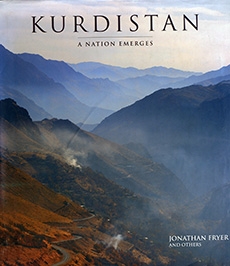
Kurdistan is one of the Middle East’s great recent success stories. The area controlled by the Kurdistan Regional Government of newly federal Iraq occupies much of what is now northern and north-eastern Iraq and has distinguished itself by its stability and strong economic growth. Crisscrossed throughout history by the invading armies of the major powers on the surrounding plains, this mountainous terrain has in recent years become strategically important in its own right because of its formidable mineral reserves. While the income from oil resources has assured financial stability for the newly established regional government, the Kurds have not lost sight of the natural bounty of their land - some of the best agricultural land in the Middle East — and of the importance of encouraging trade across its frontiers. Erbil, whose citadel lays claim to being the oldest continuously inhabited city in the world, is increasingly a hub that connects Turkey and the Levant with the Gulf states to the south. Kurdistan, A Nation Emerges is the first ever major photographic book on the land and its peoples. It assembles the work of a team of international experts to present an authoritative overview of Kurdistan’s ancient history and cultural heritage from which has emerged today’s society and the Kurds’ role in the political world of tomorrow.
The flag of Kurdistan, now prevalent across the entire area controlled by the Kurdistan Regional Government, has been carried by various Kurdish independence movements over the years, probably originating amongst Kurdish groups under the Ottoman yoke. Earlier versions were flown by the breakaway republic of Ararat in Turkey (1927—1931), and by the briefly independent Republic of Mahabad in north west Iran in 1946. The blazing disc at its centre is an ancient cultural symbol, its 21 rays having religious significance to this day for the Yazidi communities across the region.
Contents
1. Land and People / 8 2. Faith / 60 3. Society & Culture / 72 4. History / 84 5. Economy / 108 6. Kurdistan Today / 130 7. Looking Ahead / 148
Maps Governorates Map of Kurdistan / 5 Erbil in 1954 / 10 A Regional Map of the 19th Century / 89 Asia Minor and the Balkans reshaped after the fall of the Ottoman Empire / 91 Energy Resources / 123
Index / 161
1 Land & People
Erbil lies on the plain beneath the mountains, but, tor the most part, the inhabitants of Iraqi Kurdistan dwell up above in the rugged and rocky terrain that is the traditional habitat ofthe Kurds since time immemorial. With peace now established, an era may now be emerging that will see the sons and daughters of Zuhak starting to come back down to the fertile lowlands and build settled and prosperous lives there. But in the Kurdish spirit the atavistic yearning for their ancient mountain fastness is never like to fade completely.
The iconic statue of the ancient Kurdish historian Ibn Mustafi stands by the entranceway to the citadel and its ancient raised dwellings in the centre of Erbil, capital to modern day Kurdistan.
Erbil
Erbil - the name most used internationally for the ancient city that serves as today’s capital of Iraqi Kurdistan - is often referred to by the phonetic equivalents of Arbil or Erbil, as well as Arbela. The origin of the name can be traced back to Sumerian writings as early as 2000 BC referring to Arbilum, Orbelum or Urbilum. It is believed to be composed from the Sumerian roots ‘Ur’ (town) and ‘Bela (high), presumably on the basis that it is located in the upper regions, beyond the lower deltas of the Tigris. In the Kurdish language the city is still referred to as Hawler, linked perhaps to the Greek helios (sun) and denoting a sun temple, in recognition of the early Zoroastrian worship of fire and sun.
There are traces of early settled existence in the Erbil region as far back as the twenty-third century BC, but probably the first major population expansion took place when Cyaxares (625 - 585 BC), the first king of Media, settled some of the sagarthian tribes in what is today Erbil and Kirkuk. Neighbours to the Parthians in north eastern Iran, these early Persian tribes were nomadic pastoralists, reputed to use the lasso as their principal weapon. The Medes, and with them the Sagarthians, were to revolt against Darius I of Persia in 522 BC, but this revolt was firmly put down by the army which Darius sent out under the leadership of General Takhmaspada the following year. The events are depicted in the Behistun Inscription which stands today in the mountains of Iran’s Kermanshah province.
Ever the buffer zone between the two great empires of Byzantium and Persia, the plains 10km to the west of Erbil were to witness the Battle of Gaugemela between Alexander the Great and Darius III of Persia in 331 BC. Vanquished, Darius managed to flee to Erbil, which is why the battle is still sometimes referred to - rather inaccurately — as the Battle of Erbil. Erbil went on to be the seat of rule for the Adiabene Kingdom in the first century AD, largely located to the north west in the region of modern day Diyarbakir in Turkey. It is remembered in Jewish traditions for the notable conversion of its Queen, Helena of Adiabene, to Judaism before she moved on to Jerusalem. Early Christianity was also to flourish in Erbil with a bishop established in the town as early as AD 100 with a community of followers thought to be converts from Judaism.
…..
Jonathan Fryer And Others
Kurdistan A Nation Emerges Stacey International
Stacey International Kurdistan: A Nation Emerges Jonathan Fryer And Others
Stacey International in 2010
Stacey International 128 Kensington Church Street London W8 4BH Telephone: +44 (0)20 7221 7166 Fax: +44 (0)20 7792 9288 Email: info@stacey-international.co.uk Website: www.stacey-international.co.uk
Title page: A solitary angler fishes in the tranquil waters of Lake Dokan
The publishers would like to thank the Kurdistan Regional Government for their assistance in the creation of this book, in particular Talar Faiq Salih without whose major support and contribution, this book would not have been possible.
Principal text contributions Jonathan Fryer, Michael Howard, Parwez Zabihi, Max Scott
Editorial Max Scott
Design Graham Edwards
Cartography Amber Shears
Photographic credits The publishers would like to acknowledge the following photographers and photographic agencies for the use of their images in this book:
CIP Data: A catalogue record for this book is available from the British Library
All rights reserved. No part of this publication may be reproduced, stored in a retrieval system, or transmitted in any form or by any means, electronic, , ‘mechanical, photocopying, recording, or otherwise, without the prior permission of the copyright owners.