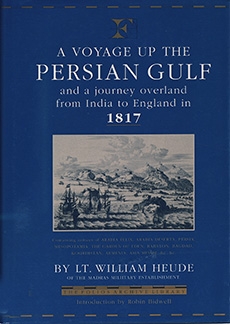
"Nature throughout, it would indeed appear, has been too much lost in the mightiness of the work, to spare a moment in softening the stroke that marks sublimity. The mountain towers above the cloud, the abysm sinks into a tearful giddy depth. The loftiest wood crowns the boldest clill: the chasm frowns, and the cataract, rushing impetuously, threatens destruction to the smiling vale that opens its bosom to receive its spellbound. and now sportive streams." In 1816 William Heude set out for England from India. He travelled through Gott and Bombay, Arabia Felix and Maskat, the Garden of Eden and Babylon, Baghdad, Koordistan and Nineveh, before reaching Constantinople in April 1817. The report of his journey, beset by mutiny, robbery and madness, and also relieved by charming hospitality and the fascination of his journey, ranks as one of the best descriptions of the region, though Heude was modest of his own achievements. "I trust the following representation of men and manners, ol countries, and the peculiar incidents of a journey overland, will be allow ed, at the worst, the humble merit of a strict adherence to truth, and fidelity of narration."
Contents
Introduction by Dr Robin Bidwell / VII
Publisher’s Note / XI
Letter to the Right Honourable Earl Fitzwilliam / iii
Preface / v
Contents (original) / ix
A Voyage up the Persian Gulf / 1
INTRODUCTION
William Heude
A Voyage up the Persian Gulf
William Heude had an aristocratic background, for his grandmother, Lady Harriet Watson, was a sister of the Prime Minister, the second Marquis of Rockingham. She eloped with a footman, William Sturgeon, and they settled near Rouen where he became involved in the manufacture of china. They had five children, the youngest of whom, Agnes, married a local man called J. La Chesnez-Heude. William, their first child, was born in Rouen in 20 January 1789, the year that his grandmother died. Presumably it was the outbreak of the Revolutionary Wars that caused the family to return to England, where they arrived in precarious financial circumstances.
Lady Harriet had obviously kept upon good terms with her sisters, one of whom had married the third Earl Fitzwilliam. She and her son the fourth Earl seem to have adopted the Heudes, for William dedicated his book to him as “the kind protector of my youth… who brought me up.” This interest may have been connected with the fact that after the Earl’s only child, William stood to become one of the greatest landowners in the country, inheriting not only the Fitzwilliam estates but also those of the Rockinghams.
In 1804 William Heude was accepted for service with the East India Company and in 1807 was posted to the Madras Military Establishment and promoted Lieutenant. He kept in touch with the Fitzwilliams, and there exists in their family papers a letter from him in which he describes a mutiny in 1810. In October 1816 he left Bombay on the journey described here. His story ends in April 1817 in Constantinople so he most probably reached England in May. In October in Kettering he married Sophie Roughton, the sister of two wine merchants. We do not know whether this was a whirlwind romance, or whether „ ' he had patiently wooed her by mail at a time when to write a letter and receive an answer could take a year. While on leave he was promoted Captain.
In this journey, travelling alone and knowing little of the languages of the territories through which he passed, Heude showed himself a man of courage, enterprise and considerable humour. His journey broke no new ground, but he had a good eye and fine powers of description. After calling at Muscat where, like most visitors, he was charmed by the Ruler Saiyyid Said, he sailed up the Gulf on an Indian boat. At a time when piracy was at its worst he met with no more misadventure than the captain’s going insane. Although he had for some time the services of an Arab with whom he could communicate in Hindustani, at Basra he fell into the clutches of a drunken Turkish guide whose truculent attitude to the Arabs and to his travelling companions always seemed likely to produce trouble. Heude’s account of Arab life in Iraq, in the last years before the Ottoman Empire could assert comparatively effective rule, is of much interest and his sketches of incidents in desert life are as good as those of more famous travellers. His study of the country and its inhabitants was apparently not without ulterior motive for he envisaged the time when, in the event of a war either with the Ottoman or the Russian Empire, Mesopotamia would have great strategic importance: exactly a century before General Maude was to enter Baghdad, Heude sketched out a plan by which this could be done.
Heude was one of the first to give a popular description of Babylon where Claudius James Rich, the Resident in Baghdad from 1808-1821, had started the excavations which had attracted the jocose attention of Lord Byron in Don Juan. In these writings Heude showed himself very much a man of his time, with learned quotations from the Bible and the classics. His account, obviously obtained from eye-witnesses, of the turbulent politics of the last Mamluk rulers of Baghdad is of particular value as it deals with a period which has attracted little scholarly attention. Soon after the Ottomans were able to resume control in 1831 the Lynch Expedition brought a new commercial interest in the country with the opening of its great rivers to steam navigation, but for the events of the previous twenty years we are dependant mainly upon official archives and a handful of travellers. Heude was himself present during a bloody insurrection of which he gives a vivid description, and he attended the Diwan of the victor. A special mission was sent to convey the heads of the leading rebels to Constantinople for display to the Sultan and, for about £20, Heude arranged to travel with the party.
In his journey through Kurdistan he at times followed the tracks of Lieutenant (later Sir John) MacDonald Kinneir (1782-1830) who had been there the previous year. Kinneir published after Heude with his Narrative of Travels which included remarks on routes used by Xenophon and the 10,000 Greeks, and later by Alexander the Great. Heude was one of the first, and certainly not the last, to describe the Kurds as ‘robbers by profession’ who lived in a state of ‘public anarchy’ and to wonder at the strange doctrines of the Yazidis, the sect that believes that since God is benevolent He may safely be ignored while the wise man concentrates his attention upon not antagonising the Devil. The final stages of the road to Constantinople were performed as fast as the horses could carry them, leaving little time for observation.
After his marriage, promotion and extended leave, he returned to India. On his way back, in February 1819, he wrote from Lisbon to Earl Fitzwilliam arranging for him to receive some port. In India in January 1820, he had a son whom, emphasising the Fitzwilliam connection, he named William Wentworth Heude. Soon afterwards he was engaged, in such a furious quarrel with another officer, whom he accused of intriguing to prevent him receiving command of a battalion in the army of the Nizam of Hyderabad, that it had to be referred to the Governor-General. His letter recounting all of this to Earl Fitzwilliam also contains an interesting account of a mutiny by unpaid troops and their subsequent execution. In February 1822 Heude’s wife died and the little boy was sent back to England to be looked after by relations. Earl Fitzwilliam paid for his education and later he became a surgeon in the army in India. Heude continued to feel that his just deserts were not recognised and complained about the financial difficulties that he encountered. He died at Masulipatan in May 1825 leaving debts which were settled by the Fitzwilliams. Heude’s narrative of his journey, despite its intrinsic value, has been largely neglected and an extremely interesting man has received less than his due.
Robin Bidwell 1993 & ...
Note on Production of this Edition
This book has been photographed from the original first edition. The quality of the type as reproduced on the pages therefore reflects the printing technology available at that time. A slight distortion of the type has also occurred during the photographic process, but this should not impair reading of the text. We feel that the benefits of capturing the original style of the book and its period out-weigh the disadvantages of any minor distortions to the type.
To the Right Honourable The Earl Fitzwilliam, My Lord,
On my return overland from India, in the happy and peaceful leisure I enjoyed under the hospitable roof of the kind protector of my youth, the arrangement of the notes I had taken on my travels was first suggested by yourself, and by those learned friends whose acquaintance, with many favours, I am proud to hold at Your Lordship’s hands.
Had I therefore no previous obligations to acknowledge, a work that owes its birth to the condescending encouragement I then received, would naturally belong to the generous friend who brought me up, and to whom, …
William Heude
Persian Gulf
Garnet Publishing
Garnet Publishing Ltd A Voyage Up the Persian Gulf and a journey overland from India to England in 1817 By Lt. William Heude
Containing notices ol Arabia Felix, Arabia Deseria, Persia, Mesopotamia, the Garden of Eden, Babylon, Bagdad, Koordistan, Armenia, Asia Minor &, &,
By Lt. William Heude Of the Madras Millitary Establishment
The Folios Archive Library
Introduction by Robin Bidwell
A voyage up the Persian Gulf, and a Journey Overland from India to England in 1817
By Lieutenant William Heude Introduced by Robin Biowell
London: Printed by Strahan and Spottiswoode, Printers-Street; For Longman, Hurst, Rees, Orme, And Brown, Paternoster-Row. 1819.
All rights reserved. No part of this book may be reproduced in any form or by any electronic or mechanical means, including information storage and retrieval systems, without permission in writing from the publisher, except by a reviewer who may quote brief passages in a review.
New Edition
ISBN 1 873938 44 6
British Library Cataloguing-in-Publication Data. A catalogue record for this book is available from the Britrsh Lrbrary.
Printed in Great Britain by Antony Rowe Ltd., Chippenham
Published by Garnet Publishing Ltd, 8 Southern Court, South Street, Reading RG1 4QS UK.