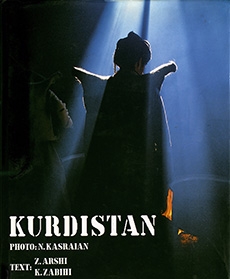
Kurdistan is one of the most inaccessible areas of the world, and little known internationally. The Kurds are one of the largest communities in the Middle East today, with an estimated population of 20-25 million in five countries. Geographically situated in the heartland of the Middle East, Kurdistan is endowed with a wealth of natural resources, and covers an area nearly the size of France. This volume, with its more than 127 colour photographs and knowledgeble text, gives the reader an insight into the customs, history and way of life of the Kurds.
Photographer, Nasrolah Kasraian studied law at Tehran University and has been photographing since 1966. His images have been shown in solo and group exhibitions in Iran, Japan, England, France, Austria, Sweden, USA, Canada, and Singapore and he has been awarded number of prizes. He has contributed to periodicals such as "GEO" (German and French), "Irone" (Italian) and "Grand reportag "(French). Presently, besides" An experiance" and "Endless Joumy" he is working on a number of books on Baluchistan, Turkman Sahra and nomadic life in Iran. Authors; Ziba Arshy, master degree in sociology studied in Tehran. She has done a number of researches on Iranian nomads. Khosro Zabihi, B.A. and M.B.A. Studied in Berkeley, California. Author of "Misticism in Kurdistan" in 1978.
Contents
Introduction / 11
1- On the passage of the history / 13 - The descendants of the survivors - The marriage of magic and beauty
2- Mountains; the shelter of the free / 15
3- The hard way of life / 17 - The plain ruins the Kurds? - Land Reform - Agrarian Relations - Handicrafts
4- The Free are Poor (22) - Statistics talks - Education - Medical care - Dwellings
5- Free but not of traditions / 25
6- The Rush of Modernism / 28
7- the Devil and the Lord / 29
8- Kurd is born a poet / 32
9- Chronology of the contemporary Kurdish history / 34
Bibliography / 138
FACE TO FACE WITH KURDISTAN
This is a simple narrative, avoiding tales of heroic struggles for self-determination, of a land with ancient secrets.
It is the simple story of a people and their sence of history. A people who have struggled continuosly to preserve their ethnic identity, to retain the secrets of their past, secrets carved on the face of the rocks, revived in an¬cient ceremonies, chanted in forgotten songs and performed in symbolic dances.
This is a glance at a land and moments in the lives of her people; a silent rider, a lonely, unruly tree, a bird in a cage, a cry in the wind and die ruins of a temple to the goddess of fertility or to the god of light and brightness, now long forgotten.
Introduction
Kurdistan, this ancient land of haughty mountains and fertile plains, of cold winters and moderate rainy summers, of hard won passes and narrow sloping valleys with hundreds of rivers flowing deep in the bottom, is where a brave people live. This is where a warlike, unruly, dynamic people have inhabited the Zagros mountain range and mingled with the natives since the dawn of the history. This is where snow-covered mountain paths await tragedies at winter dawns and dusks; and where the eternal calm of the mountains and the roaring of the free souls rule.
In the cool tranquility of the dreamlike mountains, where silence is occasionally broken by a cock’s crow or\a mule's neighing, thunderous gun-shots are not a rare sound. An age-old, surprise awaits you at each corner. Penetrate inside and you will listen to its mystery. You can understand the simple, eastern Kurdish soul; a soul filled with the paths, orchards and villages among the rocks that you find in their land, like a winding road passing through the valleys, listening to the rush of the rivers, or a pilgrim walking long roads in the hope of joining a saint buried in a grave on top of a hill and decorated with black stones and green and white flags.
This land is a plain composed of hundreds of colourful patches of earth where remote villages are found here and there resting in the morning fog sheltered by a rock, or located on top of a hill. The villages are full of earthen huts and pyramids tablets of cattle-droppings. There are vast wheat fields ready to be harvested by farmers' hands and sickles, or an open space where golden hay separated from wheat grains flies through weary fingers which have worked the soil. There is the busy market-place in a town that is feverish and armed to the teeth; a town where old, pastoral songs can be heard and magical spells as old as mankind, rise from the tambourine, its crescendo rhythm challenging every man to deny the material life as he moves into a strange dance. Arms open to the tambourine beats, hair flying in the wind mocking the man's pain and body, stabbing one's stomach with a dagger, piercing one's lips with a sword to prove that a man can say "no" to his bodily cage.
Kurdistan is a mountainous area, her landscape is formed by high altitudes, sloping valleys, and fertile plains. Mountains become higher and valleys deeper and unfit for agriculture as we go towards the Northwest. Towards the East, however, valleys become wider and there are cultivable plateaus of fertile soil.
People of the mountains are cattle-raisers and breed goats and sheep; the plains people are farmers and raise crops such as wheat, barley, rice, tobacco, alfalfa and com.
In a cultural-historical context, Kurds can be recognized as an ancient people who have resisted various invasions and deadly confrontations during their history. Their spirits reflect their nature. The bright colours of their land wrap their souls and bodies. A golden sun shines on the plains and steppes surrounded by mountains and green valleys lying in the bottom of snow-capped peaks, where cattle are milked in a village sunset when flocks of herds return to their fold. One can smell fresh bread in the narrow alleys, and hear men talking about politics in the light of the lantern sitting at the supper-cloth spread, bread, yogurt and tea.
Remnants of old forests with occasional trees of bitter almond and wild pistachio can be found in the region, while forests of oak, ash, wild tamarisk, and a rich wild life still exist in Kurdistan.
Despite the wind-swept, rain-washed petrograghs on the weary face of her rocks, the history of this land is a mixture of truth and fable. It is, however, clearly understood that they are people of Indo-European stock who have lived in a constant struggle with the plains people while inhabiting the higher altitudes of Mesopotamia, and who have at times either conquered the regional Empires or been vanquished by them. This land has been overrun by Sollukies, Parthians and Sassanids in ancient times, and by the Arab Caliphs and Mongol invaders and Ataban Turks in the Middle Ages.
The last blow against them was after the First World War, when their land was divided among the five countries of Iran, Turkey, Iraq, Syria and the U.S.S.R.
"Kurdistan" is under the control of the central governments and the affiliated offices are mosdy managed by the non-Kurds. Despite all this, "Kurds" are still alive, and each Kurd reviews the dream of autonomy in his mind, singing it in Kurdish along with his fellow kinsmen while placing their hands at each other's back and tapping their feet on the ground in a dancing motion.
Town settlers constitute half the Kurdish population and are mainly merchants or civil workers. There are no industrial firms or productive companies in Kurdistan. It is also short of natural resources, but there is an abundance of water here, as many rivers and mountain streams flow in the district. In the past, nomadism was a prevalent way of life in Kurdistan, but now most nomadic tribes lead a sedentary life.
Most Kurdish tribes have become sedentary since the last century, without losing their national identity and tribal ties. The Kurds of the mountains had preserved their tribal attitude until recent times. However, this tendency was much less among the plains people where feudal laws used to rule. Today, these relations are replaced by capitalistic ones. The Kurdish tribes come together under the patriarchal leadership of a head (Raiz) who is known as "Bag" or "Agha" and who takes authoritative measures in the absence of the legal statutes.
Sources of income in Kurdistan include fruit growing (apples, pears, pomegranates, quince, figs, walnuts, almonds, cherries, sour cherries, and peaches are grown in the area), bee-keeping and local handicrafts. The latter plays an important role in the economy of this district & differ from one place to another depending on the nature of the region.
Local handicrafts include carpets and rugs, Guelims, Jajims, shawls, brocaded silk, Guivahs (kind of light cotton shoes), felt mats, embroideries, leather products, turnery, mat-weaving, and metal tools such as knives and weapons.
Kurds are mostly Sunni Moslems today, but one can observe the remnants of Mithraism and Zoroasterianity in most of their customs. Some Kurd are Shiite Moslems and some are "Yazidis" whose religion is Syncretistic. The "Peacok Angel" (Malak Tawus) is worshipped as "alter ego" of God. Mysticism is also an important faith among the Kurds.
The Kurdish language belongs to the Indo-European family of languages and has its own grammar and it is close to ancient Iranian language. Because of the mountainous nature of the region, there are a few Kurdish dialects.
The Kurdish spirit is revealed in strange ceramic pots made by the weary hands of a woman with who fires them in a home-made kiln. In the picture frame on a top shelf a family history is portrayed. The family has been moved and separated by the Iran-Iraqi war but the picture reveals a man in Kurdish dress, another in army uniform, a third in Iraqi-Kurdish dress and a fourth is at a Turkish University; a family that is essentially and irrevocably Kurdish. One of them is a "Pesh-Marga"*, another a civilian freedom fighter.
Women look at the pieces of "once-a-family" hundreds of kilometers away, and it is clearly understood that they will always be united no matter how far away they are from one another. This spirit is crystallized in a mother's "grief-to-come" for the one she has given life to and has brought up to be taken away from her in "not-a-distant" future. It is revealed in the short life of men and women who find it more pleasing to live their lives in moments of climax than to succumb to an ordinary, quiet life. These are people who dream sweet dreams of reaching their goal; people who postpone the "grief-of-failure" to the promised moment and Facing Death, Chant the Epic of Life. One hears the cry; "It is still not over! Still not over! Take off your black costume; put on purple dress and a colorful head-band and a beautiful shawl, lest the enemy finds out our mourning shall never be over. Mourn even less over your beloved ones, so the sound of your moaning is lost in a war march. Let every one remember that "Our Land is Forever".
* Kurdish "Pesh-Marga" (those who face death) are guerrillas who fight for an autonomous Kurdistan.
On the Passage of the History
The mountains above Mesopotamia have always been inhabited by people who fought, and at times defeated, the empires of the plains such as Babylonia and Assyria. These people who are the cultural progenitors of the modem Kurds, were settled in the heart of Kurdistan through assimilation or displacement of the previous inhabitants. Minorsky (1934, pp. 1132-49) writes that on the basis of linguistic and historical data, Kurds are generally classified among the Aryan (Iranian) nations. In a brief historical summary by Soane (1912, p. 369) it has been suggested that Kurds are the descendants of the ancient Medes who first stepped across the threshold of history as Cardouchioi of Xenophon's Anabalis (Carduchi or Karduk). It is maintained that for 3500 years, this exclusive race has withstood the armies of every conquering power in the Middle-Asia, retaining their language intact, and keeping their blood free from contamination (Hay, 1921). Thanks to the same exclusiveness, they have also maintained a stagnant literary and political existence.
Kurdistan, in turn, formed part of the empires that followed; the Sullukies (331-129 B.C.), the Parthians (247 B.C.-A.D. 226), the persian Sassanids (A.D. 226-636), the Arab Caliphs (636-1258), the Mongols and Turkmen (1258-1509). Through the vicissitudes of the many wars between the Ottoman and Persian Empires from the 15th to the 19th century, the Kurdish principalities and tribes remained partially independent Hostile armies marched along the great valleys but the Kurds remained unmolested, although their country was included in the lands conquered by either side. In the 16th Century the frontiers between the Ottoman and Persian Empires were more or less stabilized leaving about three-quarters of Kurdistan in the Ottoman Empire and one quarter in Persia.
The Descendants of the Survivors
The story of the creation of a people who have lived on the high passage of man's civilization since the dawn of history is the myth of a tribe that has left the world of antiquity behind, riding their fast horses, so as to take a rest in this high plateau. The old men of the tribe narrate the story of the creation of the Kurdish people as brought in one of the myths related to the Iranian nation in the "Book of the Kings" (Shah-namah) composed by the Persian epic poet Ferdowsi. According to the story, "Jamshid" who was one of the first fictional kings of Iran, ruled over seven countries of the earth and that of the giants and the fairies. Under his rule, the earth became organized and habitable and the casts were formed and jobs and professions created. In his time, men and creatures would not die and the plants and water would not dry up, and abundance was boundless. There were no signs of cold or heat, old age or death, and also the greed that was created by the Devil. All this persisted for as long as "Jamshid" kept to his religion and worshiped the Lord; but when he became proud and called himself the Lord, the divine right left him and the world turned into chaos and the people elected "Zahak" their king.
"Zahak" was ill-set, unclean and frivolous, but at the same time brave and ambitious. He was the son of a good man called "Mardas" who lived on the plains of the lancer-riders (Arabia), and was referred to as "Bivar-Asp" because of the ten thousand horses he owned. "Zahak", deceived by the Devil, killed his father. The Devil, dressed like the? cooks, came to him and kissed his shoulders on which two snakes grew. He then hid himself, and once again reappeared to "Zahak" disguised as a sage and advised him to remedy the snakes by feeding them the brains of two youths, so the human race would became extinct. Two pious men, "Karmail" and "Armail", who were in charge of the task realized that if they fed the snakes with a brain of one youth and a calf, no one would find out, and thus they could save a youth each day. They would then provide a herd for these youths and send them to the mountains. These young people gave birth to children who started the Kurdish nation.
It is also told that a blacksmith called "Kavah" who lived at that time had nine children who were sacrificed to the snake-shouldered king. By the time his last child was to be sacrificed, the father lost his patience and hung his leathern apron on a stick and went to the people to incite to rise them against the king. The people granted his call and rushed to Zahak's palace, destroying the fortress with the aid of "Fereidoun”, a man of royal descent blessed by the Lord. They imprisoned "Zahak” in ML Damavand where he was to remain in chains until the last day/1) The event was celebrated by all, and the celebration which is referred to as "Nawroz" has remained to this day among the Kurds and Iranians.
…..
N. Kasraian Z. Arshi K. Zabihi
Kurdistan Oriental Art Publishing
Oriental Art Publishing Kurdistan Photos: N. Kasraian Text: Z. Arshi & K. Zabihi
Acknowledgments The publisher would like to thank the following people who have helped in the preparation of this book: Dr. Jemal Nebez, Orientalist and Political Scientist. Hazhir Teimourian, Middle East specialist. The Times, London. Prof. Shakro Mgoy, Lecturer of Kurdish History.Yerevan University, Armenia, USSR. Hassan Ghazi, Rashow Zilan, Sherko Bekas, Parast Rojhilat, Cemil Elbaki, Soleiman Ghaderi and Shahpour Eizadi.
This edition published in 1990 by
Oriental Ait Publishing P.O.Box 7058 831 07 Ostersund / Sweden
All lights reserved. No parts of this publication may be reproduced, or transmitted in any form or by any means, electronic, mechanical, recording or otherwise, without the prior consent of the copyright owner.