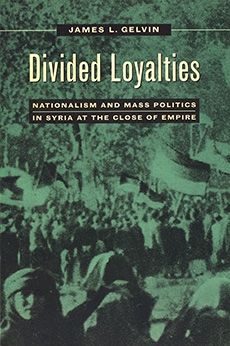
Divided Loyalties: Nationalism and Mass Politics in Syria
James L. Gelvin
University of California Press
By examining a defining moment in the history of nationalism in the Arab Middle East —the two-year interval between the end of Ottoman rule and the imposition of French mandatory control over Syria — James L. Gelvin provides a new framework for understanding the development of nationalism in the region and beyond. Whereas earlier scholars of nationalism in the Arab Middle East have focused on the ideas and activities of a narrow elite, Gelvin draws from a variety of hitherto untapped sources and applies innovative methodological strategies to recover the overlooked world of popular politics. The reintegration of this world into the study of nationalism in Syria will compel historians to reevaluate their assumptions about the origins, diffusion, and characteristics of nationalism in the region and will provide valuable insights for those interested in the comparative study of nationalisms.
"A novel study. Mass politics are central to our century, and Gelvin brings them to life in a readable narrative. This book adds a new dimension to an ongoing and important debate in the field."
Leila Fawaz, author of An Occasion for War: Ethnic Conflict in Lebanon and Damascus in 1860
"A fine piece of much-needed historical revisionism. Gelvin uses local Syrian sources to challenge many of the basic assumptions about the birth of nationalism in the Arab world."
Roger Owen, author of State, Power and Politics in the Making of the Modern Middle East
James L. Gelvin is Assistant Professor of History at the University of California, Los Angeles.
Contents
Acknowledgments / vii
Abbreviations / ix
Introduction / 1
Part One:
The Structure of Political Organization in Faysali Syria
1. From "Patriotic Agitation" to the Advent of Mass Politics / 51
2. The Popular Committees / 87
Part Two: Nationalist Communities of Discourse
3. The Symbolic Component of Rival Nationalist Discursive Fields / 141
4. The Integrative and Prescriptive Powers of Rival Nationalist Discursive Fields / 196
Part Three:
The Ceremonies of Nationalisms
5. Mobilization from Above and the Invention of Traditions / 225
6. Demonstrating Communities / 260
Conclusions / 287
Bibliography / 299
Index / 313
ACKNOWLEDGMENTS
This book could not have been written without the assistance and support of friends and colleagues. Since the book is based upon my doctoral dissertation, I would like to begin by thanking the two members of my committee, Zachary Lockman and Philip S. Khoury. The guidance both provided from the dissertation stage through the final revisions of the book manuscript was invaluable, and I am particularly grateful for their enthusiasm and for their continued support. In addition, I would like to thank David Commins, Leila Fawaz, R. Stephen Humphreys, Fred Lawson, David W. Lesch, Anne McCants, Michael Morony, Roger Owen, Chase Robinson, Eugene Rogan, Malcolm Russell, Nina Safran, Linda Schatkowski Schilcher, and Peter Sluglett, who took the time to read and comment on all or parts of the manuscript during its preparation. Ronald Mellor of the UCLA History Department and Lynne Withey of UC Press offered encouragement and backing throughout the process of preparing this manuscript that expedited its publication.
I undertook research for this book in Syria, Egypt, Jordan, Britain, France, and the United States, and I wish to thank those who facilitated my research in these places. In particular, I would like to extend my gratitude to those Syrians who consented to be interviewed (their names appear in the bibliography) and to Najate Kassab-Hassan, Fakhri Nuri al-Kaylani, Muhammad Kamal al-Qasimi, and ‘Umar Khadim al-Saruji, who helped me arrange those interviews. I am also deeply indebted to Sylva Oghlanian Bolz of Maktabat al-Asad in Damascus and to the proprietors and personnel of the Salafiyya Library/Bookstore in Cairo for their graciousness and efficiency, as well as to Abdul-Karim Rafeq and Khairia Kasmieh who guided me through the Syrian bureaucracy.
Grants for research and write-up were provided by the Fulbright-Hays Dissertation Research Committee, the Social Science Research Council, and the Charlotte W. Newcombe Foundation. I also wish to express belated thanks to Robert Faulkner and Dennis Hale of the Political Science Department at Boston College, William Graham of the Center for Middle Eastern Studies at Harvard University, and the faculty and staff of the History Departments at Massachusetts Institute of Technology and the University of California, Los Angeles, who provided me with an environment in which I could learn from my colleagues and test my ideas.
Most of all, I would like to thank Najwa al-Qattan, who has put up with me despite my grousing about the progress of this project and has suffered through countless unsolicited disquisitions on nationalism in Syria. To list her immeasurable contributions to the writing of this book would only trivialize them.
Some of the material contained in this book has appeared before. I would like to thank the editors and publishers of three publications for granting me permission to draw from the following works:
"Demonstrating Communities in Post-Ottoman Syria," Journal of Inter-disciplinary History 25(1) (summer 1994), 23 -44. Copyright © by Massa-chusetts Institute of Technology Press and the editors of The Journal of Interdisciplinary History.
"The Social Origins of Popular Nationalism in Syria: Evidence for a New Framework," International Journal of Middle East Studies 26 (November 1994), 645 —662. Copyright © by Cambridge University Press and the editors of International Journal of Middle East Studies.
"The Other Arab Nationalism: Syrian/Arab Populism in Its Historical and International Contexts," in Rethinking Nationalisms in the Arab World, edited by James Jankowski and Israel Gershoni. Copyright
© 1997 by Columbia University Press. Reprinted by permission of the publisher.
Introduction
Although this book focuses on events that occurred in Syria1 between October 1918 and July 1920—the period during which an Arab government ruled in Damascus—I have neither structured it as a narrative account nor intended it to be one. Such narratives have already been written, with greater or lesser success.2 The purpose of this book is much different: it is an examination of contending constructions of nation and nationalism in early twentieth-century Syria and of the origins and early evolution of mass politics and popular nationalism in the same region. The need for such an investigation becomes evident by juxtaposing two incidents, separated by only a few months, that took place on opposite sides of the Atlantic.
On 20 July 1920, six days after the initial French ultimatum to the Arab government of Amir Faysal and four days before French troops entered Damascus to begin their quarter-century occupation, insurrection erupted in the Syrian capital. Throughout the city, petit-bourgeois merchants, neighborhood toughs, unemployed youths, refugees from the Biqa Valley, and recently demobilized soldiers from the regular Arab army took to the streets, while former members of the prorogued Syrian General Congress, ulama, and political agitators denounced the government that had acceded to French demands from minbars and street corners. Popular leaders raised sanjaks3 and distributed leaflets that warned of conspiracies threatening the nation and described atrocities committed by French soldiers stationed to the west. Newspapers, printed as broadsheets, taunted the enemy with patriotic bluster: "Tell the Pope, the clericalists, the capitalists, and the politicians who aim at conquest," al-Kinana announced in a two-page, bold-faced spread, "that young Syria will never submit to old France."4 In the quarters of Shaghur and the Maydan, where less than two weeks before residents had disarmed and beaten military policemen who had attempted to enforce the Arab government's despised conscription policy, the same residents now attacked a contingent of troops loyal to the traitorous (khain) amir because they believed him to be collaborating with the enemies of the nation.5
When the Arab government tried to retake the streets, fighting broke out between regular army units (such as the bedouin and Yemeni troops that had fought alongside the amir during the Arab Revolt) and the population. One group of insurrectionists, shouting anti-Faysal slogans, attacked the royal palace (on the roof of which the amir, anticipating rebellion, had placed machine guns). Another group stormed the Damascus citadel where arms and ammunition were stored and where, the rebels assumed, the government had interned the popular leader Kamil al-Qassab, along with other political prisoners. According to British estimates, over …
1. I shall be using the term Syria to refer to several different geographic areas. Usually, it will refer to the territory under the administration of Occupied Enemy Territory Administration—East (OETA-E). At other times, particularly in discussions of contemporaneous notions of geographic divisions, Syria refers to "Syria within its natural boundaries"—the territory that comprises present-day Syria, Lebanon, Jordan, Israel, the "Palestinian Entity," the Israeli occupied territories, a small section of the Republic of Turkey south of the Taurus Mountains and the province of Alexandretta, and western Iraq. The reader should be able to determine which definition is appropriate from the context.
2. See, for example, Malcolm Russell, The First Modem Arab State: Syria under Faysal 1918-1920; Khairia Kasmieh (Khayriyya Qasimiyya), al-Hukuma al-‘arabiyya ft Dimashq bayna 1918-1920; ‘All Sultan, Tarikh Suriyya 1918-1920: Hukm Faysal b. Husayn; Zeine N. Zeine, The Struggle for Arab Independence: Western Diplomacy and the Rise and Fall of Faisal's Kingdom in Syria.
3. A sanjak consisted of a broad banner which was suspended from a wooden crossbeam. The crossbeam was carried by one man, while two others assisted by holding ropes attached to the bottom of the cloth to ensure that the news or slogan printed on the banner could be read. Sanjaks were usually displayed in areas of heavy traffic, near mosques, or in cemeteries. Hasan al-Amin, Dhikrayat, al-Juz’al- awwal: Min al-tufula ila al-siba,2y.
4. MD 4H114/695, "Renseignements," n.d.; MD 4H114/4/691, Cousse to Gouraud, 13 July 1920; MD 4H114/5/282-283, Cousse to Gouraud, 15 July 1920; al-Amin, Dhikrayat, 27; Ihsan Hindi, Ma'rakat Maysalun, 59-60.
5. MD 4H114/4/662, Cousse to Gouraud, 8 July 1920; FO 371/5037/E8509/74, Mackereth (Beirut) to FO, 16 July 1920; MD 4H114/5, Cousse to Gouraud, 20 July 1920; FO 371/5037/E8880/80, Mackereth to FO, 23 July 1920; MD 4H60/1, "Bulletin quotidien 1270," 23 July 1920. According to Ghalib al-'Iyashi, the crowd also called for the downfall of murraq (turncoats) and muta'amirun (conspirators). al- 'Iyashi, al-ldahat al-siyasiyyawaasrar al-intidab al-faranst‘ala Suriyya, 105-106.
James L. Gelvin
Divided Loyalties: Nationalism and Mass Politics in Syria at the Close of Empire
University of California Press
University of California Press
Divided Loyalties
Nationalism and Mass Politics in Syria at the Close of Empire
James L. Gelvin
University of California Press
Berkeley and Los Angeles, California
University of California Press, Ltd.
London, England
1998 by
The Regents of the University of California
Library of Congress Cataloging-in-Publication Data
Gelvin, James L., 1951-
Divided loyalties: nationalism and mass politics in Syria at the close of Empire
James L. Gelvin.
p. cm.
Includes bibliographical references and index.
ISBN 0-520-21069-7 (alk. paper). — ISBN 0-520-21070-0
(alk. paper)
1. Syria—History—20th century. 2. Nationalism—Syria.
3. Mandates—Syria. 4. Elites (Social sciences)—Syria. I. Title. DS98.G45 1999
956.9104—dc21 / 98-3204
CIP
Printed in the United States of America
9 87654321
The paper used in this publication meets.the minimum requirements of
American National Standards for Information Sciences—Permanence
of Paper for Printed Library Materials, ANSI Z39.48-1984.
Compositor: G & S Typesetters, Inc .
Text: 10/13 Aldus Display: Aldus
Printer: Haddon Craftsmen
Binder: Haddon Craftsmen
Cover design: Nola Burger
University of California Press
Berkeley 94720