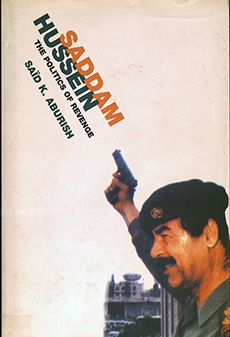
Saddam Hussein: The Politics of Revenge
Said K. Aburish
Bloomsbury
In Saddam Hussein: The Politics of Revenge, the author draws on his own knowledge of and extensive contacts within the Arab world to produce both a thorough biography and a penetrating psychological profile of the Iraqi leader.
Said Aburish worked with Saddam Hussein in the 1970s and is therefore able to add dimension and personal experience to the reader’s understanding of the terrifying, yet charismatic, dictator. The author explains why Saddam behaves as he does by suggesting that his life has been marked by a series of personal quests: for recognition after being brought up by a destitute uncle; for control of his country; for leadership of the Arab world; and for mastery over the technology of destruction.
This is the chilling story of how the man who, with the encouragement of Western governments, made his country the most advanced in the Arab world in the 1970s, and through personal ambition led it to disaster at the end of the 1980s, and who now fights for its survival. Aburish’s direct knowledge and exclusive inside sources make this an important, unique and necessary look at one of the most powerful and most unpredictable men in the world today.
Said K. Aburish was born in the biblical village of Bethany near Jerusalem in 1935. He attended university in the United States and subsequently became a correspondent for Radio Free Europe and the Daily Mail, and a consultant to two Arab governments. He is now a journalist and author living in London. His books include Children of Bethany, The Rise, Corruption and Coming Fall of the House of Saud; and Arafat: From Defender to Dictator.
Contents
1. Cruel Ancestry / 1
2. The Shadow of Al Zuhour Palace / 9
3. A Gun for Hire / 38
4. Playing Stalin to Bakr's Lenin / 67
5. Seeking Heaven / 96
6. Marching to Halabja / 129
7. From Planning to Plotting / 160
8. An Aimless War / 190
9. Illusions of Alliance / 223
10. The Friend-Foe Game / 252
11. An Abundance of Pride, A Shortage of Intellect / 284
12. Principality of Stones / 314
13. No Exit? / 346
Notes / 365
Bibliography and Sources / 383
Index / 391
1
CRUEL ANCESTRY
Much of what the press and biographers have written about Saddam’s life is true. But it represents a one-sided story since it is limited to reports of his actions; no attempt is made to explain the background to his emergence on the world stage and to locate him in Arab and twentieth-century history. Judged absolutely and in comparison, with those of his Arab contemporaries, his achievements are substantial, and some of them will outlive the current deafening noise surrounding his reputation. The possibility that he will occupy a place of honour in Arab history and condemnation elsewhere has to be understood in the context of the history of Iraq, its geopolitical position, its covetous neighbours and the major powers which believe Iraqi oil is so significant that they cannot leave the country alone.
Saddam’s role and reputation must be weighed along with the unfulfilled desires of the Iraqi people, and their justified historical belief that they have been denied the right to realize the potential of their land and earn it a place among modern nations. In other words, Saddam as an individual may be unique, even demonic, but he is also a true son of Iraq. Even his use of violence to achieve his aims is not a strictly personal characteristic, but rather an unattractive trait of the Iraqi people reinforced by their history.
Thousands of years ago Mesopotamia (‘the land between the rivers’), as it was known by the Greeks, was one of the great cradles of civilization. Its strategic importance on the overland route between Europe and Asia, combined with the agricultural potential of the rich fertile expanse between the Tigris and the Euphrates in an otherwise arid region, meant that it was constantly fought over. Ancient Mesopotamia is associated with dozens of kingdoms and empires: Sumerian, Akkadian, Babylonian, Hittite, Hurrian, Kassite, Elamite, Assyrian and, in more recent centuries, Arab, Persian and Ottoman. Whilst some of these entities expanded, then contracted and often disappeared of their own accord, most of them replaced each other violently, through conquest or rebellion or a combination of both.
In the fourth century BC, Alexander the Great captured Babylon and cut a swathe through the region on his eastward journey of conquest. In the eighth century AD, by then already known as Iraq, it was conquered by Arab Muslims who established the Abbasid caliphate and built the legendary Baghdad. But even this flourishing empire, with its libraries, scientific achievements and poetry, was anchored in violence: more than eighty of its ninety-two caliphs were murdered as a result of feuds over succession, corruption or palace intrigues. In the thirteenth century, in an orgy of slaughter and looting, the Mongol hordes ransacked Baghdad and destroyed the great libraries, the cultural inheritance of the Abbasids. During the seventeenth and eighteenth centuries both the Persians and the Ottoman Turks tried to establish dominance over Iraq and turned it into a battleground; eventually the Turks incorporated the territory into the Ottoman Empire. From the late nineteenth century, the British sought to control Iraq to safeguard their route to India. After the First World War and the defeat of the Turks, Britain occupied Iraq and briefly administered it as a mandate territory. What followed was a monarchy of Britain’s creation.
The violence and cruelty which accompanied every change in the governance of the country throughout its history occasionally took novel forms which left an indelible imprint on the local population. Two examples stand out. Upon entering the city of Najjaf in 694 AD, the Muslim conqueror Al Hajjaj Bin Yusuf Al Thaqafi described the Iraqis as people of ‘schism and hypocrisy’ and declared, ‘I see heads ripe for cutting and verily I am the man to do it’.1 When in 1258 Hulagu, the grandson of Genghis Khan, laid siege to Baghdad, he bombarded the fortified inner city to rubble and ordered the breaking of the dykes on the Tigris, thus drowning most of the population.2 It therefore comes as no surprise that, on hearing of the killing in 1958 of the British- backed royal family, the Hashemite descendants of Mohammed, the Orientalist Freya Stark wrote, ‘Even the massacre of the prophet’s family is no novelty on that soil.’3
Leaving human violence aside, the natural environment itself has been no kinder to Iraq. Floods, earthquakes, plague, famine and the wretchedness of a land where the temperature can fluctuate by 40 degrees Centigrade within a single day have contributed to the emergence of an indigenous personality at war with nature and the rule of man. Every conqueror left people and aspects of their culture behind, and the depopulation of the original inhabitants through natural disasters, civil strife and war allowed the new arrivals to create a greater impression than would normally have been the case. The influence of the Mongols who remained after their conquest, for instance, was considerable because two-thirds of the original population had been massacred. By the twentieth century the country contained a rich ethnic and religious mix of Arabs, Kurds, Turkomans, Persians, Chaldeans, Yezedis, Sabaens and Jews, along with smaller groups of Afghans, Azeris and Hindis. Even in the 1920s, 44 per cent of the members of the chamber of commerce were Jewish. In the words of the celebrated journalists, John Bulloch and Harvey Morris, Iraq remains the least Arab of the Arab countries.4
The turbulent history, harsh environment and multi-stranded culture of Iraq have produced a complex and unique conglomerate which lacks the ingredients for creating a homogeneous country and a commitment to the idea of a national community. Modern Iraq is a fractured society in which numerous clusters, tribes, ethnic and religious groups pay genuine tribute to the idea of a nation state, but one which accords paramountcy to their particular tribal, ethnic or religious background.
The schism between Sunni and Shia Muslims typifies the problem. This religious split began in AD 680 over the nature of the prophet’s succession, and grew under Persian and then Ottoman Turkish rule.
The Persians promoted their Shia co-religionists, while Sunni Turkey supported its own. Each group mistreated the others when in power and denied them their rights, and the cleavage eventually assumed a socio-economic nature - since Turkish supremacy lasted longer than Persian it gave the Sunnis an educational and wealth advantage over the Shias which still remains. Today, most Sunni Muslims are Arab nationalists who want union or closer relations with the rest of the Arabs, whilst …
Said K. Aburish
Saddam Hussein
The Politics of Revenge
Bloomsbury
Bloomsbury
Saddam Hussein
The Politics of Revenge
Said K. Aburish
First published 2000
Copyright © 2000 by Said K. Aburish
The moral right of the author has been asserted
Picture Credits
Gamma; page 1 bottom, 2 bottom
Popperfoto: page 5 top, 6 bottom, 8 bottom
Sygma: page 3 bottom, 4 top, 5 bottom, 6 top, 7 top & bottom
Topham Picturepoint: page 2 top, 3 top, 4 bottom
Every reasonable effort has been made to ascertain and acknowledge the
ownership of copyrighted photographs and illustrations included in this volume.
Any errors that have inadvertently occurred will be corrected in subsequent
editions provided notification is sent to the publisher.
Bloomsbury Publishing Pic, 38 Soho Square, London W1V 5DF
A CIP catalogue record for this book is available from the British Library
ISBN 0 7475 4653 3
10 987654321
Jacket photograph © Popperfoto - Reuters
Jacket design Nathan Burton
Typeset by Hewer Text Ltd, Edinburgh
Printed in Great Britain by Clays Ltd, St Ives Pic