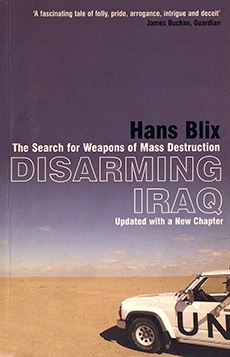
Disarming Iraq
Hans Blix
Bloomsbury
The war against Iraq has divided opinion throughout the world and generated a maelstrom of spin and counterspin. The man at the eye of the storm, and arguably the only key player to emerge with his integrity intact, is Hans Blix, head of the UN weapons-inspection team. This is Blix’s account of what really happened in the run-up to the declaration of war in March 2003.
Describing his meetings with Tony Blair, George Bush, Jacques Chirac, Dick Cheney, Condoleezza Rice, Colin Powell and Kofi Annan, he conveys the frustration, tensions, pressure and drama as the clock ticked down. Disarming Iraq is a powerful and necessary record of the most important event of our time, and a careful consideration of what the future holds in the world after Iraq.
Hans Blix was the director general of the Inter-national Atomic Energy Agency from 1981 to 1997 and was a member of Sweden's delegation to the United Nations from 1961 to 1981. From 2000 to 2003, he was the executive director of the United Nations Monitoring, Verification and Inspection Commission (UNMOVIC), supervising international inspections for weapons of mass destruction in Iraq until the inspections were suspended in March 2003. Blix has been named chairman of the newly formed International Commission on Weapons of Mass Destruction, which began its work in January 2004. He lives in Sweden.
Contents
Preface / ix
1: Disarming Iraq: Moments of Truth? / 3
2: Inspection: Why, How, When? / 15
3: Out of the Ice-Box and Into the Frying Pan / 41
4: Inspections, Yes, But How? / 69
5: The December Declaration / 99
6: To Baghdad and Back / 127
7: Approaching the Brink / 145
8: Search for a Middle Road: Benchmarks? / 175
9: Deadlock / 195
10: Bashing Blix and ElBaradei / 215
11: Diplomacy on the Brink: The Breakdown / 237
12: After War: Weapons of Mass Disappearance / 255
Epilogue / 275
Index / 303
PREFACE
Disarming Iraq was published in more than a dozen languages dur¬ing the first half of 2004. It covered my first-hand experience at the United Nations and—earlier—at the International Atomic Energy Agency of inspections and search for prohibited weapons in Iraq. The manuscript of the book was completed in January 2004 and I was able to take into account what happened and was learnt about the Iraqi question during the allied occupation up to that time.
I am glad to see the book being published in paperback. The first-hand experience that I described has not changed and I see no reason to make any alterations to the text other than minor editorial changes. However, there have been significant developments in occupied Iraq since January 2004. Much new information has become available through books and torrents of articles, and inquiries in various countries have covered the failure of national intelligence. The debate rages on about the justification of the war, the policy of preemptive strikes, the role of the UN and international inspection, the way to counter terrorist acts and the spread of weapons of mass destruction. I have not felt that this calls for a revision of my original book but I have added an epilogue with additional thoughts on the various motives for the war in light of what has been reported. I also discuss what lessons, if any, have been learned from the war regarding intelligence, preemption and ways of countering weapons of mass destruction.
I would like to make an observation relating to the reliability of sources which occurred to me when I read Bob Woodward s Plan of Attack (Simon & Schuster, 2004). While I knew how we in New York viewed the actions and statements of officials and policy makers in Washington, his book gives an account of how those persons viewed myself and others in New York. For obvious reasons, I was particularly interested in the account given of the meeting Dr. ElBaradei, Director General of the IAEA, and I had with President Bush on October 30, 2003 and at which Vice President Cheney, Secretary of State Colin Powell, National Security Adviser Condoleezza Rice and Deputy Secretary Wolfowitz were present. In the account reported by Woodward—based on interviews—the president stressed that the inspectors had the force of the United States behind them. This squares with my notes that the president assured the inspectors of U.S. support.
However, according to the account related by Woodward (see Plan of Attack p. 224) the president added “The decision to go to war will be my decision. Don’t ever feel like what you’re saying is making the decision.” As I was of the view that a decision to use armed force was not for the inspectors but for the Security Council, I would not have made any comment on the statement of the kind he was reported to have made. However, in my recollection—which is from a note I made myself after the meeting and which is reported on p. 86—President Bush said no such thing. Rather, he said that contrary to what was being alleged he was no wild, gung-ho Texan bent on dragging the U.S. into war. He would let the Security Council talk about a resolution—but not for long.
Why did Woodward’s interviewee give an account so much at variance with my notes? Of course, my memory could have been wrong. However, I have another hypothesis with a broader bearing. I have described in this book that after some talks I had with Condoleezza Rice there had been newspaper reports which made her sound as if she had been admonishing me or pushing me hard (p. 195). Both she and I were displeased about these accounts, which had no basis. My theory is that before various meetings, which Bush and Rice are scheduled to have, briefs are prepared, perhaps by some officials in the National Security Council. These officials may have wanted Bush and Rice to express more hawkish views than they chose to make. Is it far-fetched to think that in the information-management of the White House lines laid down in the briefs were sometimes communicated as reality rather than the lines that were actually pronounced? If so, we have a nice example of how virtual reality” is created.
As in the original edition I want to thank my literary agent, Jane Gelffnan, my Nordic editor, Albert Bonnier, and my friend Per Gedin for their encouragement, advice and friendship. I thank Holly Roberts, Dan Frank and Anders Mellbourn for their wise and gentle editorial work. I thank colleagues at UNMOVIC, in particular my successor, Dimitri Perricos, for help and friendship. I thank all the translators, all my good friends who have checked the translations and all the nice publishers who have taken care of me when the book has been presented in their various countries. Lastly, I thank my wise and patient wife, Eva Kettis and our son, Marten, for innumerable sensible suggestions.
Stockholm, Sweden, December 2004
1
Disarming Iraq:
Moments of Truth?
Invasion Instead of Inspection
On the afternoon of Sunday, March 16, 2003,1 was in my office on the thirty-first floor of the United Nations Secretariat building in New York, the headquarters of the UN Monitoring, Verification and Inspection Commission for Iraq (UNMOVIC). Some of my close collaborators had joined me to put the final touches on a work program I was to submit to the Security Council.
When our commission was established by a Security Council resolution in December 1999, the Council had recognized that there might still be weapons of mass destruction (WMD) in Iraq, despite the fact that a great deal of disarmament had been accomplished through UN inspections after the end of the Gulf War in 1991. In November 2002, a new round of inspections had been initiated to resolve key remaining tasks in the disarming of Iraq.
Although the inspection organization was now operating at full strength and Iraq seemed determined to give it prompt access everywhere, the United States appeared as determined to replace our inspection force with an invasion army. After the terror attacks on New York and Washington on September n, 2001, a policy of i' containment—keeping Saddam Hussein in his box—and ensuring 1 the disarmament of Iraq through UN inspections was deemed no
longer acceptable.
The people around me were all solid professionals coming from different parts of the world. There was Dimitri Perricos, probably the world’s most experienced inspector. A Greek and by profession a chemist, he had more than twenty years of experience with international nuclear inspections—in Iraq, North Korea, South Africa and many other places. He was the head of operations. Muttusamy San-muganathan, known to all as Sam, was from Sri Lanka. Both Dimitri and Sam had worked closely with me for many years in Vienna, when I was the director general of the International Atomic Energy
Agency (IAEA). Ewen Buchanan, a Scot, was our manager of media relations and institutional memory.
For years he had been a political expert and the spokesman of the previous inspection authority, the
UN Special Commission (UNSCOM). There was Torkel Stiernlof, who had been stationed in Baghdad and knew Arabic. He was about to return to his job at the foreign ministry in Stockholm after six intense months as my executive assistant. Lastly, there was Torkel’s successor, Olof Skoog, an ambassador at the early age of 35 and on loan to me.
The military invasion of Iraq was all but announced and here we were at the UN sketching a peaceful way to try to ensure the country’s disarmament! The military force, whose buildup had begun in the summer of 2002 and had been an essential reason why Iraq had accepted the inspectors back, had reached invasion strength and was now waiting to be deployed.
In the Security Council, all efforts to reach agreement on what might be demanded of Iraq in the next few weeks had collapsed. Proposals had been made by the British that Saddam Hussein should go before Iraqi television and declare his determination to disarm and to cooperate fully with the inspectors. The declaration would be accompanied by Iraq’s fulfillment of a number of specific disarmament tasks within a very short time—perhaps ten days. (The approach had some similarity to the British efforts which ten …
Hans Blix
Disarming Iraq
Bloomsbury
Bloomsbury
Disarming Iraq
Hans Blix
First published in Great Britain in 2004
This paperback edition published 2005
Copyright © 2004,2005 by Hans Blix
The right of Hans Blix to be identified as the author of this work
has been asserted by him in accordance with the
Copyright, Designs & Patents Act, 1988
Bloomsbury Publishing Pic, 38 Soho Square, London W1D 3HB
A CIP catalogue record for this book
is available from the British Library
ISBN 0 7475 7359 X
10 987654321
Printed in Great Britain by Clays Ltd, St Ives pic
All papers used by Bloomsbury Publishing are natural
recyclable products made from wood grown in well-managed
forests. The manufacturing processes conform to the
environmental regulations of the country of origin.
www.bloomsbury.com/hansblix
To the staff at the United Nations
Monitoring, Verification and Inspection Commission
(UNMOVIC)