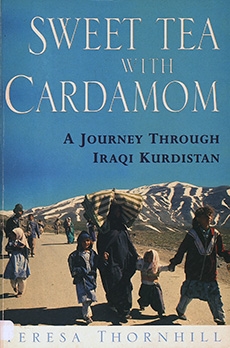
Sweet Tea with Cardamom
Teresa Thornhill
Pandora
This book records my two journeys through Iraqi Kurdistan in 1993, during the hopeful days of the Kurdish experiment in democratic self-government which followed the withdrawal of Iraqi government personnel from the region in late 1991. From late 1993 until summer 1996 the experiment foundered, as strife between the two main Kurdish parties developed into near civil war; nevertheless, the Western-protected Safe Haven survived and the Iraqi government was kept at bay. Tragically for the Kurds, those days are now at an end.
On 31 August 1996, Iraqi tanks and Republican Guards rolled into the Kurdish city of Arbil in support of the Kurdistan Democratic Party’s attempt to seize control of the city from the Patriotic Union of Kurdistan. The city fell to the KDP within hours and, although Iraqi troops soon withdrew to positions outside Arbil, they left behind large numbers of mukhaberaat, Iraqi secret police.
On 9 September KDP forces took control of the city of Sulaymaniyah.
Whether the Iraqi government will now resume domination of the Kurdish ‘enclave’ remains to be seen, but its penetration by government security personnel appears to be a fait accompli. For this reason, the names of the majority of Kurds referred to in the book have been changed. The names of well-known public figures remain unchanged.
Contents
Author’s Note / ix
Acknowledgements / xi
Prologue / xii
Chronology / xviii
Part I
Southeastern Turkey, May 1993 / 3
Tea with the British Army / 7
Saddam’s Palaces / 18
A Campaign of Genocide / 25
Galawesh, A Woman MP / 29
A Grandmother’s Story and a Woman Peshmerga / 45
Part II
Zakho, September 1993 / 61
Guests of the PUK / 68
A Night on the Roof / 75
‘My Heart Is Not Allowing Me to Marry’ / 82
The Road to Sulaymaniyah / 93
The Man with No Hands / 104
In the Bazaar / 113
Sahad the Singer / 120
‘If I Give My Heart to You,
Will You Handle It with Care?’ 126
Jwan, A Nurse / 131
Two Villages: Biyaara and Tawella / 141
Democracy in Kurdistan / 149
‘Thirty Years of War’ / 150
‘No Electricity, No Gas, No Paraffin / 163
A Desert City and an Iraqi Tank / 166
The Pomegranate Orchard / 179
The Chemicals at Sheikh Wisan / 189
Leaving Kurdistan / 202
Epilogue / 211
ACKNOWLEDGEMENTS
I would like to thank the following people for their invaluable assistance, support and encouragement in the writing of this book:
Mubejel Arif Baban, Mawlan Brahim, Geraldine Brooks, Rebwar Fatah, Kemal Farraj, Mohammed Ali, Claudia Lank, Margaret Macadam, Kanan Makiya, Bayan Shali, Afsaneh Najmabadi, Ayad Rahim, Karen Raney, Nazaneen Rashid, Anne Rodford, the late Marion Farouk-Sluglett, Sheila Thornhill, Alan Thornhill, Medea Mahdavi-Walker.
Prologue
My interest in Iraq began with a personal connection: my former partner, Ayad, was an Iraqi Arab. We had been living in Palestine-Israel when the Gulf crisis began in August 1990. My own background is partly Jewish and, combining my interest in the Arab-Israeli conflict with my legal training, I was doing research with Palestinian women who had been in prison. Ayad was working as a journalist on a Palestinian newspaper. We left Jerusalem shortly before the war, and together watched the bombing of Baghdad and the suppression of the Iraqi uprising, first with his family in the US, then back in London.
When it was all over we decided to stay in London, where I went back to my work as a family law barrister and Ayad became deeply involved in the renascent Iraqi opposition. This was an extraordinary period for Iraqis living in exile, both Arabs and Kurds. The barrier of fear which had kept so many of them silent for the last 20 years had at last been broken, and people were beginning to emerge from reclusion and talk to each other. Terrible stories were being told by newly-arrived refugees, stories of imprisonment, torture and repression. Some of these were published in the national press and Ayad came home daily with other stories which had not made the papers but were equally horrifying.
In 1992 we separated and I moved to the West country, but I remained nevertheless deeply concerned with and involved in the fate of Iraq and Iraqis, and I simply could not forget what was happening in their world.
I was trying to settle into my new life, but part of me longed to return to the Middle East. I had left very reluctantly when the war broke out and now I began to look out for opportunities to go back, whether to Palestine or Iraq or anywhere else.
Early in 1993 I heard about a two-week tour that was being organised to the Kurdish enclave in northern Iraq. At first I felt uncertain, not liking the idea of being a tourist in war-damaged Kurdistan, but when a friend suggested I should do some interviews with Kurdish women and write them up, I felt able to go. Memories of the rich days I had spent sitting in the homes of Palestinian women listening to their stories were still strong in my mind, and in the two years since the war I had often found myself wondering what it would be like to sit and talk with Iraqi women. I felt sure that they would have some extraordinary stories to tell about their fives under Saddam Hussein. Whether they would want to tell them to me, a Westerner, remained to be seen, but Iraqis I spoke to in Britain thought that my foreign-ness might be an asset. ‘Some things it is easier to tell to a complete outsider,’ one man said. ‘And you are a woman: that is good.’
The Kurdish people, who are thought to be descended from the Medes of central Asia, have for several thousand years inhabited the region of the Zagros mountains which lies to the north of Mesopotamia and to the east of the Euphrates river. Originally Zoroastrians, the Kurds converted to Islam and are mainly Sunni. Kurdish society is tribally based and the culture has some characteristics in common with that of other Middle Eastern peoples, although ethnically the Kurds have no relationship with the Arabs or Turks. Kin-dish women traditionally do not veil and they dress in bright colours, but they are subjected to many of the same social constraints as their Arab and Persian counterparts.
The Kurdish language is Indo-European in origin; different dialects are spoken in different parts of Kurdistan. Modem ‘Kurdistan’, meaning the geographical region predominantly inhabited by Kurds, is divided by the national boundaries of Turkey, Iraq, Iran, Syria and the former USSR. In southern Kurdistan, which includes north western Iran and northeastern Iraq, Sorani is spoken; in central and northern Kurdistan, which includes the northernmost part of Iraqi Kurdistan and most of southeastern Turkey, Kurmanji is the predominant dialect. Speakers of one dialect have considerable diffi-culty understanding speakers of the other; and the problem is made worse by the fact that, in Turkey, Kurdish is written in the Latin alphabet, whereas in Iran and Iraq it is written in the Arabic alphabet.
When the region was divided into nation states at the end of the First World War, the idea of a Kurdish state was mooted by the Western powers but subsequently rejected. The Kurdish nationalist movements which had begun to develop in the nineteenth century were weak and divided along tribal lines. Since the 1920s the Kurds, who as a people now number between 20 and 25 million, have lived as ethnic minorities in the five states that divide them. They constitute the fourth largest ethnic group in the Middle East after the Arabs, Turks and Persians, and are said to be the largest people in the world who lack a state of their own.
In southeastern Turkey, since 1984, Kurdish guerillas led by the Kurdish Workers’ Party (PKK) have been fighting a war with the Turkish army with the aim of creating a Kurdish state. The death toll exceeded 20,000 by 1996.
Since the creation of the state of Iraq in the 1920s, the Iraqi Kurds, who constitute nearly a quarter of the Iraqi population and number about 4 million, have continually struggled for autonomy. From the days of the British mandate to the present, relations between the Kurds in the northeast of the country and central government in Baghdad have oscillated between low level fighting, uprising and outright war. The Kurds have been treated with great brutality by successive Iraqi regimes, most notably by the present Ba’athist one of Saddam Hussein, which, among other things, has subjected them to torture, chemical attacks and a campaign of genocide.
The Iraqi Kurds have not always been well served by their leaders, however, and conflict between the main political groupings has sometimes led one grouping to form an alliance with Baghdad against the other. Both the Kurdistan Democratic Party (KDP) and the Patriotic Union of Kurdistan (PUK) have done this at different times.
With the Iraqi invasion of Kuwait in August 1990 and the inter-national military response, the Kurds saw an opportunity to rid themselves of Saddam Hussein. The Kurdistan Front had been formed in June 1988, uniting the main Kurdish parties. In March 1991, within days of the Gulf War ceasefire, spontaneous anti-govemment uprisings occurred in both the south of Iraq and in Kurdistan. The uprisings were put down savagely within two to three weeks by the Republican Guard, whereupon half of the population of Kurdistan fled to the mountainous Iranian and Turkish borders.
When John Major’s ‘Safe Haven’ was set up in April 1991 and many refugees began to come down from the mountains and return to the Kurdish cities, the security personnel of Saddam Hussein’s Ba’athist regime were still present. By the late summer, however, following failed negotiations between die Kurds and the regime, the latter withdrew from about 50 per cent of Kurdistan, leaving the Kurdistan Front more or less in control of the area. The Kurdish cities of Mosul and Kirkuk remained under government control; Sulaymaniyah, Arbil and D’hok were in the ‘liberated’ area. The Kurdistan Front did not, however, have a mandate to govern the area, and after some months a decision was made to hold elections. These took place amid great excitement in May 1992 and a Kurdish administration was formed.
The Iraqi Kurds claimed that they did not wish to establish an independent state: rather they wished to be part of a post-Saddam Iraq under a federal arrangement. The enclave soon became host to the Iraqi National Congress (INC), a coalition of the Iraqi opposition.
The odds stacked against success for the Kurdish administration were tremendous: UN sanctions were still in force against Iraq, hampering the economy of the liberated area as much as that of the south. In addition, Saddam had instituted his own blockade against the Kurds, preventing fuel, food and international aid from reaching them. And Iraqi troops were massed along the lines to which they had withdrawn in late 1991, waiting for an opportune moment to march back in. This was, nevertheless, a rare moment in Kurdish history. The Kurds were governing themselves and Iraqi Kurdistan was now one of the few places in the Middle East where an attempt was being made at democracy.
Part One
Chapter one
Southeastern Turkey
May 1993
The road surface was good and we sped along. I was sitting behind the driver, a thin man with ginger hair who sat up straight and kept his eyes on the road. I thought he was probably a Kurd, but I wasn’t sure. We had been warned not to use the word ‘Kurd’ in the airports at Istanbul and Dyarbakir.
We were crossing a vast plain of green cornfields speckled with poppies stretching as fir as die eye could see. The fields were lush and beautiful under a low-hanging cloudy sky which gave a hazy, white light. From time to time it spattered with rain and the driver pulled his window shut.
Southeastern Turkey was said to be as dangerous now for travellers as Iraqi Kurdistan, with a massive presence of heavily armed, very jumpy Turkish troops confronting the PKK. If we got stopped, we were to stress that we were ‘tourists’ on our way to Iraq, not fact-finders - and certainly not journalists. If they wanted to know more, we would say we were going to look at archaeological sites.
Relishing the silence and the sense of motion, I let my eyes drift to the horizon. I had been excited about the trip for weeks, convinced that it was a good idea to come, but right now the main thing on my mind was danger. Two foreign aid workers had been killed in Kurdistan since January, by Iraqi government agents. The second, a young Belgian, had been shot only a month earlier, ambushed on a lonely road north of Sulaymaniyah. I had heard that individual Kurds were being offered large sums of money by Saddam Hussein to kill Europeans.
…..
Teresa Thornhill
Sweet Tea with Cardamom
A Journey Through Iraqi Kurdistan
Harper Collins
Harper Collins Publishers
Sweet Tea with Cardamom
A Journey Through Iraqi Kurdistan
Teresa Thornhill
By the same author:
Making Women Talk: The Interrogation of Palestinian Women
Security Detainees by the Israeli General Security Services
An Imprint of Harper Collins Publishers
Pandora
An Imprint of Harper Collins Publishers
77-85 Fulham Palace Road
Hammersmith, London W6 8JB
1160 Battery Street
San Francisco, California 94111—1213
Published by Pandora 1997
10987654321
© Teresa Thornhill 1997
Teresa Thornhill asserts the moral right to
be identified as the author of this work
A catalogue record for this book
is available from the British Library
ISBN 0 04 440984 2 (Paperback)
Printed and bound in Great Britain by
Caledonian International Book Manufacturing Ltd, Glasgow
All rights reserved. No part of this publication may be reproduced,
stored in a retrieval system, or transmitted, in any form or by any means,
electronic, mechanical, photocopying, recording or otherwise,
without the prior permission of the publishers.