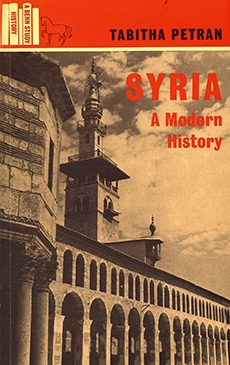
 Syria: a Modern History
Tabitha Petran
Ernest Benn
Of all Arab states, Syria has been among the most profoundly influenced by the existence of Israel. For the roots of the Arab- Zionist conflict lie in part in the breaking-up of natural Syria, the Syria of history which included Palestine, after the First World War. The impact of dismemberment and the creation of Israel in what was southern Syria have deeply marked the internal and external politics of the Syrian Arab Republic.
Syria’s modern history is one of struggle to achieve independence, national identity, and socio-economic advance. The hopes raised by the Arab Revolt were wrecked by Anglo-French interference and the interwar French Mandate, a harsh and insensitive overlordship. Independence in 1946 brought almost immediate involvement in the Palestine War, revulsion against the West, a political bankruptcy among veteran nationalist leaders, and the army’s entrance into political life. Since then nationalist and radical political ideologies have grown in a complicated and troubled environment; the Ba’th and neo-Ba’th parties, allied with the army, have dominated since 1963.
Tabitha Petran was born in Mexico of United States parentage, and after taking her degree at Smith College, Northampton (Mass.), has spent most of her working life in journalism. Since 1957 she has been mainly resident in the Arab world. She now lives in Beirut, but has spent long periods in Syria, Egypt, and Iraq.
Contents
Preface / 9
List of Illustrations / 13
Maps / 14
Acknowledgements / 5
List of Abbreviations / 16
i Unrealized Nation / 17
2 Agent of Civilization / 31
3 Leaven of Change / 45
4 A Truncated State / 61
5 Precarious Independence / 80
6 Road to Union / 106
7 Pursuit of a Myth / 128
8 The Bitter Harvest / 149
9 The Ba’th in Power / 167
io The June 1967 War: Prelude and Aftermath / 187
11 State-Building / 205
12 The Human Potential / 218
13 Crossroads / 239
Bibliography / 259
Index / 271
List of Illustrations
(All are inserted between pages 144 and 145)
1 The Barada in Damascus (1843)
2 Isle of Arwad (1843)
3 Faisal leaving the Hotel Victoria in Damascus, 3 October 1918
4 Faisal’s troops in Damascus, October 1918
5 Aleppo citizens gathering to greet Faisal, October 1918
6 General Georges Catroux with Shaikh Taj Al-Din Al-Hasani
7 Distribution of cereals to Kurds, April 1943
8 Shukri Quwatly
9 Khalid Al-Azm
10 Akram Hourani
11 Dr Yusef Z’ayyen
12 Nur Al-Din Atasi
13 People’s Army on parade in Damascus
14 Presidents Hafez Assad and Jafaar Numeiri with Colonel Mo’ammar Qadafi and President Anwar Sadat
15 Israeli transport lorries advancing through south-west Syria during the June 1967 War
16 Syrian soldier killed in the Golan, June 1967
17 Syrians driven from the Qunaytra region by the Israelis
18 One of four UNRWA emergency camps established after the June 1967 War
19 The Eighth of March State Farm, near Damascus
20 Demonstration in Damascus in autumn 1969 in support of Palestine commandos under attack in the Lebanon
21 Aleppo merchants
22 Syrian women learning to read and write
23 A courtyard near the great covered suq of Aleppo
24 The citadel of Aleppo
25 The famous Hamidiyya suq in Damascus
26 A new quarter of present-day Damascus
27 The port city of Latakia
28 Old waterwheels in Hama
29 Palmyra: The Arch of Triumph
30 The Euphrates at Deir Ezzor
Maps
1 Syria Rainfall
2 Natural Syria
3 Syria-general map
PREFACE
In Preparing This Book I have received help from many Syrians and other Arabs-so many that it is impossible to name them. To all I am deeply grateful and tender my thanks. None are responsible for my interpretation of events. I wish also to express my appreciation to the staff of Chatham House library and of Jafet Library of the American University of Beirut, especially to Miss Evelyn Zacharia Samir Hawi, and Mrs Melia Khayr for their patient and unfailing assistance.
Uckfield, / T.P.
April 1372
Certain sounds in the Arabic language are not readily differentiated by the untrained ear. Exact transliteration requires diacritical marks and letters without equivalent in European alphabets. All are omitted with the exception of the medial ayn here denoted by .’ Familiar Arabic names—e.g., Nasser, Nuri Said, etc.—appear in the accepted English form.
Acknowledgements
Acknowledgement for kind permission to reproduce illustrations is made to the following, to whom the copyright of the illustrations belongs:
W. H. Bartlett: i, 2
Camera Press, London: 8, 14, 15, 16, 20, 21, 23
The Daily Star, Beirut: 9, 10, 11, 12
The Imperial War Museum, London: 3, 4, 5, 6, 7
Syrian Arab News Agency: 13, 17, 19, 22
UNRWA (photograph by Vartan Sarkissian): 18
Chapter I
Unrealized Nation
The Name Syria, first used by the Greeks, designated in history the geographic region lying at the eastern end of the Mediterranean between Egypt and Anatolia and, at times, also political or administrative divisions within it. The Arabs who conquered this region in the seventh century called it Bilad Al-Sham, ‘the country on the left’ or north of Mecca, Islam’s holiest city. So it remained until this century when the Western Powers carved out of the region the states of Syria, Lebanon, Jordan, and Israel and gave parts of it to Turkey. In its contemporary form Syria did not exist before 1920. Neither its history nor its geography can be isolated from that of the region as a whole. In this and the next two chapters the term Syria applies to this region. Modern Syria will be referred to in these chapters as the Syrian Arab Republic.
The Syrian region is a geographic entity with marked natural boundaries—the Taurus mountains to the north; the Sinai peninsula and Arabia to the south; the Mediterranean to the west; and the desert to the east. No single, indigenous power has ever been able to assert political control over the whole region. Its original political organization was that of independent and often rival city kingdoms. From earliest times these cities—they are among the oldest continuously inhabited cities in the world-each acquired a particularist socio-political character which has persisted to the present day. For Syria’s position at the pivot of the three historic continents and its character as a marchland between neighbouring empires made it a bridge and a battleground of external powers. Through much of its history it experienced political unity as a part of larger empires but relapsed into a greater or lesser degree of fragmentation when stronger powers contested for its control and when in rare moments it was left alone. The diversity of its internal configuration and the nature of its water resources (this is an area where water is more precious than land) contributed to its political fragmentation.
Internal Diversity
Syria, which lies mainly on the northern slope of the vast and geologically ancient Arabian platform extending north-east across the Euphrates, is divided into two strikingly contrasted zones. To the west a double chain of mountains separated by a deep rift valley stretches from Turkey to Sinai. This double mountain barrier, a region of great variety and complexity about 60 miles wide, forms a facade for the vast steppeland-desert plateau of internal Syria.
…..
Tabitha Petran
Syria a Modern History
Ernest Benn
Ernest Benn Limited
Syria: a Modern History
By Tabitha Petran
Nations of the Modern World
Syria
Syria
A Modern History
By Tabitha Petran
Ernest Benn Limited
London & Tonbridge
First published 1972 by Ernest Benn Limited
2y New Street Square, Fleet Street, London, EC4A gJA
& Sovereign Way, Tonbridge, Kent, TNg iRW
First Paperback edition 1978
Distributed in Canada by
The General Publishing Company Limited, Toronto
© Tabitha Petran 1972
Printed in Great Britain
British Library Cataloguing in Publication Data
Petran, Tabitha Syria.
1. Syria—History—1516-1918 / 2. Syria—History
—20th century
I. Title
956.91’03 / DS97.5
ISBN O-5IO-389O6-6
|