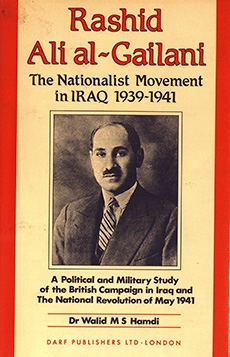
Rashid Ali al-Gailani: The Nationalist Movement in Iraq 1939-1941
Walid M S Hamdi
Darf Publishers
In this book, the author examines the political and military aspects of the Anglo-Iraqi conflict of 1941, set against the wider background of the Second World War. The work contains an in-depth study of the British military campaign in Iraq, and the mood of the people in the aftermath of the suppression of the revolt.
Drawing primarily on British and German archival material, along with published accounts and personal interviews from Iraqi sources, the author interprets British reaction to the radical nationalist movement between 1939 and 1 941. Within this study he examines the key question: "whether Germany and Italy planned to drive the British out of that country and so out of the whole Fertile Crescent, this in collaboration with Rashid 'Ali and the coup leaders of 1941."
Table of Contents
Chapter I
Introduction
The Historical Setting / 1
Iraq Under Turkish Rule, 1534-1914 / 3
Iraq Under British Occupation and Mandate 1914-1932 / 7
The Formation of the Iraqi Army and its Evolution in 1921-1932 / 10
The Tribal Legacy / 18-23
The Social and Political Structure of Iraqi Society during the Monarchical Era - General Survey / 24-25
The Political Parties / 25
The expansion of the Iraqi Army and its Role in Iraqi Politics 1932-1939 / 28
The Military Coup of 1936, the Consequent Military interventions and the Death of King Ghazi in April 1939 / 34
Nuri al-Sa’id’s Government and the War / 43
Rashid ’Ali’s Government / 45
Taha al-Hashimi’s Government / 48
Rashid ’Ali’s Return to Power / 50
Chapter II
British Policy and German Intentions in Iraq and the Middle East
British Interests in Iraq / 53
Were the British right in their assessment of what Rashid ’Ali intended to do? / 58
German intentions and Policies toward Iraq / 62
German Plans and Preparations in the Middle East / 64
German Propaganda in Iraq / 65
Axis Aims in Iraq and in the Arab Countries / 71
Chapter III
Perceptions of Strategy
British and American Historical Antecedents of contemporary British strategy in the near and Middle East / 77
British Stategy in World War Two / 80
The Emphasis on the Near and Middle East / 83
The Situation in Iraq, Syria, Persia and Turkey / 86
The Influence of Churchill / 93
American Perceptions of the Situation: the Role of Roosevelt / 95
German and Italian
Decision-Making in Nazi Germany / 96
The Preoccupation with the U.S.S.R. / 99
German High Command’s View / 101
The Debate about the Fertile Crescent / 103
Chapter IV
The Military Campaign in Iraq
The Strategic Value of Habbaniya / 107
The Deployment of Iraqi Forces and their Local and General Strength / 109
British Local and General Strength in Iraq / 111
The situation on 1 st May 1941 / 113
The Outbreaks of Hostilities / 115
India and Middle East Commands’ Attitude Towards British Policy in Iraq / 126
The Situation at Rutbah and Ramadi / 130
Axis Aid and German Aircraft Operating in Iraq / 135
Turkish Offer of Mediation / 139
The Battle of Falluja / 144
The Attack upon Falluja / 147
The Iraqi Counter-Attack on Falluja / 149
The Advance on Baghdad and the Armistice Agreement / 152
Chapter V
The Temporary Breakdown of Order / 165
The Purge of the Army / 167
The Ways in which a Machinery of British Control was Established / 169
The Kurds / 172
The Mood of the Iraqi People After the Suppression of the Revolt / 175
Chapter VI
Conclusions / 179-196
Appendices and Bibliography
Appendix ‘A’ The Anglo-Iraqi Treaty of 1930 / 197-210
Appendix ‘B ’ The Leading Personalities in Iraq in 1939-41 / 211-230
Appendix'C’ Iraqi Cabinets 1939-1941 / 231-232
Appendix ‘D’ British Cabinets 1939-1941 / 233-234
Appendix ‘E’ Secret Treaty Signed between Rashid Ali and the Axis Powers on 25 April 1941 / 235-237
Appendix ‘F’ Location Map. Iraqi Army November 1939 / 238
Appendix ‘G’ Aircraft of Royal Iraqi Air Force / 239-240
Appendix ‘H’ The Major Royal Air Force and Axis Aircraft which operated in Iraq in May 1941 / 241-247
Appendix ‘I’ Aircraft Strength of the RAF Units / 248
Appendix ‘J’ The RAF Aircraft Losses / 249
Appendix ‘K’ Scheme ‘Gold’ to attack Basra / 250-256
Appendix ‘L’ Order of Battle of Iraq Forces / 257-259
Appendix ‘M’ Iraqi Disposition at Habbaniya in May 1941 / 260
Appendix ‘N’ Map of the Attack on Falluja / 261
Appendix 'O’ Map of Advance of Northern and Southern Columns on Baghdad including the Arab Legion / 262
Appendix ‘P’ Map of Ramadi-Baghdad / 263
Appendix ‘Q’ Map of City of Baghdad / 264
Appendix ‘R’ Leaflet dropped on Baghdad by the British Embassy / 265
Bibliography / 266-277
PREFACE
The material for this thesis comes largely from a variety of primary sources. Thus it was drawn especially heavily on British and German archival material. The most relevant British archives are the Foreign Office, the Air Ministry, the War Office and the Cabinet Files together with Colonial Office records. Other primary sources used included collections of private papers of the Middle Fast Centre of Oxford University, the Birmingham University Library and the Public Record Office. The German archives used were very largely those of the Foreign Ministry.
As regards Iraqi sources, no use has been made of the Iraqi National Archive Centre, as all of its materials have been removed from Baghdad for security reasons, in view of the hostilities with Iran. Therefore, reliance has mainly been placed upon such published sources as memoirs and diaries and also upon personal interviews. But the weakness of these sources — and especially of the memoirs — is a strong vein of self-justification and national bias. Accordingly, one had to be careful when dealing with them.
In effect, this study is an interpretation of Britain’s interaction with the radical nationalist movement in Iraq between 1939 and 1941. A key question has to be whether Germany and Italy planned to drive the British out of that country and so out of the whole Fertile Crescent, this in collaboration with Rashid ’Ali and the coup leaders of April 1941. Correspondingly one has to explore whether the British were right in their assessment of what Rashid ’Ali intended to do.
Synopsis
This book addresses the political and military aspects of the Anglo-Iraqi conflict of 1941, this in the wider context of the Grand Strategy of World War Two. It examines in depth the British military campaign in Iraq, and also the mood of the people in the aftermath of the suppression of the revolt.
In its introductory chapter, the book examines the historical background from since Iraq came under Turkish rule to its foundation as a nation state under a British mandate in 1920; and then through the termination of the mandate in 1932. The creation and evolution of the Iraqi army, under the insistent guidance of the British Advisory Military Mission, is a particular aspect of this study. Just before and during the post-mandate period, the Iraqi army witnessed the emergence within itself of politicised groupings, especially the ‘Four Colonels’ (the Golden Square) who later became a determining factor in every change of government in the country. The social and political structure of Iraqi society is another subject which will be dealt with in this chapter. Furthermore, the first military coup d’etat in Iraq in 1936 and the mysterious death of King Ghazi also merit particular attention. The chapter explores, too, the rise of Rashid ’Ali and his dialectic with the British Embassy, then his resignation and return to power by military coup in April 1941.
Chapter two considers British policy and Axis aims in Iraq and the Middle East as a whole. It asks whether, in the spring of 1941, the Germans and Italians were actively seeking to displace the British in Iraq.
Chapter three examines the strategic importance of the Near and Middle East; reviews British and US Grand Strategy in the region; and assesses German and Italian aims and options in the Fertile Crescent.
Chapter four deals with the British military campaign in Iraq in the spring of 1941, including the battles of Habbaniya and Falluja and up to the armistice of 31st May and the return of the Regent Abd al-’Ilah to Baghdad.
Chapter five explores the restoration of British and monarchical control over Iraq. The chapter also examines the machinery whereby the British established their control, the attitude of the Kurds, the purge of the army, the breakdown of order in Baghdad, the ‘Farhud’ and the mood of the Iraqi people in the aftermath of the war.
Finally in Chapter six some conclusions are drawn.
Acknowledgements
I am deeply thankful for having had the opportunity to be supervised by Professor Neville Brown whose invaluable guidance, criticism and, most important of all, his encouragement and incisive comments have helped me to reinforce my own investigation and accomplish this study. His seminars have been a stimulating experience. I also gratefully acknowledge the generous help of Mr. R. R. Mellor (now retired) of the Reading Room Office at the Public Record Office, London; Mr. George Clout of the Department of Printed Books, Imperial War Museum; and Mr. W. D. Symington, Foreign and Commonwealth Office, Library and Records Department, London. I am likewise deeply grateful to the Staff of Library of the School of Oriental and African Studies, London University; the Staff of the Middle Centre of Oxford University; and the Staff of the Birmingham University Library. My thanks go to Sir John Glubb and Elizabeth Monroe for answering enquiries. I am also most grateful to Professor Albert Hourani for his reading of my script with helpful comments on parts of the text, and for his encouragement, guidance and generous concern.
In Baghdad, 1 am indebted to the late General Nur al-Din Mahmud and his family for their generous hospitality and for being allowed access to his books and private papers. My thanks are due as well to General Rafiq Arf and to Major-General Hasan Mustafa and Mr. Najdat Fathi Safwat for giving me interviews. I should like to express deep appreciation to Mr. Jamil Abu al-Timman for his support and encouragement and to my father and my wife who have supported me throughout the successive stages of my studies in Britain since 1976.
Chapter I
Introduction
The Historical setting
Iraq became a separate territory in 1920, having previously been a province within the Ottoman Empire. In the immediate aftermath of the First World War the territory was administered by Great Britain through a Civil Commissioner. But from 1920 it was a League of Nations Mandate under the tutelage of Britain (after the distribution of the Near Eastern Mandates at San Remo in April, 1920). Iraq’s location and, from 1927, an ever-rising output of oil gave her great geostrategic importance, not least as seen either from London or from New Delhi.
After Iraq gained her formal independence in 1932, her political system was to be disrupted four times by coups. Starting off with a Westminster model government in 1924, Iraq became in 1936 the first Arab country to witness a military coup d'état.
So let us consider first the geographical location. Iraq lies astride the ancient land of ‘Mesopotamia (see below), between the southern border of Turkey and the ‘Upper Gulf. On its Eastern borders lies Iran and on its western frontier lie Syria, Jordan and Saudi Arabia.
It can be divided into three physical regions. The north and north-eastern zone comprises a succession of mountains which constitute part of the Armenian and Zagros ranges. The central flatfish region embraces the capital, Baghdad; the provincial capitals, Ramadi and Rut; and the holy cities, Karbala and Najaf. Then there is the lower Tigris-Euphrates delta. Deserts extend west, south and east from the Tigris and Euphrates valleys.
Iraq’s total area is 175,000 square miles with a population which (on the basis of extrapolation from British official estimates) can be put at about 3.75 million in 1941- Demographically, the northern part of the country is a Kurdish domain except lor Mosul and Kirkuk, towns which are predominantly Arab and …
1 Naval Intelligence Division, Iraq and the Persian Gulf, Series B.R. 524 (London, 1944)
Walid M S Hamdi
Rashid Ali al-Gailani
The Nationalist Movement in Iraq 19394941
Darf Publishers
Darf Publishers Ltd
Rashid Ali al-Gailani
The Nationalist Movement in Iraq 1939-1941
A Political and Military Study of the
British Campaign in Iraq and the
National Revolution of May 1941
By Dr Walid M S Hamdi
Darf Publishers Ltd-London
Dr Walid M. S. Hamdi
Msc.(Econ)
Thesis submitted for the Degree of Doctor of Philosophy in the
University of Birmingham Department of Political Science
Faculty of Commerce and Social Science
Darf Publishers Limited
London
1987
First published in 1987
by Darf Publishers Ltd, London
© 1987 Dr W. M. S. Hamdi
ISBN 1 85077 164 2
Printed and bound in Great Britain
by A. Wheaton & Co. Ltd, Exeter, Devon