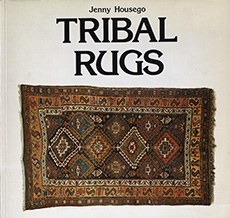
Tribal Rugs
An Introduction to the Weaving of the Tribes of Iran
Jenny Housego
Scorpion Publications
Tribal rugs are part of a tradition very different from that of the finely woven floral carpets with which the name Persia (the more usual Western term for Iran) has long been associated. Yet they have a power and vitality of their own. Designs are geometrical, abstract, with an inventiveness of detail and boldness of colour that sometimes echoes contemporary painting.
Unlike the commercial urban and village products, they were woven exclusively for home use. Furnishings of the type used in the West are unknown. Life is spent on the floor, upon which various coverings are always laid. Best pieces are kept aside for special occasions. Bedding is stored in decorative bags stacked round the sides of the tent, and rolled out at night. Bags in all shapes and sizes provide versatile containers. Thus woven goods form the mainstay of house-hold equipment. And into these everyday objects was once poured a love of colour and pattern which had no other outlet, and was handed down from generation to generation.
The study of such rugs is not without problems. Persian monarchs have ...
Contents
Map / iv
Representative Technical Analyses / V
Introduction / 7
Bibliography / 21
The Main Techniques / 22
Colour Plates / 25-36
Black and White Plates / 37-84
Colour Plates / 85-108
Black and White Plates / 109-I72
Index / 173
REPRESENTATIVE TECHNICAL ANALYSES
The following are brief technical analyses of a typical example from each of the nine principal weaving tribes or areas discussed in this book. Z and S refer to the spin and the ply of the threads. Thus Z2S means that the individual fibres have been spun anti-clockwise, then two finished spun threads are taken and plied clockwise. This is most commonly encountered although Z3S is sometimes found. Diagrams explaining the main techniques are on pages 22—23. ‘Sides’ and ‘ends’ explain the finishes of a piece. These often prove to be important factors in identification.
Plate 5 Mughan Shahsavan Horse-blanket
Size i'75m x 1-5501
Warp Z2S, wool, blue and red
Weft Z2S wool, blue and red
Technique additional all-over weft-wrapping
Sides plain weave
Ends bottom: horizontal braided herringbone band and braided warp fringe; top: plain weave folded over and sewn down
Plate 33 Khamsa Shahsavan Bedding Bag
Sizei-oom x 0-42111 x 0-6401
Warp Z2S undyed ivory wool
Weft Z2S red wool
Technique face: all-over weft-wrapping; back, bottom and sides: red plain-weave Sides herringbone overcast in several colours Ends plain-weave folded over and sewn down
Plate 45 Kurdish Pile Rug
Size 1 82m x 1 01m
Warp Z2S undyed natural and brownish wool
Weft Z2S undyed brown. 2 shoots between each row of knots
Technique knotted pile, symmetrical knot
Sides not original
Ends bottom: not original; top: band plain-weave
Plate 54 Luri or Bakhtiyari Horse-blanket
Size 1 90m x 1 54m
Warp Z2S wool, undyed brown
Weft Z2S various colours, wool
Technique double interlocked tapestry, extra-weft patterning stripes, two widths sewn together Sides plain-weave, overcast in red wool Ends bottom: knotted and braided warp fringe terminating in coloured tassels; top: plain-weave turned over and sewn down
Plate 100 Qashqa‘i Rug
Size 2 o8m x 1-21m
Warp Z2S undyed light brown/dark brown wool
Weft pink wool, two shoots between each row of knots
Technique pile, asymmetrical knot, open left
Sides one cable overcast in alternating strands of pink and mustard
Ends bottom: plain-weave band: top: band plain-weav with knotted warp ends
Plate 118 Kirman Horse-blanket
Size 1 68m x 1 72m
Warp Z2S red wool
Weft Z2S red wool
Technique all-over countered weft-wrapping, guard stripes in discontinuous extra-weft patterning Sides overcast in ochre and brown wool with added tufts Ends bottom: herringbone band with braided warp ends and tassels; top: herringbone band with plain weave folded over and sewn down
Plate 80 Baluchi Prayer Rug
Size 1 38m x 0 83m
Warp Z2S undyed ivory wool
Weft brown wool, two shoots between each row of knots
Technique pile, asymmetrical knot, open left
Sides four cables overcast by the weft
Ends top and bottom: plain-weave bands with extra-weft
Patterning
Plate 138 Kurds of Khurasan Rug
Size 2 59m x 1-59m
Warp Z3S undyed ivory wool
Weft red wool, three or four shoots between each row of knots
Technique pile, symmetrical knot
Sides two cables overcast in red wool
Ends bottom: missing; top: band plain-weave in red and
ivory stripes with knotted warp ends
Plates 146 and 147 Luri Varamin Bag
Size 1 32m x 0 72m
Warp Z2S undyed brown wool
Weft red wool
Technique face: all-over weft-wrapping; back: plain weave with extra-weft patterning, dovetailed tapestry, pile knotted with symmetrical knot
Edges overcast not original
Ends bottom: braided warp ends: top: ends turned over and sewn down
Introduction
Tribal rugs are part of a tradition very different from that of the finely woven floral carpets with which the name Persia (the more usual Western term for Iran) has long been associated. Yet they have a power and vitality of their own. Designs are geometrical, abstract, with an inventiveness of detail and boldness of colour that sometimes echoes contemporary painting.
Unlike the commercial urban and village products, they were woven exclusively for home use. Furnishings of the type used in the West are unknown. Life is spent on the floor, upon which various coverings are always laid. Best pieces are kept aside for special occasions. Bedding is stored in decorative bags stacked round the sides of the tent, and rolled out at night. Bags in all shapes and sizes provide versatile containers. Thus woven goods form the mainstay of house-hold equipment. And into these everyday objects was once poured a love of colour and pattern which had no other outlet, and was handed down from generation to generation.
The study of such rugs is not without problems. Persian monarchs have had a propensity for uprooting peoples en masse for political or military reasons, and putting them down elsewhere. The Safa vid Shah ‘Abbas (1587-1629) moved large numbers of Kurds to the eastern province of Khurasan to form a bulwark against the unruly Uzbeks to the north. Nadir Shah Afshar dispersed bis own tribesmen to various parts of the country. Fath ‘Ali Shah Qajar (1798-1834) transplanted to areas near Tehran several clans of Shahsavan from which to levy recruits for his army.
Thus different groups of one tribe may be found in far-flung areas, perhaps adding to their own repertoire some of the weaving techniques and designs used by newly acquired neighbours. Intermarriage and changes of allegiance between tribes have further contributed to the diffusion.
These factors often make difficult an attribution to a specific tribe. At the same time, tribes in the past have moved freely across what are now modern political frontiers. In a discussion of a rug woven by Kurds, for example, provenance could as well be eastern Turkey, eastern Iraq or even the Soviet Caucasus, as Iran. Equally in a fast disappearing way of life, tribes themselves have forgotten what their ancestors wove, and may be unaware of the work even of a neighbouring group. A piece found in one place may be unrecognizable to someone perhaps only a few miles away. Thus even systematic field-work presents problems in a field which, until recently, has scarcely been studied at all.
In most cases, however, it is possible to indicate the region in which a particular rug was made by the type of wool and weaving techniques employed. Colour is another factor, and so is the drawing of the design. This last can sometimes be the least satisfactory element since there are some popular designs that are shared by several different tribes.
There will be no attempt at precise dating of any of the pieces illustrated. Until the political up-heavals Iran has undergone in the past fifty years, it is likely that tribal traditions had remained unchanged for generations. Goods were woven for everyday use and replaced when they wore out. Most of the rugs here are probably less than one hundred years old, and many are more recent.
Colours can help in indicating age. In the past these were made from plants or roots, and mellowed with the years. The first synthetic dyes introduced into Iran in the 1850’s were prone to fading, particularly the pinks and purples. Later these dyes, which are less laborious to make, were fixed with more permanency, but continue to have a disadvantage over natural colours in their very immutability. The two are not always immediately distinguishable. Little weaving is carried on among the tribes now, who often prefer to sell their wool for the large price it commands, and buy what they need from nearby villages. Modern tribal rugs, such as they exist, are all too often characterized by harsh, bright colours, stereotyped designs and coarse weaving.
Tribes were habitually, though not exclusively nomadic. Increasing numbers are becoming settled. The term ‘tribal’ does not necessarily imply a migratory way of life. It is used here to denote peoples of similar ancestry, like the Lurs or the Kurds, or those of mixed origins like the Qashqa'i or the Shahsavan.
Inevitably, however, the borderline between their weaving and that of villagers, into whose communities former nomads have been absorbed, is often blurred.
The following pages treat the country anti-clockwise, from northwest to northeast. Included are the main weaving tribes under separate headings as well as areas where tribes of different origins mingle.
The word ‘rug’ is used as a general term for covers and bags of all kinds, flat-woven as well as knotted pile. Terminology of the main types found is discussed under a separate heading below.
The Turkic Tribes of Northwest Iran
The most famous of these are a confederation of tribes known as the Shahsavan. There are several groups scattered in the northwest part of the country. The largest migrates from the plains of Mughan, in the northeastern tip of the province of Azarbayjan, to summer pastures on the slopes of the fourteen-thousand-foot Mount Savalan, west of the town of Ardabil.
Their most outstanding contributions are cere-monial horse-blankets with bold stylized peacocks and animals marching across them (plate 5). Covers for floor and bedding are decorated with a variety of abstract and formalized floral and other motifs, on grounds of different colours (plates 1, 2). Saddle and bedding bags in various shapes and sizes portray a wealth of ornamentation in bright colours (plates 7, 16, 17, 18).
These are woven in a weft-wrapping technique sometimes known in the West by the misleading term sumak, probably after the town of Shemakha in the Caucasus. The technique is by no means …
Jenny Housego
Tribal Rugs
An Introduction to the Weaving of the Tribes of Iran
Scorpion Publications
Scorpion Publications Limited
Tribal Rugs
An Introduction to the Weaving of the Tribes of Iran
Jenny Housego
For exclusive sale in Iran by Tajerzadeh Book Store
Chain.
Keyvan Book Store. Takht-E-Tavous Bookshop.
Shah'rzad Bookshop. Rastegar Bookshop. Jordan
Bookshop. Boulvar Bookshop. Iran Shahr News
Stand.
Scorpion Publications Limited
Text: © Jenny Housego 1978
Photographs: © Scorpion Archives 1978 unless stated otherwise
All rights reserved. No part of this publication may
be reproduced, stored in a retrieval system, or transmitted
in any form or by any means, electronic, mechanical,
photocopying, recording or otherwise, without the prior
permission of the copyright owner.
First published 1978 by
Scorpion Publications Ltd
P.O. Box No I London WC2E
ISBN 0 905906 05 5 paper
ISBN o 905906 11 X cased
Managing Editor: Antony Hutt
Series Editor: Leonard Harrow
Design and Art Direction: Colin Larkin
Design Assistant: Rhonda Larkin
Photographic: unless otherwise stated, all the photographs were
especially commissioned by Scorpion Archives and taken by John
Warren. We wish to thank Biblios Publishers’ Distribution
Services Ltd for their co-operation in extending photographic
facilities.
Set in Monophoto Photina 74 7
by Tradespools Ltd, Frome, Somerset, England
Black and white origination by Tradespools
Colour origination and printing by Acorn Litho Colour Printers,
Feltham, Middlesex, England
Monochrome printing and binding by W S Cowell Ltd,
Ipswich, England