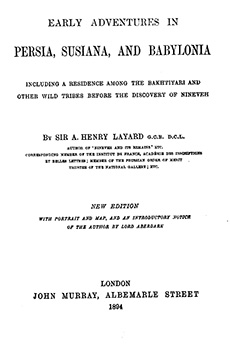
Early Adventures in: Persia, Susiana, and Babylonia
Austen Henry Layard
Gregg International Publishers
1 Another portrait in crayon was made by Mr. Watts, apparently a few years later, and is to be seen among the collection of his pictures at Little Holland House, to which the public is so liberally admitted. Beth these portraits were made some years before the growth of that beard which, in its massive white flow, formed so striking a characteristic of his face in later life. 2 The family of Layard, which has produced several men of distinction in the Church, in Medicine, in the Army and Civil Service, is of French origin. The first member who ...
Contents
Chapter I Leave Jerusalem—Hebron— Yusuf Effendi— The bastinado — Sheikh Abu-Dhaouk—Departure for Petra—The tents of Abu- Dhaouk—Arab dentistry—Danger from Arab robbers—A sacred spot—Enter mountains—IVady Musa—Reach Petra— Difficulties with the Arabs—The ruins / I
Chapter II Leave Petra—Danger from Arabs—The Seydlin Arabs—The Dead Sea—The Mountains of Moab—Plundered by Arabs— Arrival at Herat—The son of the Mujelli—Recovery of my property—The Christians of Herat—Its ruins—My Christian host—Sheikh Su/eiman-Ibn-Fais—Departure for the Desert— Encampments of Christian Arabs— The country of Moab—The Beni Hamidch—Remains of ancient tenons—Meshita—An Arab banquet—The tents of Suleiman -Ibn- Pais—Reach Ammon / 20
Chapter III The ruins of Ammon—Skeith Suleiman Shibli—Fortunate escape —A funeral—The plague—Reach Jerash—Description of the ruins—Isaac of Hebron—The plague at Remtheh—Irbid—A Bashi-Bosuk—Cross the Jordan—Mood—Deserted by my guide — Tiberias—Hyam, a Jew—His generosity—Safed—The Jew Shimoth—Effects of the earthquake—An Arab muleteer and his wife—Start for Damascus—Robbed by deserters—Hafcr- howar—Evading the quarantine—Escape from arrest—Arrival at Damascus / 51
Chapter IV Consul Wherry—A Turkish bath—Damascus houses—An Arab barber-surgeon—Purchase a mare —Leave Damascus—Cross Anti-Lebanon—The Mutuali—Arrive at Baalbek—The Emir —Leave for Beyrout—Cross Lebanon to Beyrout—Journey to Aleppo—Rejoin Mr. Mitford—Leave Aleppo for Baghdad / 79
Chapter V Leave Baghdad—Assume the Persian dress—Reach Kermanshah—The Shah's camp—The Minister for Foreign Affairs—The camp raised—Reach Hamadan—The Prime Ministei—Difficulty in obtaining firman—Separate from Mr. Mitford / 91
Chapter VI Leave Hamadan—My mehmandar—Doulctabad—A Persian palace —Burujird—Khosrauabad—Difficulties of the journey—A village chief—The Bakhtiyari—Renounce attempt to reach Shuster—Freydan — A Georgian colony—Tehrun— Reach Isfahan — M. Bori—Mr. Burgess—The Matamet— The punishment of Imaum Verdi Beg—Shefila Khan—Ali Naghi Khan—Invitation to Kala Tul—Delays in departure—7'he Palaces of Isfahan—Persian orgies—The Mujtehed / 97
Chapter VII Departure from Isfahan — My travelling companions — The Shutur-bashi—Shcfia Khan—False alarm—Enter the Bakh¬tiyari country—Fellaut—Hospitable reception — Chilaga—A foray—Lurdagon—A Bakhtiyari feast—Effect of poetry— Difficult mountain pass—Thieves —Reach the Karun—Kala Tul—The guest-room—Mehemet Taki Khan's brothers—His wife—His sick son—The great Bakhtiyari chief—Cure his son—Khatun-jan Khanum — Khanumi — Fatima — Hussein Kuli—Ali Naghi Khan's wives—Dress of Bakhtiyari women —Marriages—Life at Kala Tul—The Bakhtiyari / 127
Chapter VIII Excursion to Mai-Emir—Bakhtiyari graves—The Atabegs—A wife of Mehemet Taki Khan—Plain of Mai-Emir—Mullah Mohammed—Sculptures and inscriptions of Shikcfti-Salman —Leave Mai-Emir for Silsan—Robbed on the. road—Diffi¬culties in crossing the Karun—Mullah Feraj—The tomb of Daniel—A fanatic—Suspicions of the Bakhtiyari— The ruins —Ancient bridge—Bakhtiyari music—Leave Silsan—Forest encampment—Return to Kala Tul—Recover my .property—Visit ruins of Manjanik—Legend relating to Abraham—Ill of fever—Village of Abu'I Abbas—Attempt to visit Shefia Khan—Dangers of the road—Return to Kala Tul—Accom¬pany Sheffa Khan to his tents—A terrible night—Encounter with a lion—The lions of Khuzistan—Leopards and bears—Recalled to Kala Tul—Escape from drowning / 164
Chapter IX Demands upon Mehemet Taki Khan—He is declared in rebellion — Threatened invasion of his mountains—Requests me to go to Karak—The trade of Khuzistan — Leave for Karak—The Kuhghelu—Ram Hormuz—The Bahmei—Behbahan—Bender Dilum—Mirza Koma—Embark for Karak—Arrive there— Return to Kala Tul—March with Mirza Koma—Dangerfrom Arabs—Reach the castle—Mehemet Taki Khan at Med-Emir— Adventure with Baron de Bode—Join Mehemet Taki Khan— Effect of poetry on Bakhtiyari / 192
Chapter X Arrival of the Matamet—My horse stolen—Negotiations with the Matamet—The Matamet at Kala Tul—Sculptures and inscrip¬tions in Mai-Emir—Kul Faraun—Shefia Khan made prisoner —Hussein Kuli—Arrival at Shuster with the hostages—Inter¬view with the Matamet—Return to Kala Tul— War against Mehemet Taki Khan— Return to Shuster / 214
Chapter XI Mehemet Taki Khan leaves the mountains—Plan to carry off Hussein Kuli—Leave Shuster—The naphtha springs—Join some dervishes—Return to Shuster—Description of the town —Descend the Karun—Robbed of my money—Leave Ahwass for Fellahiyah—Alarm and flight of the Arabs—Construct a raft—Float into the musif of the Cha'b sheikh—Sheikh Thamer —Arrival of Mirza Koma / 227
Chapter XII Discover a Baihtiyari—Join Mehemet Tali Khan—His flight from Kala Tul—The Bakhtiyari encampment—Eellahiyah fortified—The sheikh's artillery—Mir Mohanna—Arrival of Arab warriors—Attempts to obtain surrender of Mehemet Taki Khan—He leaves for the Matamet's camp—Is betrayed and thrown into chains—negotiations with Sheikh Thamer—Hight attack upon the Persian camp—Release of Au Kerim—The Matamet withdraws—Sufferings of Mehemet Taki Khan's family—Muhammera— The Bakhtiyari fugitives depart— Attacked by Arabs—Mission of Au Kerim to the II-Khani—The Bahmehi chief-—Au Kerim and the author made prisoners —Our escape—Au Kerim captured—A grateful seyyid—Reach Shuster—Murder of Au Kerim / 248
Chapter XIII Interview with the Matamet — A young Georgian — Persian cruelty—Mulla Feraju-Allah—Leave for Hawizah—An inhos¬pitable desert—The Kerkhah—Arab buffalo keepers—Sheikh Faras—His ‘musif'—The Hawizah Arabs—Taken for a Georgian—Reach Hawizah—The Sabaans—-Join caravan to Basra—A lion—Reach the Euphrates—An English merchant- ship—Arrive at Basra / 281
Chapter XIV Basra—Accompany Agayl postman to Baghdad—The Agayls—The mirage—Chased by Bedouins—A sick companion—Kilt-el-Agayl —Semawa—The Lemloom Arabs — Hillah—The road to Baghdad—Robbed by Shammar Bedouins—Harrow escape— Arab thieves—Destitute condition—Reach Baghdad—Dr. Ross —Descend Tigris in the 'Assyria'—The tomb of Ezra—The Hafar—The Bahmch-Shir—Return to Baghdad—Sheikh Math- kur—Ruins of Ctesiphon / 298
Chapter XV Leave Baghdad for Khuzistan—Sheikh Mathkur—Saleh the Lur —Tib—Robbed—Ruins of Kerkh—Kala Haji Ali—Reach Shuster—Hatem Khan—Kala Dokhter—Bakhtiyari Ilyats—The Diz of Jaffer Kuli Khan—The plain of Shimbor—The Puli-Neghin—Anecdotes of bears—The Tangi-Butun—Ancient sculptures—Return to the Diz—Leave for Shuster—The Musjedi-Suleiman—Flight of Sheikh Thamci—Mehemet Taki Khan in chains—Khatun-jan—Her sufferings and adventures —Ali Naghi Khan—Hussein Kuli—Take leave of Khatun-jan Khanum / 318
Chapter XVI Arrive at Dizful—The guardian of the tomb of Daniel—The tomb —The black stone—Legends about Daniel—The Ruins of Susa —Return to Dizful—foin Faili horsemen—Cross the Kerkhah —A Lur encampment—A Lur family—A narrow escape—Lur hospitality—Arrival at the Walls tents—Ahmed Khan—The ‘tushmals’— The Walls suspicions— The chief of the Sag- wand—Second interview with the Wali—A messenger in search of me—Detected by an Arab—My life in danger—Saleh's mis¬conduct—Reach Baghdad—Incident on the way / 349
Chapter XVII Renounce journey to India—Ascent of the Karun in the ’Assyria'—The bend of Ahwaz—Get aground—Notables of Shuster visit the ‘Assyria’—Awkwardposition of the vessel— Floated again—Ascend the Ab-Gargar—A lion — Fate of Mehemet Taki Khan—Ascend river of Dizful—An unjust attack—Lieutenant Selby wounded— Travel Tatar to Constanti¬nople— The ruins of Nineveh—Monsieur Botta—Embark at Samsoun / 373
Chapter XVIII Arrive at Constantinople—Reception at the British Embassy—Sir Stratford Canning—Mission to European provinces of Turkey —Salonica—Omar Pasha—Ambelakia—Larissa— Chatalja— Namik Pasha—Mcteora—A swollen stream—Mezsovo—Zagori —Revolution in Servia—The Servian leaders—Return to Constantinople—Travel Tatar—Reach Pera—Sir Stratford's Servian policy—Policy of Russia—Mr. Longworth—Ahmed Vefyk Effendi-—Ruh-ed-Din Effendi—Turkish life—Reshid Pasha—Turkish politics—Mediation, of England in Turco- Persian question—Remain at Constantinople / 387
Chapter XIX Live at Candili—Sultan Abtful-Mejid—Safvct Pasha—Frederick Pisani — A Christian apostate beheaded — Sir Stratford Canning's action—Scene at the palace—Insurrection in Albania—Sent there on a mission—Omar Pasha—Negotiations with a Ghega chief—Dervish Czar—An Albanian dance—Ghegas attack Turkish camp—Turkish treachery—Ochrida—Leave for Nineveh—Conclusion / 408
Index / 427
INTRODUCTORY NOTICE
I have been asked, as one of the few surviving friends of Sir Henry Layard, to write something by way of preface to this work, which, recording his earliest travels, received his revision and last touches almost on his death-bed.
I first knew him in 1848, when he had become suddenly and widely famous by the publication of his work on ‘Nineveh and its Remains.’ We speedily became friends, and I can truly say that our attachment strengthened with advancing years. He was then thirty-one years of age—therefore nine years older than when he set out on the travels which form the subject of this volume. His outward appearance at that time is perfectly rendered by the portrait in crayon made, I believe in 1848, for the late Mr. John Murray by Mr. G. F. Watts, R.A.,1 of which the frontispiece is a reproduction. His face was singularly attractive and impressive; his figure suggested strength and power of endurance, rather than exceptional activity. I have vividly before me the scene of our first acquaintance, when, being on a visit to his relations Sir John and Lady Charlotte Guest, he described to the Dowlais workmen in vigorous and graphic language his wonderful discoveries of buried monuments, with—what specially interested them—their close bearing on Biblical history, and their illustrations of Bible language and imagery.
Although I do not doubt the sound judgment of the Publishers—his old and attached friends—in giving to the world an edition of the ‘Early Adven-tures’ reduced in size and cost so as to secure a still wider circulation than that obtained for the first publication in 1887, I cannot but record my regret that it was not deemed practicable to produce an enlarged, instead of an abridged, edition of those fascinating volumes. I have the assurance of a friend, who had seen the original journals from which the work was composed, that for such enlargement there exist ample materials, which in value and interest are not inferior to those portions of them which were selected by him for publication. In some respects, especially in the qualities of personal charm and interest, I do not hesitate to give the preference to these ‘Early Adventures,’compiled as they were from the original rough notes taken at the time, over the more elaborate works ‘Nineveh and its Remains’ (1848) and ‘Nineveh and Babylon’ (1853). Undoubtedly the two earlier publications are far richer in historical and archaeological discoveries and dis-quisitions,' and have therefore an importance which cannot be claimed for this record of his earliest Eastern travels. Nor are they wanting in picturesque descriptions of ancient and remote people, almost forgotten or unknown, in adventures of breathless interest bringing into strong relief his fearlessness, often amounting to extreme rashness, his presence of mind, his resources in danger and difficulty, and his extraordinary influence over wild and semi-savage races. In the previous works as well as this last we are attracted by the same indignation at acts of cruelty and oppression, the same intense sympathy with suffering; a sympathy not satisfied with mere pity, but inciting to earnest effort for redress, often successful and of more than passing efficacy. In all alike we find the same sense of humour, which was doubtless the secret of much of his popularity and influence among those wild children of nature, whether Arabs or Kurds, and was not without its effect even upon the stately and reserved Turks; a natural gift, let me be permitted to add, which gave a peculiar charm and zest to his daily intercourse, not failing him even on his deathbed. Add to these a style manly, clear, and simple, yet lending itself to descriptions as vivid and picturesque as ever gave life to the pages of the most gifted among the glorious roll of British travellers.
These merits are common alike to all his books of travel. But I do not think that I err in attributing much of the extraordinary attraction of the present work to the youth of the traveller, and to the vividness of the impressions made upon an eager and inquiring mind in its first associations with the East.
Born March 5, 1817, Layard2 commenced an expedition which lasted for nearly four years (1839- 1842) at an age when most young men of his condition have hardly left the University. His education, although scarcely one which could be recommended for general adoption, was in many respects well fitted to prepare him for his future career, not only as a traveller and archaeologist, but even as a statesman and diplomatist It was highly cosmopolitan. He was born in Paris. His father, suffering from asthma, left England for Pisa in 1821, but finally removed to Florence, where he and his family remained for some years, during which his son went to a school kept by an English lady. But even in those early days the father cultivated his son’s taste in literature and art. To borrow Layard’s words: ‘Much of my boyhood was passed in Italy, where I acquired a taste for the Fine Arts, and as much knowledge of them as a child could obtain who was constantly in the society of artists and connoisseurs. I also imbibed that love of travel which has remained to me through life.’3
Returning to England, his family settled for a while at Ramsgate, Henry, still a child, being placed at a school at Putney kept by two old ladies. In 1825 his father removed to Moulins, and his son, then eight years old, was sent to a French school, where he was much bullied by his companions, whose enmity he attributed to the hatred of the English still prevailing after the great war, as well as to his being a Protestant. From Moulins his family removed to Geneva, where he entered a boarding school. Thence his father's health caused their return to Florence, where Henry attended an Italian school, at which he commenced a lifelong friendship with Ubaldino Peruzziand William Spence. He probably owed more to the hours spent in botanising and collecting butterflies on the hills of Fiesole than to those passed on the school-bench; and it was when so engaged that the eager and intelligent boy attracted the notice of Walter Savage Landor. Much of his time was passed in the picture galleries and among the rich collections of art in the beautiful city. About 1830 he returned to England, and went to a school at Richmond, which he left in 1833. To quote again his own words: ‘When about sixteen years of age I was sent to London to study the law, for which I was destined. But, after spending nearly six years in the office of a solicitor, and in the chambers of an eminent conveyancer, I determined for various reasons to leave England and to seek a career elsewhere.’
During this time he was articled to his uncle, Benjamin Austen, an eminent solicitor, married to a highly cultivated wife. In their house he made the acquaintance of the D’Israelis, Samuel Warren, Plumer Ward, Theodore Hook, as well as of many of the best artists of the day. Mr. D’Israeli’s brother Ralph was also articled to Mr. Austen. In an article in the Quarterly Review, January 1889, on the Early Life of Lord Beaconsfield, Layard states:
‘The earliest recollection of the writer of this article is connected with a visit to which he was taken, when quite a child, to Mrs. D’Israeli—his mother. “Ben” was sent for, and appeared in his shirt sleeves, with boxing-gloves, having been inter-rupted in the middle of a lesson from a professor of the noble art. In his youth he was a constant rider. He used to say, that some of his best thoughts and ideas came to him when scouring the country mounted on a good horse.’
In the same article Layard dwells upon the influence exercised by his aunt, Mrs. Austen, on the development of young D’Israeli’s character and genius. ‘She was highly accomplished and a proficient in music, an amateur artist of no common skill, possessed great conversational powers, and had a rare command of her own pen. D’Israeli wrote of it “the comprehensive circuit of your lively pen;” and in one of his many letters to her he says: “You appear to be the only person in the world except myself who have any energy; what would I give to have you always at my right hand!” She had gathered round her a ciicle of men of letters and artists, including some of the foremost authors and painters of the day, with many of whom she maintained a correspondence.’ To her ‘D’Israeli confided the secret that he was writing a novel; consulted her during its progress; received from her much valuable advice; and ultimately placed the MS. of “Vivian Grey " in her hands to arrange for its publication.’ At her death in 1888, at the age of 92, the MSS. of ‘Vivian Grey’ and 1 Captain Popanilla,’ D’Israeli’s second work, were found among her papers.
I have heard from Layard many interesting anecdotes of his early acquaintance with D’Israeli. I hope that I may be acquitted of indiscretion in recording one of them equally creditable to both. Soon after Layard’s entrance into Parliament, he met D’Israeli, who, after a few words of friendly congratulation, invited him into the Carlton Club for a quiet talk. They entered a private room, when D’Israeli, after dwelling in flattering terms upon Layard’s foreign experience and general talents, urged him to join the Conservative party, assuring him that he would be cordially welcomed, and might safely look to an official appointment. Layard, who had been returned as a rather advanced Liberal, pledged to several measures to which the Conservatives were opposed, of course declined the offer, of the sincerity and kindness of which he had however no doubt. Some years later, when acting as Under-Secretaty of Foreign Affairs (1861-6), he was often brought into sharp collision with the Conservative party, and was sometimes assailed with much personal bitterness. During all this time D’Israeli, leading the Conserva-tives, and necessarily taking an active part in debate, never allowed his political differences to pass into personal attacks, but treated his early friend with uniform consideration and respect. With Mrs. Austen Layard kept up a close and affectionate intercourse to the very end. Is it too much to assume that the bright influence exercised by her on D’Israeli was largely shared by him; and that the six years of distasteful study passed in her husband’s office (1833-9) were, under her stimu-lating guidance, mainly employed in repairing the deficiencies of his desultory education? His father, who had removed to Aylesbury—afterwards represented in Parliament by Layard—died in 1834. The Austens’ house became a second home to him, and it was impossible that he should not have gained much from the cultivated society which frequented it. But, young as he was, the spirit of travel had possessed him. In 1835 he accompanied Brockedon in a tour in the Alps—which that artist recorded in prose and picture in a once popular work —in the course of which Layard made the acquaintance of Cavour and his family. In 1837 he travelled in North Italy, and met Silvio Pellico, and other distinguished Italians. In 1838 he started alone on a tour through Sweden and Russia.
It was in 1839 that he set out upon the Travels recorded in this volume. For these he prepared him-self with his usual vigour and thoroughness. He had already acquired several European languages; he had seen much of men and manners in various lands; he was familiar with the best productions of European art. But he was not satisfied with this equipment He has described in the Introduction to the first edition of this work what further steps he took to fit himself for travel in the vast, varied, and little-known regions of the East in which he was about to adven-ture himself. When as a boy he pored over the ‘Arabian Nights,’ he had, he tells us, been inflamed with the desire of visiting Aleppo, Damascus, Baghdad, and Isfahan. As he grew older he greedily read every volume of Eastern travel that fell in his way. He made the acquaintance of Baillie Fraser, whose novels descriptive of Persian life he ‘devoured with the greatest eagerness.’ He had listened with the liveliest interest to the accounts by Sir Charles Fellowes of his discoveries among the ruined cities of Asia Minor, and had been inspired with an ardent desire to follow in his footsteps. The works of Morier, Malcolm, Rich, and others had given him a longing to visit Persia, Babylonia, and the wild tribes of Kurdistan. ‘Having a vague notion that I might some day be able to see those countries, I had even attempted to master the Arabic characters and to learn a little of the Persian language.’ From a retired captain of the merchant service he received lessons in the use of the sextant, and learned how to take observations of the sun for the latitude, and to fix the positions of mountain peaks, of towns and ruins not marked, or inaccurately laid down, in the best maps. He provided himself with a pocket sextant, an artificial horizon, a prismatic compass, a telescope, some thermometers for determining the temperature' and ascertaining heights, an aneroid barometer, and a silver watch. Some idea of the dangers he was doomed to encounter must have been suggested to him by the advice of Sir C. Fellowes that this watch should be painted black, lest the sight of the bright metal should excite the cupidity of the wild people amongst whom he was about to travel, who would not hesitate to rob or even murder him in order to obtain possession of an object of seeming value. In the course of these Travels the reader will have many opportunities of observing what repeated and desperate efforts Layard made to preserve these instruments, and how, long before his journeys were completed, all, or nearly all, of these precious articles were violently taken from him, broken, or lost.
By a medical friend he was instructed in the symptoms of the diseases which he was most likely to meet with, the use of the lancet, the treatment of wounds, &c. Imperfect and superficial as was the knowledge thus hastily acquired, its value to him was inestimable, although an exaggerated conviction of his skill among his wild and credulous hosts, who firmly believed that he could cure every imaginable disease, exposed him to no little inconvenience, and sometimes even personal risk.
Thus accoutred, and in company with Mr. Mitford, an accomplished traveller, he started on his journey in the summer of 1839. His scheme of travel at that time included an overland journey across Asia to Ceylon, where a relation, holding a high official position, led him to hope that he would find employment either at the Bar or in the Civil Service. He proposed to reach India through Persia and Afghanistan, after visiting Asia Minor and Palestine and the Mesopotamian Desert as far as Baghdad; but, on the suggestion of the Royal Geographical Society, the travellers agreed to vary this plan by pursuing a less-known route to India, and endeavouring to reach Kandahar from Isfahan through Jezd and Seistan, exploring on their way the Lake or vast marsh of Furrah, in and around which ruins of ancient cities and of remarkable monuments were said to exist. But events greatly modified their intentions. They reached Jerusalem in January 1840. There they parted for a while, Mr. Mitford declining—very prudently, as the reader will find— to join in the perilous excursion to the ruins of Petra, Ammon, and Gcrash, during which the younger traveller, not only suffered terrible hardships, but repeatedly incurred the greatest risk of losing his life at the hands of ferocious Bedouin robbers. They met again at Aleppo, whence they travelled together until they reached Hamadan in Persia, where, on August 8, 1840, they finally separated, Mr. Mitford to pursue his long and perilous journey to Kandahar, Layard to engage in those not less perilous wanderings in Persia which form the most interesting portion of this volume; encountering adventures which I venture to think make these Travels among the most interesting ever published. It was well for us that this separation occurred, for to it we undoubtedly owe that long residence and close intimacy with the Bakhtiyari chief and his family, so graphically described, which had so pathetic a history and ending. Throughout these Travels the reader cannot but be struck by the passionate eagerness with which, exposed to hardships of every description, weakened by fever, threatened and chased by murderous robbers, he followed up the slightest trace of any ancient ruins or monuments throwing light on the past history of what was once the mighty empire of Persia. In his indomitable courage and firmness, in his power of winning the confidence and attachment of the wild tribesmen, among whom he remained long enough to be known and appreciated, we discover the secret of that singular influence of which so many striking proofs reveal themselves in his later travels, and without which it may be safely affirmed his great work of discovery in the regions of Nineveh and Babylon could not have been accomplished. In following him throughout his career of sufferings and dangers, we are often tempted to ask ourselves whether the pain did not so far exceed the pleasure as to discourage and disenchant the youthful traveller. How little this was the case—how different the impression left on his mind—may be gathered from the following extract from his ‘Nineveh and its Remains,’written five years later, in 1848:— ‘During the autumn of 1839 and the winter of 1840, I had been wandering through Asia Minor and Syria, scarcely leaving untrod one spot hallowed by tradition, or unvisited one ruin consecrated by history. I was accompanied by one no less curious and en¬thusiastic than myself. We were both equally careless of comfort and unmindful of danger. We rode alone; our arms were our only protection; a valise behind our saddles was our wardrobe, and we tended our own horses, except when relieved from the duty by the hospitable inhabitants of a Turcoman village or an Arab tent. Thus unembarrassed by needless luxuries, and uninfluenced by the opinions and prejudices of others, we mixed amongst the people, acquired without effort their manners, and enjoyed without alloy those emotions which scenes so novel, and spots so rich in varied association, cannot fail to produce.
‘I look back with feelings of grateful delight to those happy days when, free and unheeded, we left at dawn the humble cottage or cheerful tent, and, lingering as we listed, unconscious of distance and of the hour, found ourselves, as the sun went down, under some hoary ruin tenanted by the wandering Arab, or in some crumbling village still bearing a wellknown name. No experienced dragoman measured our distance and appointed our stations. We were honoured with no conversations by pashas, nor did we seek any civilities from governors. We neither drew tears nor curses from villagers by seizing their horses or searching their houses for provisions; their welcome was sincere; their scanty fare was placed before us; we ate, and came and went in peace.’ 4
All dangers, hardships, annoyances, disappoint-ments are forgotten after the lapse of a few short years. Nothing but the free life of adventure, novelty, and discovery is remembered.
Excellently as Layard was gifted as a traveller in his power of observation and description, I venture to think that, from the earliest to the latest of these recorded journeys, it is the man who constitutes the chief and central interest. On reading once again these three remarkable works, what strikes me even more than his eagerness in discovery and his indomitable spirit is the fiery indignation at human suffering, which impelled him at all risks and hazards to make himself everywhere the champion of the weak and oppressed. A large part of the two memorable books on Nineveh and Babylon is devoted to the sufferings of the Nestorian Christians, to those of the Yezidi, or so-called Devil Worshippers, to the cruelties perpetrated now on whole tribes, now on individuals, and to his efforts, ardent and continuous, to have their wrongs redressed. But while, during his first operations at Mosul and Nimroud, he could, when expostulation with the local governors and pashas failed, appeal with the certainty of vigorous support to his friend and patron, Sir Stratford Canning, then exercising at Constantinople an influence probably never equalled by the ambassador of any country; while on his second expedition he was acting as the emissary of the British Museum, with the countenance of the British Government, exerting the moral weight and authority with which his previous successful vindications of the rights of these poor people against wrong and outrage had invested him—in these earlier travels such advantages were entirely wanting. He, a young and unknown man, had only himself to depend upon, in a country the rulers of which were hostile to the English almost to the very verge of war. Generally suspected of being a spy, his real objects were entirely misunderstood, every attempt at prosecuting them exposing him to dangers from which he often barely escaped with life, maltreated and stripped even of the clothes he wore. See his account of his final disasters on his approach to Baghdad5 :—‘We were left alone, almost stripped to the skin. I however considered myself fortunate in having escaped with my life…. Never having been accustomed to walk with bare feet, I suffered the greatest pain and inconvenience from the want of shoes and stockings. The ground was so heated by the sun that it almost burnt the soles of my feet, which soon began to swell, blister and bleed…. But the night was not to pass without a further adventure. We were suddenly stopped by two Arabs on foot armed with short heavy clubs. They demanded our clothes, and as we had no means of resistance, I was compelled to surrender my “tarbush,” and my “abba,” for which one of the thieves generously gave me his own ragged clothing in exchange…. I sank down on the ground, overcome with fatigue and pain.’
No wonder that a party of mounted European ladies and gentlemen, his own familiar friends, although they passed close to him, did not recognise him in the dirty Arab in rags crouched near the entrance. At a little distance behind them came his friend, Dr. Ross. ‘I called to him, and he turned towards me with the utmost surprise, scarcely believing his senses when he saw me without a cover to my bare head, with naked feet, and in my tattered “abba.5”
Yet, even thus constantly imperilled, with no help but in his own energy, no sooner did he become aware of the cruel persecutions under which the Christian sect of the Sabseans, once numerous, then reduced to a few hundred families, were suffering, than he collected in his hut all of them he could bring together, and having heard from them the account of the oppression to which they had been subjected by the Persian authorities, he addressed himself to the false and ferocious, but all-powerful governor, Matamet, and by his earnestness and force of character obtained for them some relief from their persecutions. But his sympathy did not rest there. He appealed on their behalf to Colonel Taylor, the able and learned political agent of the East India Company at Baghdad, who exerted himself success-fully in obtaining some measure of protection for them. Many years later, when ambassador at Constantinople, Layard received from the Queen a sum of money generously given for their relief; and he then obtained from the Sultan orders to the authorities in Turkish Arabia to protect from illusage those of the Sabaeans who inhabited their territories, and to insure them full liberty in the profession of their faith and in the performances of their religious ceremonies.
Similar instances of energetic exertion on behalf of the oppressed abound throughout all his travels, and there are few pages more interesting than those which record the gratitude of the people whom he spared no pains to serve. One striking instance of the depth and earnestness of this feeling can be found in p. 40 et seq. of his ‘Nineveh and Babylon,’ describing his reception by the Yezidis in acknowledgment of the important services he had rendered to them at Constantinople. Still more striking is the incident which occurred as he approached Mosul:—‘Suddenly a large body of horsemen appeared on a rising ground to the east of us. Wet could scarcely expect Arabs from that quarter; however, all our party made ready for an attack. Cawal Yusuf and myself, being the best mounted rode towards them to reconnoitre. Then one or two horsemen advanced warily from the opposite party. We neared each other. Yusuf spied the wellknown black turban, dashed forward with a shout of joy, and in a moment we were surrounded and in the embrace of friends. Hussein Bey and Sheikh Nasw, with the Cawals and Yezidi elders, had ridden nearly forty miles through the night to meet and escort me, if needful, to Mosul! Their delight at seeing us knew no bounds; nor was I less touched by a display of gratitude and good feeling, equally unexpected and sincere’ (p. 58).
Such instances of gratitude and devotion abound during his wanderings among the Nestorian Christians of Kurdistan, in whose cause he had exerted himself with an energy which triumphed over the contemptuous indifference or open hostility of their Turkish oppressors.
May I add that during my many years of close personal and political intimacy with Layard, I ever observed in him the same keen sensitiveness, to human suffering, the same ardent desire to protect the oppressed? Animated by this feeling he went to the Crimea in order to test the truth (to use the memorable words of Lord John Russell) of the ‘horrible and heart-rending’ sufferings of our English soldiers. In the same spirit he visited India during the Indian Mutiny in order to ascertain for himself whether, or to what extent, that terrible outbreak was due to misgovernment.
I know but too well that his motives on those occasions, and his consequent action, were impugned and attributed to ambition, to political and personal passion and what not, by those—and they were many—who misunderstood his character, and failed to appreciate the strength of his sympathy with suffering. His nature was vehement, his convictions strong, and when he exposed incompetence or injustice, he smote and spared not, possibly with occasional injustice or exaggeration, which, given the man and his nature, were, I fear, inevitable. ‘The horse that wins the race must gallop beyond the goal,’ said Fuller, in palliation of some of Luther’s words and deeds. But those who knew him well— those who, not knowing, had studied his character as unconsciously exhibited in his Travels—were able to supply more generous and truer explanations than could occur to his prejudiced and illinformed critics. This warmth of sympathy he retained to the end of his life, and to it can surely be attributed that intense attachment and affection which the grateful people of Venice felt and evinced for their friend and benefactor during his long residence among them.
I have already referred to the irresistible attraction which the antiquities of the wild regions traversed by Layard—the scattered and mutilated remnants of a high state of ancient civilisation—exercised upon his mind. This volume records how it was strengthened, and how it received its special direction, by his meeting with M. Botta, the French Consulat Mosul, then ‘meditating those excavations which ended in the discovery of the Assyrian ruins at Khorsabad and rendered his name famous.’ How on his arrival at Constantinople Layard succeeded in interesting Sir Stratford Canning in this work of discovery, how Sir Stratford generously contributed out of his own purse 60/. to meet an equal sum collected by Layard, how with this modest fund of 120/. those excavations were begun at Nimroud Kouyunjik, and elsewhere, which made his own name famous, is told with admirable spirit in his first great work ‘Nineveh and its Remains.’ The testimony of many travellers establishes the fact that these vast and difficult explorations could never have been executed but for the personal influence which he exerted over the Arab tribes and the enthusiasm he aroused among those children of the desert who felt that they had among them a man born to lead, to do and to command.
Nowhere is the astonishment excited by this wonderful Frank more strikingly and amusingly expressed than by an Arab chief, one of Layard’s most devoted allies, in the description of the lowering of the great winged bull and its removal from the ruins of Nimroud :—‘The Arab sheikh [Abd-ur-rahman], his en-thusiasm once cooled down, gave way to moral reflections. “Wonderful! Wonderful 1 There is surely no God but God, and Mohammed is his Prophet,” exclaimed he, after a long pause. “In the name of the Most High, tell me, O Bey, what you are going to do with those stones? So many thousands of purses spent upon such things! Can it be, as you say, that your people learn wisdom from them, or is it, as his reverence the Cadi declares, that they are to go to the palace of your Queen, who, with the rest of the unbelievers, worships these idols? As for wisdom, these figures will not teach you to make any better knives, or scissors, or chintzes, and it is in the making of those things that the English show their wisdom. But God is great! God is great! Here are stones which have been buried ever since the time of the holy Noah—peace be with him! Perhaps they were underground before the Deluge. I have lived on these lands for years. My father, and the father of my father, pitched their tents here before me; but they never heard of these figures. For twelve hundred years have the true believers (and, praise be to God! all true wisdom is with them alone) been settled in this country, and none of them ever heard of a palace underground. Neither did they who went before them. But lo! here comes a Frank from many days’ journey off, and he walks up to the very place, and he takes a stick”—illustrating the description at the same time with the point of his spear— “and makes a line here, and makes a line there. Here, says he, is the palace; there, says he, is the gate; and he shows us what has been all our lives beneath our feet without our having known anything about it. Wonderful! Wonderful! Is it by books, is it by magic, is it by your prophets, that you have learnt these things? Speak, O Bey! tell me the secret of wisdom.” ’6
But yet another side of Layard’s character, hardly less marked than his archa; ological enthusiasm, is brought into strong relief before he leaves the scene of his early adventures. During his residence with the Bakhtiyaris and his conversations with their intelligent chief, who lamented the existence of that state of society which perpetuated disorder and ennobled robbery and murder, he had become strongly impressed with the conviction that the best, if not the only, remedy for such deep-rooted evils was to be found in the appeal to their interests through the agency of commerce and the interchange of their native productions with foreign manufactures. The success of such an attempt was greatly facilitated by the access to the united waters of the Tigris and Euphrates supplied by the river Karun, which at little cost might be made navigable up to the very heart of the Bakhtiyari country. The Bakhtiyari chief and other leading men at Shuster and throughout the province entered heartily into the project, and Layard, renouncing his journey to India, no sooner returned to Baghdad than he began to take measures for ascending the Karun and testing the feasibility of his schemes, which had received the approval of Colonel Taylor. His ascent of this river in the ‘Assyria’ forms a very interesting episode in these Travels, and established the soundness of his views.7 A dispute between Turkey and Persia of'great importance, and turning upon the position of the past and present mouths of the Karun, led to an acquaintance with Sir Stratford Canning which soon ripened into confidence and friendship. It seemed as if the difference between these countries could only be settled by war. Layard, having thoroughly examined the locality, thought he might be of service to the British Ambassador by sending him a paper on the subject. On his arrival at Constantinople, Sir Stratford consulted him, and, adopting his views, asked him to write an answer to a despatch of Lord Aberdeen which seemed based on imperfect information. This he did; but Lord Aberdeen persisted in his opinion, and declined to act upon Sir Stratford’s suggestion that Layard should be appointed as one of the Commissioners to whom the contending countries had agreed to refer the question. This refusal probably deepened the interest of the Ambassador in his young prottgt, and he immediately employed him on a mission to the European provinces of Turkey, of which this volume contains an animated account, and, as has been already stated, led him to give Layard substantial assistance in his explorations at Nineveh. From this point may therefore be dated his career as an archaeologist, diplomatist and politician, which deserves a far fuller account than is consistent with the object of this Preface, in which I propose to confine myself to his early career, leaving its subsequent development to others. I am happy to think that materials unusually ample exist for a biography extending over the whole of his active life. Not only do his Travels abound in biographical details, but a large amount of contemporaneous correspondence has been preserved. For many years he kept up a close correspondence with Signor Morelli on subjects mainly connected with art, as well as with Lady Eastlake, especially during the years when Sir Charles Eastlake acted as Director of the National Gallery, during which time Layard frequently travelled in Italy, and suggested acquisitions or discussed the merits of proposed purchases. During his residence in Venice, from 1880 forward, he wrote with great care that portion of his biography which related more especially to his diplomatic career in Spain and Turkey, and over all these periods his correspondence with many old friends has been preserved, vividly illustrating his ‘many-coloured’ life. When this biography has been worthily written, I do not fear the verdict of his countrymen. The admiration once felt for his mar-vellous Travels and Discoveries will revive, and the impress of his striking personality once more will rise before us.
‘The frame of adamant, the soul of fire’ which carried him triumphantly through so many dangers; the tenacity, the energy, the enthusiasm which animated him in all he undertook; the warm affections, and generous unswerving friendships; the horror of cruelty, the sympathy with suffering, which ever made him the champion of the oppressed, the resource and hope of the miserable. Carlyle wrote of Walter Scott: ‘No sounder piece of British manhood was put together in that eighteenth century of time.’ Often, when conversing with Layard and thinking of his place among the worthies of this century, I have felt that no words could more fitly portray this strenuous and gifted descendant of the French Huguenots.
Aberdare October 1894
1 Another portrait in crayon was made by Mr. Watts, apparently a few years later, and is to be seen among the collection of his pictures at Little Holland House, to which the public is so liberally admitted. Beth these portraits were made some years before the growth of that beard which, in its massive white flow, formed so striking a characteristic of his face in later life.
2 The family of Layard, which has produced several men of distinction in the Church, in Medicine, in the Army and Civil Service, is of French origin. The first member who settled in England, Pierre Raymond de Layard (the name is found variously spelt in ancient documents—Layars, Layarde, Layardde, and Lajard), was a Huguenot refugee, one of the many victims of the Revocation of the Edict of Nantes in 1685. He was born at Montflanquin, in Guienne, in what is now the department of Lot and Garonne, of a noble family, connected by marriage with several distinguished families of that part of France, his mother being Franfoise Savary de Maulon et Castilian. His son, Pierre Raymond, escaped with him to Holland, entered into the service of the Prince of Orange, and crossed with him to England in 1688, fought at the battle of the Boyne, became a major in the British army, and died in 1747. His eldest son, Daniel, was an eminent physician, a Fellow of the Royal Society, and physician to the Princess of Wales, mother of George III. He married Suzanne Henriette Boisragon, from whom sprang all of the name in England. Layard’s grandfather was Dean of Bristol, and his father, Henry P. J. Layard, was in the Ceylon Civil Service, and married Marianne, daughter of Nathaniel Austen, banker, of Ramsgate. It may be as well to state that, although signing himself Austen Henry in deference to the wishes of his uncle Benjamin, his right name was Henry Austen. Sir Henry married, in 1869, Enid, daughter of Sir John Guest, Bart., and of Lady Charlotte Guest.
3 Page 6 of first edition of Early Adventures.
4 Nineveh and its Remains, vol. i. p. 2.
5 Early Adventures, p. 312.
6 Nineveh and its Remains, vol. ii. p, 84.
7 It was in this voyage that he made the acquaintance of Quartermaster Lucas, whose entry in the log-book of the ‘Assyria’ has immortalised him. The ‘Assyria’ had been left under his care near Basra, when there arose one of those violent tornadoes which occasionally sweep over this part of Arabia. The vessel was in great danger. After the storm was over, Mr. Lucas thus recorded the event: — ‘The windy and watery elements raged. Tears and prayers Was had recourse to, but was of no manner of use. So we hauled up the anchor and got round the point.’
Early Adventures
Chapter I
Leave Jerusalem—Hebron—Yusuf Effendi—The bastinado—Sheikh Abu-Dhaouk—Departure for Petra—The tents of Abu-Dhaouk— Arab dentistry—Danger from Arab robbers—A sacred spot—Enter mountains — llady Musa—Reach Petra—Difficulties with the Arabs— The ruins.
[This volume is an abridgment of a work bearing the same title published by me in 1887. I may remind my readers that in the summer of 1839 I left England, in company with Mr. Edward Ledwich Mitford, with the intention of making our way through Turkey, Asia Minor, Syria, Persia, and India, to Ceylon, with a view to establishing ourselves permanently in that island. As my companion has published a narrative of our journey until we separated in the following year at Hamadan, in Persia,1 I have omitted a description of the countries through which we passed together, and have confined myself to an account of my adventures when travelling alone.]
I reached Jerusalem with Mr. Mitford early in January 1840. I had a longing to visit the ruins of Petra, Ammon, and Gerash, and had resolved to make an attempt to do so; but my companion declined to accompany me in what, at that time, was a very perilous journey. Notwithstanding the warnings and remonstrances of the British Consul, I …
1 A Land-March jrom England to Ceylon Forty Years Ago, through Dalmatia, Montenegro, Turkey, Asia Minor, Syria, Palestine, Assyria^ Persia, Afghanistan, Seinde, and India. By Edward Ledwich Mitford, F. R.G.S. 2 vols. London : W. H. Allen & Co. , 1884.
Austen Henry Layard Early Adventures in: Persia, Susiana, and Babylonia Gregg International Publishers
Gregg International Publishers Limited Early Adventures in: Persia, Susiana, and Babylonia Including a Residence Among the Bakhtiyari and Other Wild Tribes Before the Discovery of Nineveh By Sir A. Henry Layard G.C.B. D.C.L.
Sir A. Henry Layard G.C.B. D.C.L. Author of ‘Nineveh And Its Remains’ etc. Corresponding Member of the Institut de Franck, Académie des Inscriptions et Belles Lettres; Member of the Prussian Order of Merit Trustee of the National Gallery; etc.
New Edition With Portrait and Hap, and An Introductory Notice of the Author by Lord Aberdare
London John Murray, Albemarle Street 1894 :
All rights reserved. No part of this publication may be reproduced, stored in a retrieval system, or transmitted, in any form or by any means, electronic, mechanical, photocopying, recording, or otherwise without the prior permission of Gregg International Publishers Limited
ISBN 0 576 03260 3
Republished in 1971 by Gregg International Publishers Limited Westmead, Famborough, Hants., England Printed in offset by Anton Hain KG, Meisenheim/Glan Western Germany