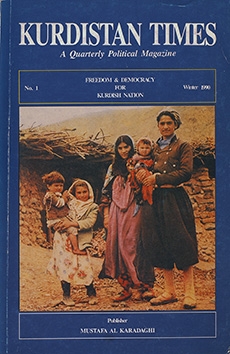
Kurdistan Times N°1 Freedom and Democracy for Kurdish Nation
Mustafa Al Karadaghi
Kurdistan News
The Kurdish nation is a divided nation cut up into five parts and distributed among the states of Turkey, Syria, Iraq, Iran, and the Soviet Union. The origin of the Kurdish division dates back to the end of the first world war when Turkey unconditionally surrendered and the allies divided among themselves the vast domain of the Ottoman Empire. It should be observed that that the Kurdish nation and the whole Middle Eastern region, except Iran, was under the Ottoman rule for more than three centuries from 1636 until 1918. In terms of ethnic origin, the Kurds belong to ...
Contents
Kurdistan Times / 1 The Kurds and Their Country Kurdistan / 3 Summary of the Kurdish History, by Mustafa Al Karadaghi / 8
Part I — Kurds in the Ancient Historical Era / 8
Part II — The Role that Kurds Played in The Ancient World / 25 The Kingdom of Lullu / 25 Kingdom of Gutium / 30 The Kassite Kingdom / 33 Hurri-Mittani Empire / 38 Kingdom of Nairi / 42 Kingdom of Urartu / 45
Part III — The Kurds are The Direct Descendents of the Medes / 49 Kurdish Language, by Mustafa Al Karadaghi / 52 Kurdistan — The Homeland of the Kurds, by N. Simko / 66 General Outline / 68 The Ethnic Boundaries of the Kurds 71 Natural Resources of Kurdistan / 81 Area of Kurdistan / 87 Trends in the Dynamics of the Geopolitical Environment of Kurdistan After World War II, by Omar Sheikhmous, BA, MA / 90 The International Conference in Paris on: “The Kurds: Human Rights and Cultural Identity” / 99 Parliamentary Human Rights Group—Remark of Lord Avebury, Chairman of the Parliamentary Human Rights Group, U.K / 102 The Tragedy of Iraqi Kurdistan: The Destruction of People and Culture Remarks to the International Conference on the Kurds: Human Rights and Cultural Identity, by Peter W. Galbraith / 105 Madame Mitterands Speaks Before the United States Congressional Human Rights Caucus, by Pary Al-Karadaghi, M.D. / 110 Testimony Before the Congressional Human Rights Caucus Tuesday, October 24, 1989, by David A. Kom / 114 The Plight of the Kurds-Congressional Human Rights Caucus, by Senator Edward Kennedy / 117 Kurdish Population in the Soviet Union / 119 Soviet Union to Grant Kurds Autonomy, by J. Arshak / 120 How Southern Kurdistan Became Part of Iraq, by H. Mirkhan / 123 The Mockery of the Kurdish Autonomous Region, by Kak Homer / 130 Number and Distribution of the Kurdish Refugees / 140 The Poisoning of the Kurdish Refugees in Kiziltepe Camp Near Mardin in Turkey, by A Western Reporter—Young Lady / 146 Among the People I Met in Kiziltepe Refugee in Turkey I Remember Kurdish Mother, Gulla, by A Western Reporter—Young Lady / 150 A Kurdish Refugee in London Prison Burned Himself to Death Rather Than Go Back to Turkey / 153 Our Poetry is Written with Tears, by M. Emin Bozarslan / 157 President Rafsanjani Visits the Kurdish Areas in Iran / 160 Turkey’s Basic Principles Face Serious Challenges, by Jonathan C. Randal / 164 Turkish Water Warfare Against Syria and Iraq, by N. Arsalan / 167 Saddam Hussein Restore the Statute of King Faisal / 178 Explosion in Iraq; Missile Factory / 180 Reporter for Weekly London Observer hanged in Baghdad / 181 Terrorized Egyptian Escape Iraq to Save Their Lives, by Abu Mahdi / 183 Tikriti Ruling Clique Are Killing Each Other, by Abu Mahdi / 188 Why the Baathist Regime of Iraq is killing Kurds — Reason behind Genocide Against the Kurds in Iraq / 193 Amnesty International Condemns Iraq for Killing and Executing Children and Minors / 204 Document (Translated from Arabic) from Iraqi Secrete File, Proving Genocide Against the Kurdish People in Iraq / 209 Make No mistake — This is a Genocide, by Jim Hogland / 211 Getting away with Genocide, By Richard Cohen / 213 Hitler-Style Genocide Threatens the Kurds, by Helga Graham / 215 Sadistic beast of Baghdad, by Smith Hempstone / 218 Gulf Crisis—What Is It All About / 220 Short Autobiography of The Publisher / 229
KURDISTAN TIMES
Kurdistan Times is a quarterly political magazine devoted primarily to the study of different aspects of the Kurdish Nation, its history, language, culture, and the sad situation under which it now lives. It is determined to bring to the attention of the world the bloody struggle the Kurdish people are now going through in order to survive in their own homeland. Kurdistan Times carries the message of Kurdish hopes and dreams to be free and live free from oppression and persecution. The result of these studies and enquiries will be presented to the general public of the western world with the definite purpose of increasing their understanding of the Kurds and their country, Kurdistan.
Kurdistan Times is watching and looking out for any violation of Kurdish human rights whenever it takes place. It stands firm against those who violate Kurdish human rights. It publishes complaints against governments that abuse Kurdish rights with international organization, private individuals and organizations concerned with human rights violations. On the other hand, Kurdistan Tiems may advocate civil disobedience and civil protest against those who abuse Kurdish human rights.
The Kurdish nation of 25 million people, living in a vast and rich country, is divided into five parts among the states of Turkey, Syria, Iraq, Iran, and the Soviet Union. We describe the Kurdish nation as a “divided nation”, “a homeless nation”, “a persecuted nation”. The Kurdish people have their distinct ethnic identity and language, unique culture, and a well-defined historical homeland. There is no moral or legal justification for this artificial and unnatural division of the Kurdish nation. None of the people among whom the Kurds are divided have any claim on the Kurds or their country, Kurdistan.
It is encouraging to know that most of the leaders of the world of today have frequently declared that “the winds of freedom are blowing everywhere”, and that “in our era of freedom and democracy the control of one people by another is unacceptable”. Kurdistan Times raises its voice loud and clear demanding full national rights for the Kurds. It raises its banner high for all to see as a declaration that “the Kurds have the divine right to self- determination and to live in freedom and democracy in their own homeland free from foreign domination.”
The Kurdish nation is a part of the Middle East. Kurds share with Arabs, Turks and Iranians, a common historical experience of foreign domination and exploitation. The Kurds have played an important part in the movements for freedom and democracy in the Middle East. The Kurdish people are greatly concerned about what happens in the Middle East. Any political events, positive or negative, in Baghdad, Damascus, Tehbran, Ankara, Cairo, or in Tel Aviv and Moscow may have a direct effect on the Kurds and their future, for better or worse.
Kurdistan Times stands against war and conflicts among the countries of the Middle East. It is wrong for Middle Eastern people to fight each other and spend their limited resources and energy on wars of destruction such as the 8-year bloody Iran-Iraq war, a strange and a phony war. It is a waste of resources to build huge armies and buy expensive weapon systems. Some of the Middle Eastern rulers find all kinds of pretexts for buying weapons from certain countries, for instance Italy. The definite purpose is to grant Italy petro-dollars or supply her with crude oil at a reduced price in order to strengthen her economy. The oil revenue of the Middle East is wasted on buying weapons or it is appropriated quietly by foreigners while Middle Eastern people are engaged in cock-fighting among themselves.
We wish to see a new order of economic cooperation and integration established for The Middle East in the form of a Common Market on the model of the European Common Market. We would like to see freedom and democracy prevail in the Middle East. We raise the banner of “Government by the people for the people”, which would be accomplished by a system of free elections, free press, a multi-party system including an opposition to watch over the actions of the government in power. This democratic system is the best guarantee against the emergence of a little mad ruler like Saddam Hussein who drags his country into a war of destruction and drives his people into slavery. When this new Middle Eastern order is established the Kurdish nation should participate not as a divided nation but as a united independent nation in order to play its part constructively.
Kurdistan Times is an independent mgazine which is under no obligation to any political party or organization. However, in orientation Kurdistan Times follows the line of the Kurdish Nationalist Movement. As a free organ it is bound only by the rule of objectivity and truth in presenting its subject matter. It is our highest hope that Kurdistan Times succeeds in its mission of gaining the sympathy and support of the western world for the Kurdish people who are struggling to survive in their own historical homeland.
The Kurds and Their Country Kurdistan
The Kurdish nation is a divided nation cut up into five parts and distributed among the states of Turkey, Syria, Iraq, Iran, and the Soviet Union. The origin of the Kurdish division dates back to the end of the first world war when Turkey unconditionally surrendered and the allies divided among themselves the vast domain of the Ottoman Empire. It should be observed that that the Kurdish nation and the whole Middle Eastern region, except Iran, was under the Ottoman rule for more than three centuries from 1636 until 1918.
In terms of ethnic origin, the Kurds belong to the Indo-European family of Nations. The Kurdish Language is a branch of Indo-Eupean family of languages which includes Kurdish, Persian, Baluchi, Urdu, Afghani, and most of the European languages such as German, Russian, Italian, Spanish, French, Scandinavian languages, and English. Many scholars and linguists believe that the Kurdish language, because of its isolation and seclusion in the numerous closed valleys and mountain slopes of the Kurdistan highlands, has preserved many of its original characteristics; it is considered to be pure and to resemble closely the original primitive Aryan tongue.
The Kurdish population is estimated to be 25 million distributed as follows: In Turkey, 12 million; Iran, 7 million; Iraq, 4 million; Soviet Union, 1.15 million, and in Syria there are 1 million Kurds. Outside Kurdistan proper the Kurds live in Tehran, and other Iranian cities also, in Baghdad, Beirut, Damascus, Aleppo, Istanbul, and Ankarra.
Tribes of Kurdish origin are settled in Baluchistan, Afghanistan, and Algiers. An estimated 170,000 Kurds live in different European countries, Canada, United States, and Australia.
Kurdistan- the homeland of the Kurds- is a vast mountainous highland which extends in the form of a crescent from the neighborhood of Persian Gulf in the south to the Mediterranean Sea in the northwest. The Kurdistan highlands is situated between the Iranian Plateau and the Mesopotamia steppe in the east and west, the Armenian tableland in the north, and the Anatolian lowlands in the west. The area of Kurdistan is estimated to be 550,000 sq. Kms. or equal in size to France. In ancient times, the Greek and Roman geographers and writers used to call The Kurdistan highlands “Zagros mountains” by which they meant the country of Karduchi, or the ancient Kuitis. The mountain system of Kurdistan is made up of parallel chains which …
Mustafa Al Karadaghi
Kurdistan Times Freedom & Democracy for Kurdish Nation
Kurdistan News
Kurdistan News Kurdistan Times A Quarterly Political Magazine n°1 Freedom & Democracy for Kurdish Nation Mustafa Al Karadaghi
Winter 1990
Publisher Mustafa Al Karadaghi
Cover picture represents A Kurdish peasant family. Saddam Hussein razed to the ground 4 000 villages and displaced 1 500 000 Kurdish peasants.
Kurdistan Times A Quarterly Political Magazine, n°1
Freedom & Democracy for Kurdish Nation
Publisher’s Note: The words Kurdistan News should read Kurdistan Times on running heads throughout the magazine.