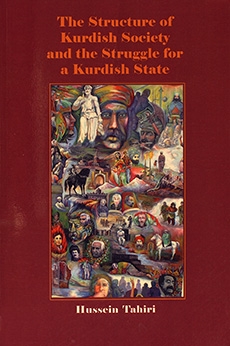
The Structure of Kurdish Society and the Struggle for a Kurdish State
Hussein Tahiri
Mazda Publishers
Despite over 150 years of armed struggle, why have the Kurds been unsuccessful in forming their own nation-state? This book argues that Kurdish society has traditionally been divided along tribal lines. Tribal loyalty has transcended loyalty to the Kurdish nation. After World War II. Kurdish political parties were formed, however. Kurdish intellectuals did not have the power to mobilize Kurdish masses. Kurdish political movements were forced to incorporate Kurdish tribal leaders, and with them tribal structure and values were integrated into politics.
The Kurdish political parties that replaced Kurdish tribes in leading Kurdish revolts after World War II engaged in fratricidal lighting against each other—as their tribal ancestors had done—thereby weakening them-selves in the process. The leaders of Kurdish political parties have followed the path of their tribal ancestors, thus preventing the development of Kurdish nationalism.
Examining the major Kurdish revolts, this book analyzes the internal factors that led to their defeat, as well as arguing that reliance by Kurdish leaderships on foreign powers has had disastrous consequences at crucial points in Kurdish history. This in-depth analysis traces the development of Kurdish politics through a systematic work on the issue of tribalism in Kurdish history. The author has conducted a series of highly significant interviews with key political figures, which are extremely important in understanding the evolut ion of the Kurdish problem during the last few decades.
Dr. Hussein Tahiri settled in Australia as a refugee in 1989, and completed his Ph.D. in Political Science at The University of Melbourne, Australia, in 2001. Dr. Tahiri has worked as a Lecturer teaching Middle East politics. He is a commentator on Kurdish and Middle Eastern affairs in Australian and Interna-tional media. He is currently an Honourary Research Associate with the School of Political and Social Inquiry, Monash University, Australia.
Contents
Acknowledgments / xi
Preface / xiii
Note on Spelling, Names and Sources / xv
Introduction / 1
Chapter 1
Kurdish Ethnicity, Nationalism and Tribalism / 10
Chapter 2
Attempts to form Kurdish States:
Mid-Nineteenth to Mid-Twentieth Centuries / 34
Chapter 3
The Kurdish Republic of 1946: Its Rise and Demise / 79
Chapter 4
Mullah Mustafa Barzani's Revolt and its Collapse, 1943-1975 / 102
Chapter 5
Iranian Kurdistan, 1947-2000 / 134
Chapter 6
Iraqi Kurdistan 1975-2000: The Endless Turmoil / 159
Chapter 7
The Kurds in Turkey: World War 11-1998 / 189
Chapter 8
The PKK Abandons the Idea of a Kurdish State / 233
Chapter 9
Tribal Legacy: Kurdish Interrelations / 263
Chapter 10
Kurdish Nationalism Accelerated / 310
Appendices
Appendix One / 351
Questions to Interviewees
Appendix Two / 353
The Peace Agreement of 11 March 1970
Appendix Three / 358
Law for Autonomy in the Area of Kurdistan
Bibliography / 367
Index / 389
ACKNOWLEDGMENTS
Many people helped in the process of writing this book. I am very grateful for their assistance and generosity in sharing their knowledge and dedicating their time. I would like to thank many people: The officials of various Kurdish political parties, intellectuals and scholars (too numerous to name) who graciously allowed me to interview them. I would like to pay a special tribute to Sami Abdurahman whom I have referred to so many times throughout this book. He was killed in a suicide bomb attack on Sunday 1 February 2004. The Kurds in various parts of Kurdistan enthusiastically answered my questions and discussed various issues with me.
My family has been a great support to me and has been patient to allow me to complete this book.
Darryl Corp, Sharon Urquhart, Michelle James who have read chapters of this book, and gave me invaluable feedback. Other friends and colleagues who read the last draft of my book also made valuable comments.
I would finally like to thank Dr. Paul J. White, Associate Professor Jeremy Salt, Dr. Richard Pennell, Dr. Alperhan Babacan and Professor Robert Olson for their constructive comments and feedback.
Preface
As General Editor of the Kurdish Series at Mazda Publishers I am particularly pleased to present Hussein Tahiri's study to concerned scholars and interested parties of Kurdish and Middle East history, politics and societies. This is only the second recently published work, the other being Denise Natali’s, The Kurds ami the State: Evolving National Identity in Iraq, Turkey and Iran, that encompasses the emergence, growth and consolidation of Kurdish nationalist movements in Turkey, Iraq and Iran in the 20th century with prognostications for developments in the first decades of the 21st century. Tahiti’s study is additionally valuable in that he was able to carry out field work in Turkey, Iraq and Syria from the early 1990s onwards. His language skills in Kurdish, Persian and Turkish add immensely to his sound conclusions and interpretations. A major merit of the study is that Tahiri has also been able to assess the impact of the U.S.’ invasion and occupation of Iraq in March 2003 and to juxtapose his analyses of the occupation’s impact on Kurdish nationalist movements vis-a-vis his assessments of the potential of Kurdish nationalist to reach frill maturity prior to the U.S. occupation of Iraq. He acknowledges that the challenges to Kurdish nationalist movements in Turkey, Iran and Iraq differ, but he concludes that Kurdish nationalism has accelerated in all three countries. Fully explicit in his study is the realization that while the U.S. invasion and occupation of Iraq has created the largest window of opportunity for the consolidation of Kurdish nationalism in Kurdish history; it also poses the greatest challenges. The growth of ethnic nationalism in countries under occupation such as Iraq, and under siege, such as Iran, and a country like Turkey facing major nationalist challenges from its own Kurdish population, proffers up the possibility of combined attacks against Kurdish nationalist entities. The Kurds also face the dilemma of achieving a more geopolitically and politically viable position in which to consolidate their nationalist movements as a result of the occupation of a superpower that is heartily disliked by most of the governments and populations among whom the Kurds live. The author notes that even as the Kurds face many geopolitical dilemmas, they must also surmount lingering aspects of tribalism, kinship and patronage if “the modern foundation of Kurdish society is to be built. If it is not built on a solid foundation of democratic values and principles, it runs the risk of forming a society and government apparatuses that are no different from other parts of the Middle East.” Hussein Tahiri presents readers with a bold, encompassing and highly original study of the trials, tribulations, possibilities and potential of Kurdish nationalism in the 21 century. I enthusiastically recommend it.
Robert Olson,
General Editor, Kurdish Series
Introduction
Despite over 150 years of armed conflict, why have the Kurds still not been able to form their own nation state? Many analysts of Kurdish politics have tried to blame other countries such as the states ruling over Kurdistan (Turkey, Iran, Iraq and Syria), and the imperial and superpowers for Kurdish failure to form their own nation state.1 If a people fail to achieve their goals, those people should be studied first. Only then can one analyse and assess what has gone wrong and what has caused their failure. Thus, the structure of Kurdish society will be studied in this book, and the internal factors preventing the Kurds from forming their own nation state analysed. It will be argued that Kurdish society was divided along tribal lines. Tribal leaders could not come to an agreement among themselves. Tribal loyalty transcended loyalty to the Kurdish nation. After World War II, Kurdish political parties were formed, but they inherited a tribal structure and values. Therefore, the leaders of Kurdish political parties have followed the path of their tribal ancestors.
From this viewpoint, the structure of Kurdish society will be analysed and assessed to discern how it has prevented the Kurds from forming their own nation state. This book will focus from World War I onwards. The Kurds of Syria and the former Soviet Union have not conducted any armed struggle or aimed for the creation of a Kurdish state, or autonomy and federalism within their countries. Therefore, only the structure of Kurdish society in Turkey, Iran and Iraqi Kurdistan will be analysed.
It should be noted that the aim of this book is not to discuss or analyse external problems preventing the Kurds from forming their own nation state; it will only focus on internal factors.
…..
1 Of course, the imperial powers and superpowers had a hefty role in the division of Kurdistan and suppression of the Kurds, however, this does not mean one should ignore the shortcomings of the Kurds.
Hussein Tahiri
The Structure of Kurdish Society and the
Struggle for a Kurdish State
Mazda Publishers
Mazda Publishers
The Structure of Kurdish Society and the
Struggle for a Kurdish State
Kurdish Studies Series, No. 8
Mazda Publishers, Inc.
Costa Mesa, California
2007
Funding for the publication of this volume was
provided in part by a grant from
The A. K. Jabbari Trust
Mazda Publishers, Inc.
Academic Publishers Since 1980
P.O. Box 2603
Costa Mesa, California 92628 U.S.A.
www.jnazdapub.com
Order Online: www.mazdapub.com
Copyright © 2007 by Hussein Tahiri
All rights reserved. No parts of this publication may be reproduced or
transmitted by any form or by any means without written peimission
from the publisher except in the case of brief quotations embodied in
critical articles and reviews.
Library of Congress Cataloging-in-Publieation Data
The Structure of Kurdish Society and the Struggle for a
Kurdish State/ Hussein Tahiri.
p.cm.—(Kurdish Studies Series; No. 8)
Includes bibliographical references and index.
ISBN 10:1-56859-193-4
ISBN 13: 978-1-56859-193-3
(alk. paper)
1. Kurds—Politic and government—20th century. 2. Kurdistan—Politics and
government—20th century. 3. Kurds—Social conditions—20th century. 4.
Tribal government—Kurdistan—History.
I. Title. II. Series.
DS59.K86T344 2006
956.6702—dc22
2006046198
Cover: "Kurdish Historical Panel, 1991," an original
oil painting by Hasan Bagdas, Melbourne, Australia.